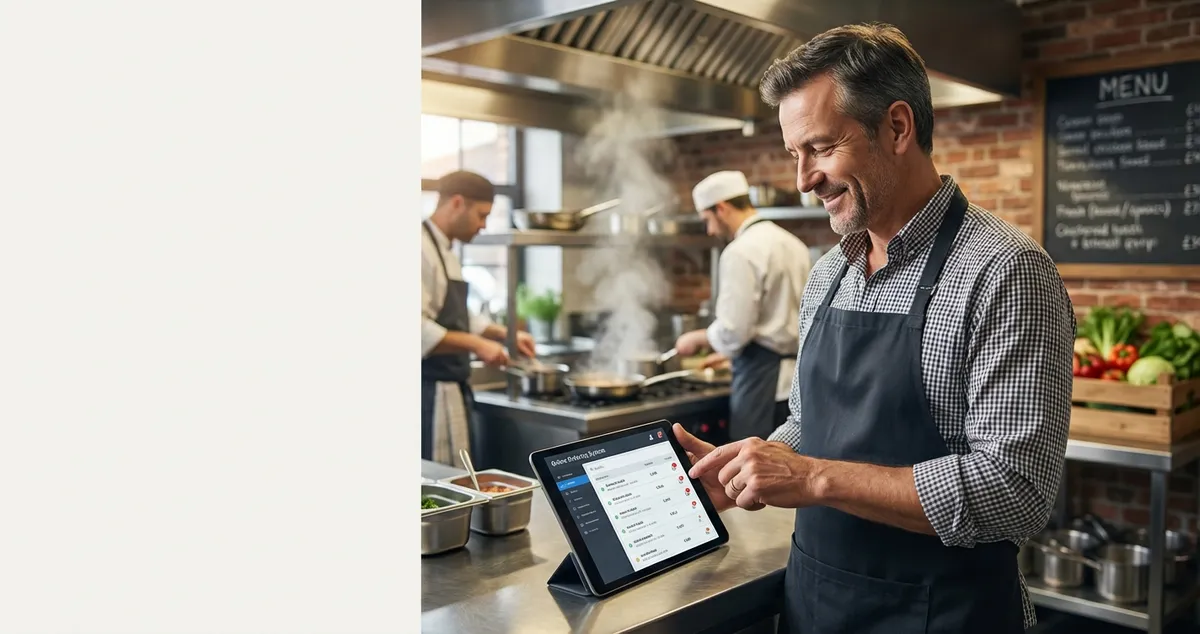
Online ordering for restaurants saves thousands yearly. Compare direct ordering vs third-party apps with UK costs and features.
You're watching 30% of every delivery order disappear to Just Eat or Deliveroo. That's not a commission fee - that's your profit margin walking out the door. With average restaurant profit margins sitting around 3-9%, losing a third of your delivery revenue isn't sustainable. An online ordering system for your restaurant changes that equation entirely.
Two-thirds of consumers now prefer ordering directly from a restaurant's own website or app rather than through third-party platforms (Flipdish, 2026). The question isn't whether you need online ordering - it's whether you're going to pay someone else 30% for the privilege, or keep that revenue yourself.
What you'll learn in this guide:
- The real cost difference between third-party apps and your own online ordering system
- Essential features every restaurant online ordering system needs
- How to choose between free and paid platforms
- A practical framework for switching from delivery apps to direct ordering
What is an Online Ordering System for Restaurants?
An online ordering system for restaurants is a framework that allows customers to browse your menu, place orders, and pay directly through your website or branded app - cutting out third-party delivery platforms like Deliveroo, Just Eat, or Uber Eats entirely.
Think of it as your own digital shopfront. Instead of customers finding you on a delivery app alongside dozens of competitors, they come directly to you. The order goes straight to your kitchen, the payment goes straight to your account, and the customer data stays with you.
For example, a fish and chip shop in Manchester switched from Deliveroo to their own ordering system and kept an extra £400 per week that would have gone to commission - money back in their pocket instead of funding a tech company's expansion.
Modern restaurant ordering systems do far more than just take orders. They integrate with your EPOS system, send orders directly to kitchen display screens, track inventory, manage customer loyalty programmes, and provide analytics on ordering patterns. A restaurant POS system is no longer just a billing tool - it's the digital backbone of the entire operation (Restroworks, 2025).
Pro Tip: Before choosing a system, ask for a demo during a quiet period. Most providers offer free trials - use them to test how the system handles your actual menu complexity.
Related: Restaurant Online Ordering
Third-Party Apps vs Your Own System: The Real Cost Comparison
Before you decide which route to take, let's look at what you're actually paying. The differences are stark.
What Third-Party Platforms Charge
| Platform | Commission Rate | Additional Fees |
|---|---|---|
| Deliveroo | 20-35% | £2.50 admin fee per order |
| Just Eat | 14-35% | £699 setup + 50p per order |
| Uber Eats | 30-35% | £3.50 admin fee per order |
As a rule of thumb, expect to lose between a fifth and a third of every order value to platform commissions.
For example, a restaurant doing £5,000 per week in delivery orders through Deliveroo at 30% commission loses £1,500 weekly - that's £78,000 per year in commission fees alone (Menuviel, 2025).
Just Eat offers a lower commission of 14% if you use your own delivery drivers, making it significantly cheaper if you already employ delivery staff (MerchantSwitch, 2025). But even at 14%, you're still paying thousands annually.
What Direct Ordering Systems Cost
Direct ordering platforms typically charge much less:
- Payment processing only: Under 3% per transaction for click and collect
- With delivery features: Up to 10% with no upfront costs
- Monthly subscription models: Fixed monthly fee with lower per-order fees
The maths is simple. On a typical order, Deliveroo might take a third of the value. A direct ordering system takes a fraction of that.
Commission fees aren't a cost of doing business - they're a choice. Every pound you keep is a pound you can reinvest in your food, your staff, or your future.
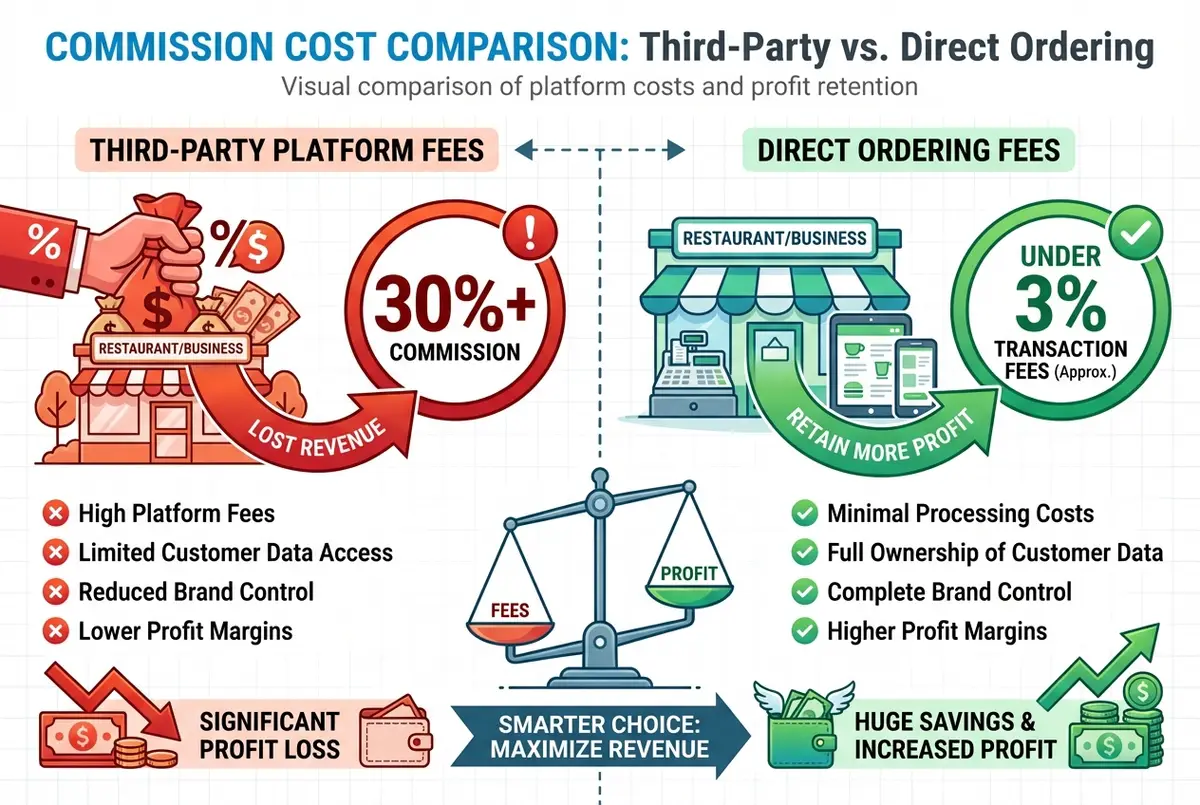
Direct ordering systems typically charge a fraction of third-party platform commissions
Essential Features Your Restaurant Ordering System Needs
Not all online ordering systems are equal. When evaluating options, use this checklist to compare your options:
- Integrates with your existing EPOS system
- Accepts all payment methods (card, Apple Pay, Google Pay)
- Allows real-time menu updates
- You own the customer data
- Works well on mobile devices
- Provides order analytics and reporting
EPOS Integration
Your online ordering system should connect directly to your existing point of sale system. Orders flow straight to the kitchen without manual re-entry, reducing errors and speeding up service. The best systems integrate with kitchen display screens and printers automatically (3S POS, 2025).
For example, a busy curry house using a system that syncs with their kitchen display dramatically reduced order errors in the first month - no more handwritten tickets getting lost during the Saturday rush.
If you're only using a standalone tablet for online orders you'll always lose efficiency to competitors who've integrated their systems properly.
Menu Management
Look for systems that allow:
- Real-time menu updates (86 the special instantly)
- Modifier and customisation options
- Allergy and dietary labelling
- Dynamic pricing by order type or time
Payment Processing
Your system should accept all major payment methods - cards, Apple Pay, Google Pay, and PayPal at minimum. Contactless payments dominate UK dining, so ensure your system supports all wallet and mobile checkout options.
Customer Data Ownership
This is crucial. When customers order through Deliveroo, that's Deliveroo's customer. When they order through your system, that's your customer - and you can market to them directly.
Nearly half of customers can't even recall the restaurant name after ordering through delivery apps. Your brand disappears. With your own system, you build a customer database that enables loyalty programmes, email marketing, and repeat business.
Ask yourself: if a customer orders from you five times through Deliveroo, can you email them about your new menu? The answer tells you who really owns that relationship.
Mobile Responsiveness
Most UK customers ordering food online are doing so on mobile devices. If your ordering system doesn't work flawlessly on a phone, you're losing orders. Test any system on your own mobile before committing.
Related: Restaurant Ordering App
Free vs Paid Online Ordering Systems: Which Makes Sense?
Several UK platforms offer free online ordering systems for restaurants. But "free" rarely means zero cost.
What Free Systems Typically Include
- Basic menu display and ordering
- Standard payment processing (with transaction fees)
- Simple order management
- Limited customisation
If you're only using a free system because it's free you'll always miss the features that actually save time during a busy Friday night.
What Paid Systems Add
- Advanced EPOS integration
- Loyalty programme tools
- Marketing automation
- Detailed analytics and reporting
- Priority support
- Custom branding
For example, a small cafe doing 50 online orders a week might do perfectly well with a free system like GloriaFood or Square's free tier. A busy takeaway doing 300+ orders weekly would likely benefit from a paid system's efficiency features and integrations.
The right choice depends on your volume. Lower volume restaurants work well with free systems and transaction fees. Higher volume operations benefit from subscription models with lower per-transaction costs. If you're not sure which category you fall into, track your current delivery orders for a month before deciding.
How to Switch from Third-Party Apps to Direct Ordering
The recommended strategy is to use delivery platforms to build awareness, then migrate high-value customers to your own direct ordering system where you keep 100% of revenue (storekit, 2025).
If you can't tell whether your delivery orders are profitable or just keeping you busy, that's usually a sign you need to track commission costs properly before making any changes.
Here's a practical approach:
Phase 1: Set Up Your System (Week 1-2)
- Choose a platform that integrates with your existing EPOS
- Upload your menu with accurate descriptions and photos
- Set up payment processing
- Test thoroughly with staff orders before going live
Phase 2: Incentivise Direct Orders (Ongoing)
- Include flyers in every third-party delivery: "Order direct next time, get 10% off"
- Offer exclusive menu items only on your direct platform
- Build a loyalty programme that rewards repeat direct orders
- Train staff to mention your ordering website to dine-in customers
Phase 3: Monitor and Adjust
Track the percentage of orders coming through each channel. Many restaurants aim to move 30-50% of delivery orders to direct ordering within 12 months.
For example, a Thai restaurant in Bristol started with all their delivery orders through Deliveroo. After launching their own system and including a "10% off your next direct order" card in every bag, they moved a significant portion of repeat customers to direct ordering within six months.
If you're thinking "I can't just leave Deliveroo" - you don't have to. Many restaurants keep a presence on third-party apps for discovery while actively pushing regulars toward direct ordering. The key is having the choice.
Hoping customers will remember your restaurant name after ordering through Deliveroo? That rarely works. The platform owns the relationship, not you.
Choosing the Right Restaurant Ordering System
With dozens of options available, here's how to narrow down your choice. Would you actually use the system you're considering, or does it feel like it was designed by someone who's never worked a 12-hour shift?
For Small Restaurants and Cafes
Start with free or low-cost options like GloriaFood, Square for Restaurants, or Flipdish. These offer essential features without significant upfront investment and can scale as you grow.
For example, a neighbourhood Italian doing a few dozen online orders weekly would work perfectly well with Square's free tier - paying a small transaction fee instead of a third of every order to Deliveroo.
For Busy Takeaways
Look for systems with robust kitchen management, driver tracking if you do your own delivery, and strong EPOS integration. If you're only looking at basic systems when you're doing hundreds of orders weekly you'll always struggle with the operational complexity.
For Multi-Location Operations
Scalability becomes critical. Evaluate systems on their ability to support growing and multi-unit operations, with centralised menu management and location-specific settings.
Questions to Ask Before Committing
Would your customers actually use the ordering system you're considering? If the answer isn't a clear yes, keep looking.
- Does it integrate with my current EPOS?
- What are the total costs including transaction fees?
- Who owns the customer data?
- What's the contract length and cancellation policy?
- How quickly can I go live?
Related: Restaurant Ordering Systems
If You Only Have 30 Minutes This Week
All these options are great in theory, but you've got service in two hours and you're down two staff. Here's the minimum viable approach.
If you only have 30 minutes this week, do this:
- Day 1-2: Sign up for a free trial with Square for Restaurants or GloriaFood - takes 10 minutes
- Day 3-4: Upload your top 10 menu items with photos from your phone
- Day 5-7: Share the ordering link on your Google Business Profile and social media
That's it. You can add more items and refine the setup later. But getting a basic system live means every order you take directly saves you versus waiting another month while Deliveroo collects their cut.
For example, a kebab shop owner in Leeds set up Square in 15 minutes on a quiet Tuesday afternoon. Two weeks later, she'd already saved more than the time investment was worth.
If you're only accepting orders through third-party apps you'll always lose profit margin to competitors who've built their own ordering channel.
Key Takeaways: Online Ordering System for Restaurant
If you run a restaurant and want to see how Local Brand Hub can support your marketing, explore our restaurant marketing tools.
Key Takeaways: Online Ordering System for Restaurant
Investing in your own online ordering system isn't about technology - it's about protecting your margins in an industry where every percentage point matters.
The essentials:
- Third-party commissions add up: 30% of delivery revenue is unsustainable for most independents
- Direct ordering keeps profits in your pocket: 2.9% transaction fees vs 30% commission is a significant difference
- Customer data is valuable: Owning your customer relationships enables loyalty and repeat business
- Start simple, scale later: Free systems work well for lower volumes; paid systems pay for themselves at higher volumes
- Use both strategically: Third-party apps for discovery, direct ordering for regulars
The industry is clearly moving toward direct digital ordering. The question is whether you'll be leading that shift or watching your margins shrink further.
Online ordering isn't about technology - it's about who captures the value when a hungry customer opens their phone. Right now, that's mostly delivery platforms. It doesn't have to be.
The restaurants that thrive in the next decade won't be the ones with the best food - they'll be the ones who own their customer relationships.
Weekly Action
- This week: Sign up for a free trial with Square for Restaurants or GloriaFood
- Next week: Upload your top 10 menu items with photos
- Week three: Share the link on your Google Business Profile and test with a few regular customers
If LocalBrandHub can help simplify your restaurant's digital presence - from online ordering to local SEO - see how it works.
Last updated: February 2026. Commission rates sourced from Menuviel, MerchantSwitch, and platform documentation.
About the Author
Local Brand Hub
Empowering UK Businesses
Local Brand Hub provides comprehensive business management tools designed specifically for UK local businesses to streamline operations, automate marketing, and grow revenue.
More articlesRelated Articles
 Marketing Tips
Restaurant Interior Signage: Menu Boards & Upselling
Plan your restaurant interior signage strategy. Compare menu boards, wayfinding signs, hygiene displays and upselling signage with UK costs and rules.
 Marketing Tips
Restaurant Outdoor Signage: A-Boards & More
Choose the right restaurant outdoor signage for your UK venue. Compare A-boards, projecting signs, fascia options, costs and planning permission rules.
 Tutorials
Digital Restaurant Signage: Screens, Costs and Setup
How to set up digital restaurant signage in the UK. Covers screens, digital menu boards, software platforms, realistic costs and installation.