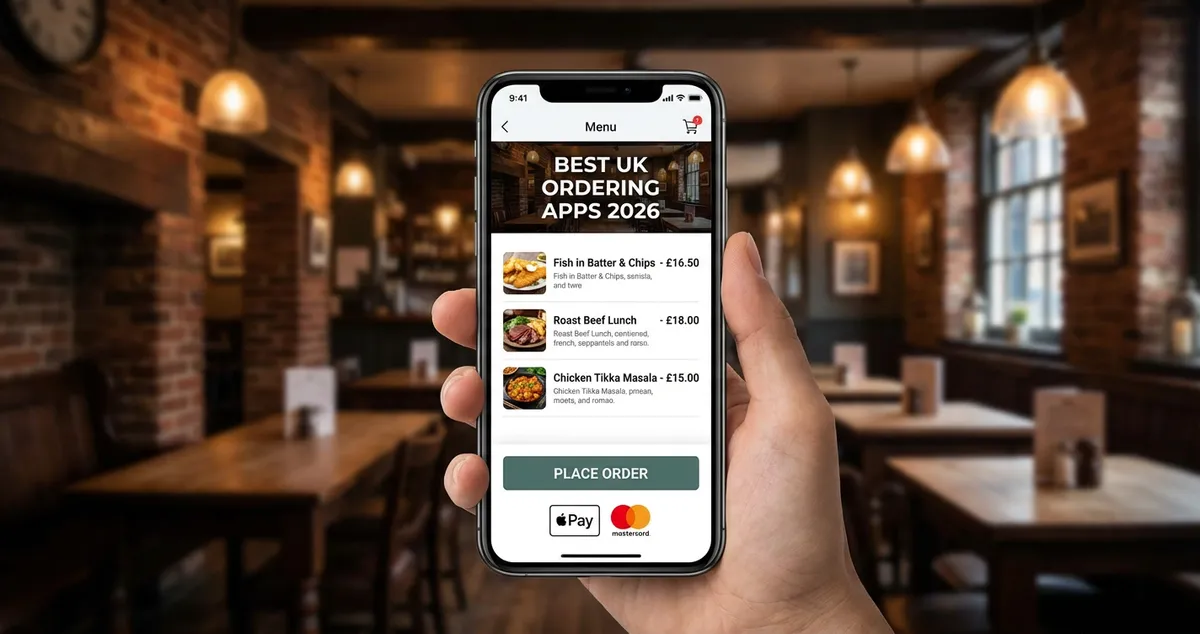
Watch the visual overview· 83 seconds
Compare the best restaurant ordering apps for UK restaurants. Find commission-free options, setup steps, and which app fits your business.
Related: Restaurant Online Ordering Hub - complete guide to online ordering systems.
Your phone buzzes constantly during a Saturday rush. Not customers messaging to book tables. It's orders piling up through three different delivery apps, each taking a cut of every sale. The kitchen's running behind. Your tablet's crashed again. You're wondering whether technology is helping or making things worse.
Sound familiar? A restaurant ordering app done right streamlines everything into one system you actually control. Choosing the wrong one means more headaches, not fewer.
A restaurant ordering app is software that lets customers browse your menu, place orders, and pay from their smartphone, either through a branded mobile app or a web-based system that works on any device.
This guide breaks down what works for UK restaurants in 2026. We cover free options, paid solutions, and practical decision frameworks. By the end, you'll know which app fits your situation.
What You'll Learn
- Which restaurant ordering apps work best for UK restaurants
- How to compare free versus paid options honestly
- What apps waiters and front-of-house staff use daily
- A simple decision framework for choosing your system
What Is the Best App for Ordering Food?
The best app for ordering food is a framework for deciding which platform matches your restaurant type, order volume, and budget: there's no universal answer.
Top Picks for UK Restaurants
Square Online, GloriaFood, and Storekit often rank highest for UK independent restaurants because they typically offer commission-free models and straightforward setup. What works for a busy city centre takeaway differs from what suits a countryside gastropub.
Top restaurant ordering apps for UK restaurants:
Note: Pricing and features may vary. Check current terms before committing.
| App | Best For | Cost Model | Key Strength |
|---|---|---|---|
| Square Online | All-rounders | Free + payment fees | Full POS integration |
| GloriaFood | Budget-conscious | Free tier available | Zero commissions |
| Storekit | Dine-in QR ordering | Monthly fee | No contracts |
| Hungrrr | Delivery-focused | Monthly subscription | Branded app included |
| OrderingDirect | Takeaways | Setup + monthly | UK-specific support |
Research shows 67% of consumers now prefer ordering directly from a restaurant's own platform rather than through third-party aggregators (Lightspeed, 2025). That preference is your opportunity.
A fish and chip shop in Manchester switched from Just Eat to their own GloriaFood ordering page. They saved roughly £400 per month in commission fees. The setup took one afternoon.
If you're paying 15-35% commission on most orders through delivery apps, switching even a portion to your own restaurant ordering app often pays for itself. For more on escaping high commissions, see our guide on restaurant commission-free ordering.
Why this matters: Commission savings go straight to your bottom line. With thin restaurant margins, even modest monthly savings add up to significant annual profit gains.
What Apps Do Waiters Use?
So you've got customer ordering covered. But what about the technology your staff actually use every shift?
Waiters and front-of-house staff typically use tablet-based ordering apps connected to your POS system. These apps let them take orders at the table and send them straight to the kitchen. No paper tickets. No walking back and forth.
Modern waiter ordering apps handle table management, split bills, customer preferences, and real-time inventory updates. They've evolved from simple order entry tools into proper restaurant management systems.
Common apps UK restaurant staff use:
- Square for Restaurants: Works on any device, syncs with back-of-house instantly
- TouchBistro: iPad-based with strong table management features
- Lightspeed Restaurant: Popular for multi-location restaurants
- Zettle by PayPal: Budget-friendly for smaller operations
- Tevalis: UK-focused with strong hospitality support
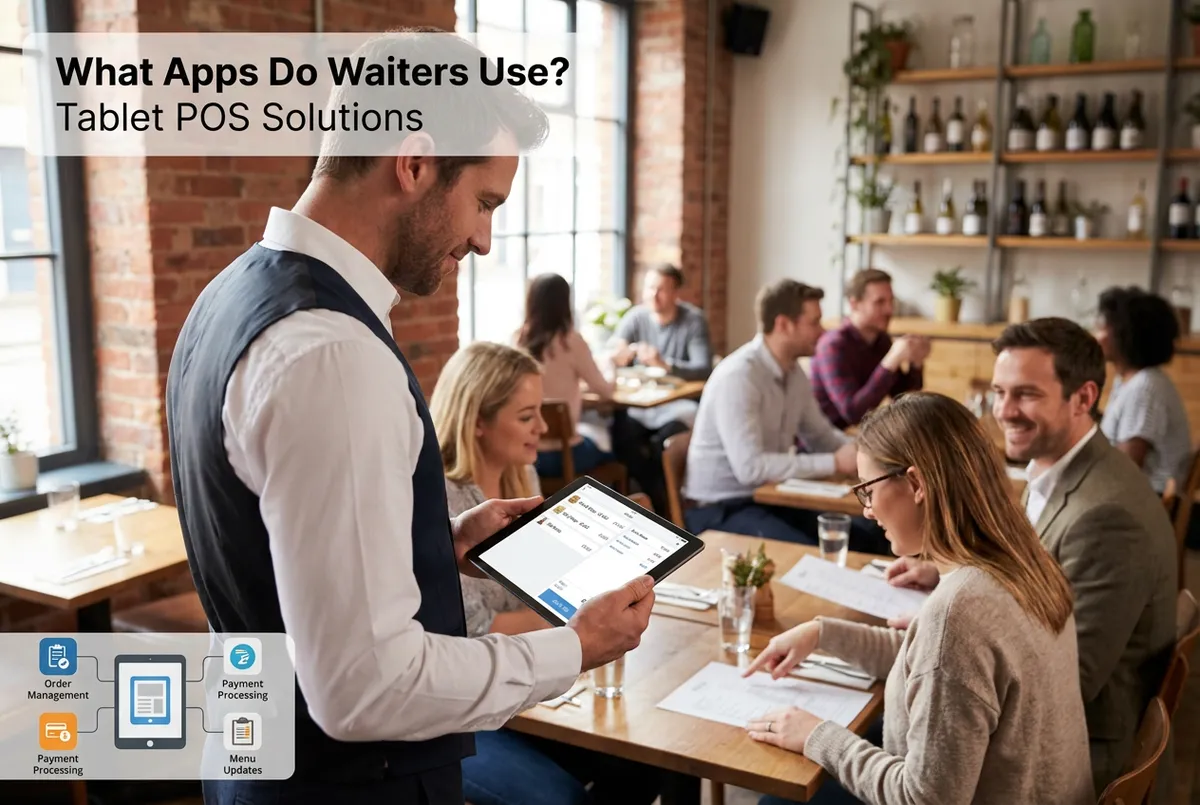
The difference between a good waiter app and a frustrating one often comes down to speed
The difference between a good waiter app and a frustrating one often comes down to speed. When you're down two staff on a busy Friday night, your team doesn't have time for complicated menus or slow syncing.
A pizzeria in Leeds tried three different waiter apps before finding one that worked. The first two crashed during busy periods. Staff went back to paper tickets. The third (Square) worked offline. Orders still went through even when Wi-Fi dropped.
What makes waiter apps work in practice:
- Offline mode: Orders work if Wi-Fi drops
- Quick item search: Find menu items in seconds
- Modifier handling: Easy customisation for dietary needs
- Table transfer: Move items between tables easily
If you're evaluating options, have your staff test apps during a quiet service first. Their feedback often matters more than any feature list.
What Is the Best Restaurant Scheduling App?
With ordering covered, let's address another common search: staff scheduling.
The best restaurant scheduling app is a framework for evaluating tools that help you manage rotas, track hours, and handle shift swaps without endless WhatsApp messages and spreadsheet chaos. Apps like 7shifts, Deputy, and Planday are popular choices among UK restaurant owners.
This connects to ordering apps directly. Staff scheduling affects your ability to handle orders. Understaffed shifts mean slower service, longer wait times, and frustrated customers who might not return.
Top scheduling apps for UK restaurants:
As a rule of thumb, "Best Feature" reflects what users commonly cite, your priorities may differ.
| App | Starting Price | UK Payroll | Best Feature |
|---|---|---|---|
| 7shifts | Free tier | Limited | Staff communication |
| Deputy | £3.50/user/month | Yes | Demand forecasting |
| Planday | £2/user/month | Yes | Multi-location support |
| RotaCloud | £2/user/month | Yes | UK-focused |
Smarter scheduling apps use your historical order data to predict busy periods. For instance, if your ordering app shows you get slammed between 6-8pm on Saturdays, your scheduling app can flag when you need more hands on deck.
A curry house in Birmingham connected their ordering data to Deputy. They discovered Thursdays were busier than they'd thought. They added one extra server on Thursday evenings. Tips went up because service improved.
If you're thinking "I just use a spreadsheet and it works fine," you're not alone. Many restaurants do. The question is whether the time you spend managing schedules could be better spent elsewhere. Would you follow a restaurant that posted about staffing chaos on social media? Probably not.
What's the Best Food Delivery App in the UK?
Now that you've sorted waiter apps and scheduling, let's tackle the question that keeps many restaurant owners up at night: delivery platforms.
The "best" delivery app question typically has two answers for restaurant owners. Which aggregators tend to bring the most orders? And which owned-delivery solutions let you keep more profit?
Third-party delivery apps lead UK consumer spending. Just Eat processed over £2 billion in UK orders in the past year. The market continues growing (Statista, 2025). But commission costs remain substantial.
UK delivery app comparison for restaurants:
- Just Eat: Largest UK market share, commission varies by location
- Deliveroo: Strong in urban areas, higher average order values
- Uber Eats: Growing rapidly, aggressive marketing campaigns
- Your own system: Zero commission, but you handle logistics
For example, a takeaway in a suburban area might find Just Eat brings more discovery traffic, while a city centre restaurant often sees better results from Deliveroo's premium customer base.
Restaurants using their own ordering systems alongside aggregators tend to keep more of their customers. Customers ordering directly become your customers, not the platform's. That ownership only pays off if you stay in touch: generating regular social posts keeps those direct customers coming back.
How one restaurant balances both approaches:
A Thai restaurant in Bristol runs both Deliveroo and their own ordering site. They offer a 10% discount for direct orders. About 40% of their delivery orders now come direct. They keep an extra £800/month compared to running Deliveroo alone.
If you can't tell whether delivery apps bring genuinely new customers or just cannibalise existing ones, that's usually a sign you need better data.
For a detailed comparison, see our guide on online ordering vs delivery apps.
Related: Best Online Ordering System for Restaurant - detailed platform comparisons.
What Is the 30/30/30 Rule for Restaurants?
You've seen how delivery commissions eat into margins. But how do those costs fit into the bigger picture of running a profitable restaurant?
Understanding the Framework
The 30/30/30 rule is a cost management framework that suggests restaurants should spend roughly:
- 30% on food costs
- 30% on labour costs
- 30% on operating costs
That leaves approximately 10% as profit margin. This matters for ordering apps because commission-heavy platforms eat directly into that slim profit.
How the 30/30/30 rule applies to ordering apps:
| Cost Category | Target % | Impact of Third-Party Apps |
|---|---|---|
| Food costs | 30% | Unchanged, but margin compressed |
| Labour costs | 30% | Potentially lower with automation |
| Operating costs | 30% | Includes app fees, commissions |
| Profit margin | 10% | Heavily affected by platform fees |
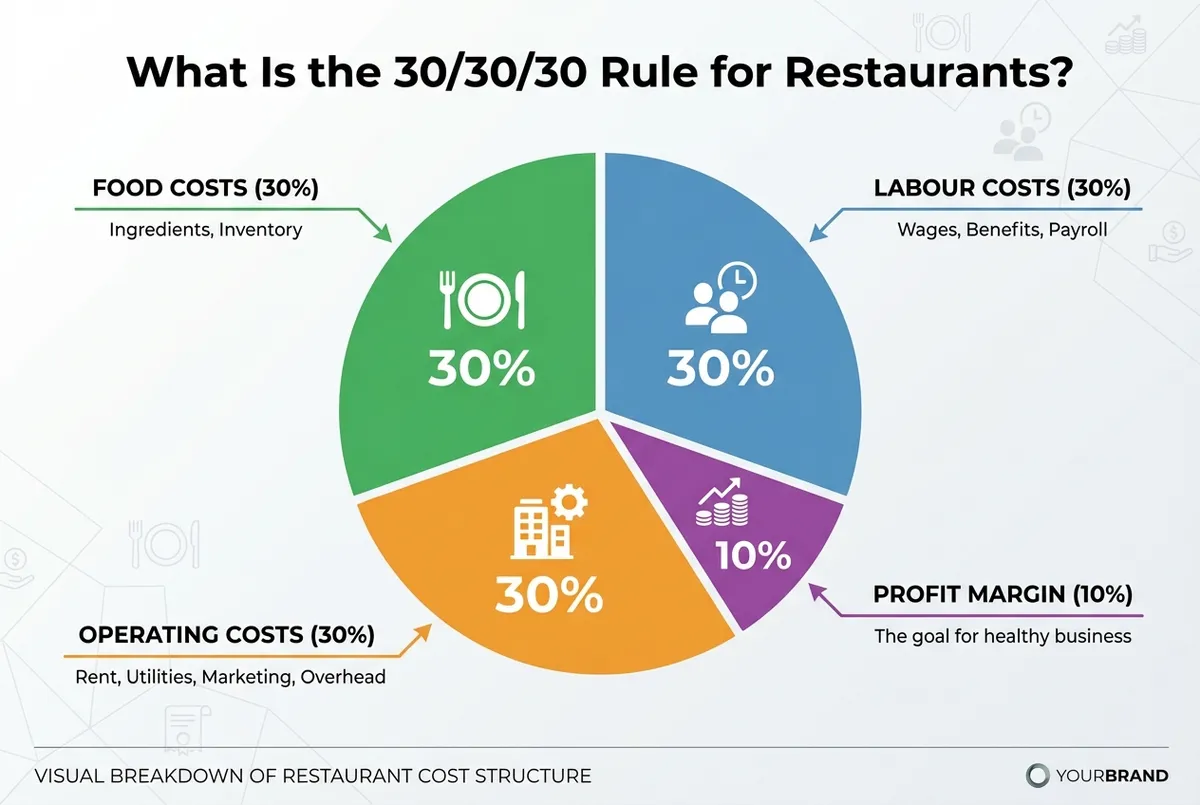
The 30/30/30 rule helps visualise where ordering app commissions hit your bottom line
How the 30/30/30 rule works in practice:
An Italian restaurant in Edinburgh tracked their costs carefully. Third-party delivery commissions pushed their operating costs well above target, squeezing their profit margin significantly. After moving most orders to their own app, operating costs dropped and profit margin recovered to a healthier level.
A restaurant ordering app with zero or low commissions preserves more of that 10% profit. Moving half your third-party orders to direct ordering often improves your bottom line significantly.
The reality for most independent restaurants: that 10% profit margin is optimistic. If your ordering system costs push you below profitability, that's usually a sign something needs to change.
Pro Tip: Track your delivery commission costs monthly. Many restaurant owners underestimate what they're paying until they see the actual numbers.
How to Choose the Right Restaurant Ordering App
You've seen the options and understand the costs. Now let's turn that knowledge into a practical decision framework.
Your Four-Step Decision Process
Step 1: Calculate your current ordering costs
Add up commissions, subscriptions, and payment processing across your platforms. Many restaurants underestimate this until they see the numbers in black and white.
Step 2: Identify your main ordering channel
Are you primarily dine-in with some takeaway? Takeaway-focused? Delivery-heavy? The answer shapes which features matter most.
Step 3: Check your existing tech
If you already have a POS system, choose apps that integrate with it. Starting fresh? Consider all-in-one solutions like Square that handle POS and ordering together.
Step 4: Test with real staff
The fanciest features mean nothing if your team finds the app frustrating during service. Trial periods exist for good reason.
If you're only testing apps when it's quiet you'll always lose to competitors who test during actual busy periods.
For most UK independent restaurants, a commission-free platform with your own branding typically offers the best balance of cost and control. The initial setup takes more effort than signing up for Just Eat. But you own the customer relationship and keep more revenue.
If you're only relying on third-party apps you'll always lose to competitors who build direct ordering channels alongside aggregators.
Related: Restaurant Ordering Systems - broader comparison of all system types.
Key Takeaways: Restaurant Ordering App
If you run a restaurant and want to see how Local Brand Hub can support your marketing, explore our restaurant marketing tools.
Key Takeaways: Restaurant Ordering App
We've covered a lot of ground. Here's what matters most when choosing your restaurant ordering app.
Choosing a restaurant ordering app isn't about finding the single "best" option. It's about matching your restaurant's specific needs with the right technology.
The essentials:
- Commission-free options exist: Square, GloriaFood, and Storekit offer zero-commission models that protect your margins
- Integration matters: Your ordering app should talk to your POS, scheduling, and kitchen display systems
- Direct ordering builds loyalty: Customers who order from your own app become repeat customers
- Staff adoption determines success: Often the best app is one your team will actually use correctly
If you only have 30 minutes this week, do this:
- Day 1-2: Calculate what you're paying in commissions across all ordering platforms
- Day 3-4: Sign up for a free trial of one commission-free option (Square or GloriaFood work well)
- Day 5-7: Test the ordering flow yourself and show one staff member how it works
That's it. You don't need to switch everything overnight. Start small. See what works. Expand from there.
The restaurants that succeed with ordering technology aren't the ones with the biggest budgets. They're the ones that pick a system and stick with it long enough for customers to learn where to order.
Weekly Action
This week, audit your current ordering setup:
- List the platforms where customers can order from you
- Calculate the total fees and commissions you paid last month
- Identify which platform brings your most valuable orders
Ready to take control of your ordering? Start with our complete restaurant online ordering guide, or explore specific solutions in our online ordering system for restaurant comparison.
This guide is produced by LocalBrandHub to help UK restaurant owners navigate restaurant ordering app options. Our team has reviewed dozens of ordering platforms and spoken with restaurant operators across the UK to compile these recommendations. Information verified February 2026.
For restaurants, salons, and local businesses
Need help with your marketing?
We help UK businesses turn social media into real results, not busywork.
Start freeGet More Marketing Tips
Practical marketing tips for UK business owners, straight to your inbox. No spam, unsubscribe anytime.
About the Author
Local Brand Hub
Empowering UK Businesses
Local Brand Hub provides comprehensive business management tools designed specifically for UK local businesses to streamline operations, automate marketing, and grow revenue.
More articlesRelated Articles
 Operations
Best Online Ordering System for Restaurant: UK Prices
Compare the best online ordering system for restaurant use in the UK on the prices Square, storekit and GloriaFood publish, plus the checks first.
 Operations
Restaurant Commission Free Ordering: Keep Every Sale
Restaurant commission free ordering helps UK owners keep 15-30% more per order. Compare platforms, see setup costs, and calculate your potential savings.
 Operations
Restaurant Delivery System: UK Costs, Types & Setup Guide
Compare restaurant delivery system options for UK restaurants. Discover POS integration, costs from £0-200/month, commission-free ordering setup and tips.