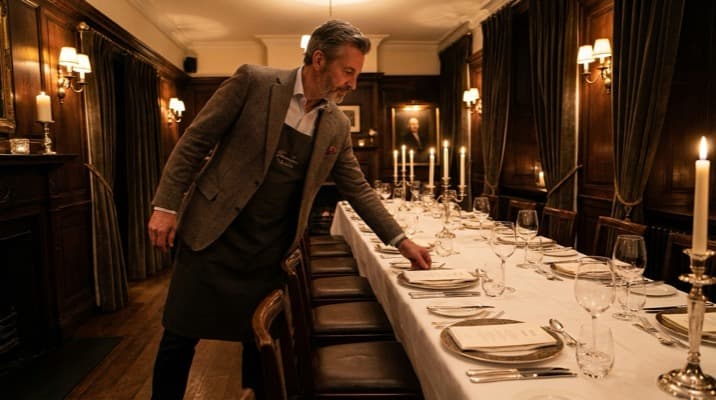
Turn your underused back room into steady revenue. A UK guide to private dining setup, pricing models, and marketing for restaurant owners.
Your private dining room seats 20 and hasn't had a booking in three weeks. Tables still pushed together from the last party, AV screen gathering dust, events page saying "contact us." Meanwhile, a venue platform is sending corporate groups to your competitors because they actually listed their space.
Info
Related: Restaurant Group Dining Marketing, your complete group dining marketing strategy
What You'll Learn
- Why a dedicated dining space delivers higher margins than regular covers
- How to convert underused space into a bookable room without major renovation
- The pricing models that protect your revenue: minimum spend, room hire, and per-head
- Where corporate clients and celebration organisers actually search for venues
- How to structure set menus that simplify operations and maximise profit
- A minimum viable marketing plan you can start this week
Why This Is Your Most Profitable Revenue Stream
The private dining model is a framework that turns underused restaurant space into guaranteed, high-margin revenue through pre-booked group events with set menus and minimum spend commitments.
For guests, it means privacy and personalised service. For you, it means predictable income, simplified operations, and higher spend per head.
Tagvenue (February 2026) shows London venues averaging £1,000 minimum spend per event, with smaller rooms averaging £750. Compare that to a regular Saturday night where 20 walk-in covers might generate £600-£800 total. The dedicated room consistently outperforms walk-in revenue per square metre.
The margin advantage goes deeper. Set menus reduce food waste. Pre-orders mean your kitchen runs efficiently. Drinks packages lock in beverage revenue that might otherwise be a single round of tap water.
For example, a neighbourhood Italian running a 16-person birthday dinner on a set menu at £55 per head generates £880 in food revenue alone, before drinks. That same room with 16 walk-in covers on a Tuesday might bring in half that. The group booking effectively doubles revenue from the same tables.
If you're reading this thinking "I already have a room, I just can't fill it", you're not alone. Most independent restaurants have the space but lack the marketing system to keep it booked. That's what the rest of this guide fixes.
Info
See also: Restaurant Events Guide, broader event planning strategies for your venue
Setting Up Your Private Dining Space
With the revenue case clear, let's look at what the room actually needs.
You don't need a purpose-built area to offer this service. Many successful operators convert existing spaces: a back room, a mezzanine, even a section screened off with quality partitions.
What Makes a Space Ready
The minimum requirements are simpler than you might think:
- Physical separation: A door, partition wall, or curtain that creates genuine enclosure
- Dedicated seating: A table arrangement for 8-30 guests (the sweet spot for most bookings)
- Independent lighting: Dimmable options or candle-friendly surfaces for atmosphere
- Audio control: Background music you can adjust separately from the main floor
- AV capability: A screen or projector for corporate presentations (optional but valuable)
Investment Priorities
If you're converting an existing space, focus your budget on three things:
- Sound insulation first. Nothing kills the experience faster than hearing the main restaurant through the walls. Even basic acoustic panels make a noticeable difference.
- Lighting second. Swapping fluorescent strips for dimmable warm lighting transforms the atmosphere without major construction.
- AV equipment third. A wall-mounted screen with HDMI input opens the corporate market. It's a one-off cost that pays for itself within a few bookings.
For example, a gastropub might spend £2,000-£5,000 converting a back room: acoustic panels, lighting upgrade, mounted screen, and basic furniture. A fine-dining restaurant might invest more for a fully independent space with its own entrance and dedicated service area.
Check before you spend
Before spending anything, check whether your existing back room already qualifies. If it has a door and seats 10+, you might only need lighting and a menu to start taking bookings.
If you're only listing your room on your own website you'll always lose to competitors who appear on dedicated venue platforms. But before we get to marketing, let's talk about the menu that makes this profitable.
Creating a Private Dining Menu That Maximises Margins
With your space sorted, the next step is building a menu that protects your margins.
The private dining menu is a framework that uses curated, pre-selected dishes to give operators control over food costs, kitchen workflow, and revenue predictability for group bookings. Unlike your regular menu, it's built around operational efficiency and margin control.
Set Menu vs A La Carte
Set menus are the industry standard, and for good reason. SquareMeal's cost analysis confirms most restaurants limit group options to pre-selected menus rather than offering full a la carte service.
Here's why set menus work better for your operation:
| Factor | Set Menu | Full A La Carte |
|---|---|---|
| Food waste | Minimal: exact prep quantities | High: must prep full range |
| Kitchen pressure | Controlled: limited dishes | Intense: full menu for large group |
| Staffing needs | Lower: streamlined service | Higher: complex orders |
| Revenue predictability | High: locked in per head | Variable: unpredictable spend |
As a rule of thumb, these comparisons hold true across most UK venues, though exact results vary by cuisine and location.
Structuring Your Tiers
Build 2-3 set menu tiers:
- Standard (2 courses + coffee): Your entry-level option
- Premium (3 courses + canapes + coffee): The mid-range choice most groups pick
- Celebration (canapes + 3 courses + cheese + coffee): Top-tier for special occasions
Each tier should include a drinks package option. A simple wine-inclusive package (half a bottle per person) adds a meaningful amount to the bill while reducing bar service complexity.
For instance, a contemporary British restaurant might offer: Standard at £45 (soup, chicken supreme, sticky toffee pudding), Premium at £65 (cured salmon, lamb rump, chocolate fondant with canapes on arrival), and Celebration at £95 (full canape reception, three courses, cheese board, coffee and petit fours). All three built from dishes already on the main menu, just repackaged with a margin target.
The reality for most independent restaurants is that menu creation for groups falls to whoever isn't busy at the time. Don't just copy your regular menu because you'll lose the margin advantage that makes private dining profitable. Spend one afternoon building three set menus from your existing dishes, price them with a 65-70% gross margin target, and you've done the hard work once.
Marketing Private Dining: Where Clients Actually Search
You've built the room and created the menus. Next step: filling it. If you've just put a single page on your website saying "available for bookings," you're missing where the real demand lives.
The Channels That Work
1. Dedicated venue platforms (highest impact)
PrivateDiningRooms.co.uk ranks at the top of Google for venue search terms across the UK. This is where corporate event planners and PA assistants search first. If you're not listed, you're invisible to a significant segment of the market.
Other platforms worth listing on:
- Tagvenue
- SquareMeal (group dining section)
- Hire Space
- VenueScanner
2. Google Business Profile
Update your profile with room photos, a dedicated post about your offering, and ensure "private dining" appears in your business description. When someone searches "private dining near me," Google pulls from these profiles first.
3. Social media with purpose
Don't just post food photos. Show the room set up for different occasions: a corporate lunch, a birthday dinner, a wine tasting. Tag the occasion, not just the food, and plan your posts around the seasonal peaks when people book most: Christmas parties, Valentine's dinners, milestone birthdays. Geo-targeted ads on Facebook and Instagram reach local audiences effectively when paired with interest-based targeting.
4. Direct outreach to corporate clients
Local businesses need venues for team lunches, client entertainment, and quarterly dinners. A simple email to office managers and PAs within a mile radius costs nothing and can fill your quietest months.
Case Example: From Staff Room to Revenue Generator
Consider a 40-cover city centre restaurant that converted its upstairs room into a bookable private dining space:
- Before: Room used for staff breaks, generating zero revenue
- After listing on two venue platforms: Enquiries jumped from two per month to eight within the first quarter
- Result: Three enquiries converted to repeat corporate clients booking quarterly
The room generates more per evening than the main floor on a quiet Wednesday night.
If you're only responding to enquiries days later you'll always lose to competitors who reply within two hours with a PDF of menu options and availability.
Would you book a venue that took three days to reply to your enquiry? Neither would your customers. Don't wait for someone to chase you for availability, because you'll have lost the booking by then.
For the guest perspective on what the booking experience looks like, see our consumer guide to restaurant private dining. Understanding what bookers want helps you shape a better response.
Private Dining Pricing: Minimum Spend vs Room Hire vs Per-Head
With marketing driving enquiries, the next question is pricing. Getting it wrong either leaves money on the table or scares off enquiries. Here's how the three models work.
Minimum Spend (Industry Standard)
The guest commits to spending a set amount on food and drinks. No separate room hire fee. If their bill falls short, they pay the difference. Tagvenue research puts the typical London range at £500-£1,500 per event.
Why it works: Revenue is guaranteed. Guests feel they're paying for food, not an empty room. It's the most psychologically comfortable model for bookers. Avoid underpricing your room because it attracts the wrong type of booking and undervalues the space.
Room Hire + Food
A fixed hire fee for the space, plus food and drink at menu prices.
When to use it: If your room has premium features (views, AV equipment, private garden) that justify a standalone fee.
Per-Head Fixed Price
Everyone pays the same amount per person, all-inclusive.
When to use it: For celebration packages where simplicity matters to the booker.
Recommended Framework
| Day | Suggested Minimum Spend | Notes |
|---|---|---|
| Monday-Wednesday | £500-£750 | Lower threshold fills quiet days |
| Thursday-Friday | £750-£1,200 | Peak corporate demand |
| Saturday | £1,000-£1,500 | Celebration premium |
| Sunday | £500-£800 | Lower demand, flexible pricing |
These ranges are a rule of thumb based on London averages; adjust for your location and venue tier.
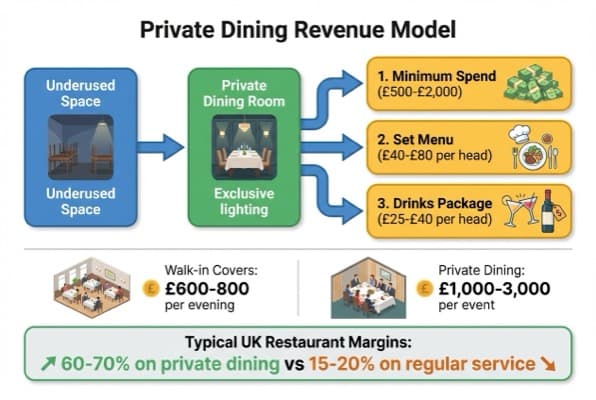
Private dining revenue model: pricing tiers, menu structure, and marketing channels
If you can't tell whether your enquiries are increasing or decreasing month over month, that's usually a sign you need a proper tracking system. Even a simple spreadsheet logging enquiry date, source, event type, and outcome gives you data to optimise.
Info
Related: Restaurant Marketing Guide, your foundation for all restaurant marketing activity
Managing Private Dining Bookings: Deposits, Communication, Pre-Orders
Pricing is set. Next, let's make sure the booking process doesn't lose you the sale.
Private dining isn't about having a room with a door. It's about having a proposition that gives people a reason to close it. That proposition includes how smooth your booking process feels. Here's what separates restaurants that stay booked from those that don't.
Deposits and Cancellation Policies
- Take a non-refundable deposit of 25-50% at booking confirmation. This protects against no-shows: the single biggest revenue risk.
- Set a clear cancellation window: Full refund if cancelled 14+ days out, 50% refund at 7-14 days, no refund within 7 days.
- Require final guest numbers 5-7 days before the event. This locks in your kitchen prep and staffing.
Pre-Order Systems
Require menu selections at least 48 hours before the event. This delivers three benefits:
- Kitchen efficiency: Your team preps exactly what's needed, reducing waste and stress during a Saturday rush
- Dietary management: Allergies and requirements are handled in advance, not on the night when you're down two staff
- Service speed: Dishes arrive faster when the kitchen knows the order sequence
Tripleseat's UK venue guide recommends staff rotas begin four weeks before the event, with front-of-house teams briefed on the service plan two weeks prior.
Communication That Builds Confidence
Send three emails:
- Booking confirmation (immediately): Menu options, deposit invoice, cancellation terms
- Planning email (2 weeks before): Menu selection deadline, dietary requirements form, AV needs
- Final details (3 days before): Arrival time, contact on the day, any last adjustments
This sounds like a lot of admin. In practice, it's three email templates you send on repeat. Build them once, personalise the name and date, and you've got a system that runs itself.
Protect your revenue
A no-show on a Saturday night costs you a full evening's revenue from that room, with no deposit to soften the blow. The templates take an hour to create. The protection lasts forever.
If you're thinking "I don't have time for all this process", you're right to question it. But consider the alternative: that empty room on a night you could have filled it.
Ask yourself: if you were booking a private dining room for your own birthday, would you feel confident booking with your restaurant based on the response you send? If the answer is anything other than yes, that's the gap to close first.
Info
See also: Restaurant Party Packages, how to bundle your offering into ready-made packages
Frequently Asked Questions
Is offering private dining worth it for restaurant owners?
Yes. Dedicated group spaces typically generate higher revenue per square metre than regular service. Pre-ordered set menus reduce waste and staffing complexity, so the margins outperform equivalent walk-in covers. The key is marketing the space effectively so it books consistently rather than sitting empty.
What is a private dining room?
The private dining room concept is a framework that gives restaurants an enclosed, dedicated space reserved exclusively for one party, combining privacy, personalised service, and a set menu experience under a single booking. For restaurant owners, it represents a flexible revenue stream: the same space can host corporate lunches on weekdays and celebrations on weekends.
What is a private dining menu?
The private dining menu is a framework that uses curated, tiered dish selections to give operators control over food costs and service flow for group bookings. Unlike a la carte service, set menus give the kitchen exact prep quantities, reduce waste, and simplify service. Most UK restaurants price these between £40-£85 per head for standard options and £80-£120+ for premium experiences.
How much does it cost to set up a private dining space?
Costs depend on your starting point. Converting an existing back room or mezzanine typically runs £2,000-£5,000 for acoustic panels, lighting, and basic AV equipment. A full build-out with independent entrance could reach £10,000-£20,000. Either way, the investment typically pays for itself within a handful of bookings at average minimum spend levels.
How do I attract corporate clients?
List on dedicated venue platforms where PAs and event planners search (PrivateDiningRooms.co.uk, Tagvenue, SquareMeal). Update your Google Business Profile with relevant keywords and photos. Send direct emails to office managers at local businesses within a mile radius. Ensure your room has basic AV capability (screen, HDMI) for presentations: this single feature opens the entire corporate market.
If you run a restaurant and want to see how Local Brand Hub can support your marketing, explore our restaurant marketing tools.
Key Takeaway
Key Takeaways
- Revenue: Dedicated group spaces deliver £750-£1,050+ per event with guaranteed minimum spend, outperforming equivalent walk-in covers
- Setup: You don't need a purpose-built room: acoustic treatment, lighting, and basic AV can convert existing space for £2,000-£5,000
- Menu strategy: Set menus reduce waste, simplify kitchen operations, and lock in margins of 65-70%
- Marketing: Venue listing platforms drive more group enquiries than your website alone: list on at least two
- Pricing: Minimum spend is the industry standard: set it by day of week, with lower thresholds on quiet days to fill gaps
- Operations: Deposits, pre-orders, and a three-email sequence eliminate the chaos of group bookings
For restaurants, salons, and local businesses
Need help with your marketing?
We help UK businesses turn social media into real results, not busywork.
Start freeGet More Marketing Tips
Practical marketing tips for UK business owners, straight to your inbox. No spam, unsubscribe anytime.
About the Author
Local Brand Hub
Empowering UK Businesses
Local Brand Hub provides comprehensive business management tools designed specifically for UK local businesses to streamline operations, automate marketing, and grow revenue.
More articlesRelated Articles
 Marketing Tips
Private Dining Restaurant Marketing Ideas: 9 That Work
Nine private dining marketing ideas for UK restaurants: what to put on your room page, where to list it, and how to answer an enquiry before rivals do.
 Marketing Tips
Private Dining Marketing Strategy: 12-Month Plan
Build a private dining marketing strategy that fills your room year-round with seasonal campaigns, corporate pipelines, and rebooking systems.
 Business Growth
Restaurant Group Bookings: The UK Operator's Guide
Manage restaurant group bookings with deposit policies, pre-ordering systems, and no-show prevention. A UK guide to turning large parties into real profit.