Your restaurant booking website is three places: your Google listing, your own booking page and a marketplace. Which to use, and what each one costs you.
A restaurant booking website is wherever a diner turns "I fancy dinner on Thursday" into a confirmed table. For most UK restaurants that is three places, not one: your Google listing, a page on your own site, and a marketplace. They cost different things, and the third usually keeps the guest for itself.
It is twenty to eight on a Friday. You are carrying three plates, the pass is calling, and the landline starts. By the time you reach it the caller has booked elsewhere, and you are unlikely ever to know. Nobody tells you where the button goes.
Search "restaurant booking website" and Google returns OpenTable, TheFork and a discovery app. Those are shops for diners. You are not shopping for a restaurant, so the results answer someone else's question.
What this guide covers:
- The three places a booking can happen, and who owns the guest
- The booking button that stays off until you switch it on
- What your booking page owes the person filling it in
Related: Local SEO for restaurants covers how diners find you at all. This piece is about the twenty seconds after they have.
What Counts as a Restaurant Booking Website
Three things get called a booking website, and confusing them is why owners pay twice.
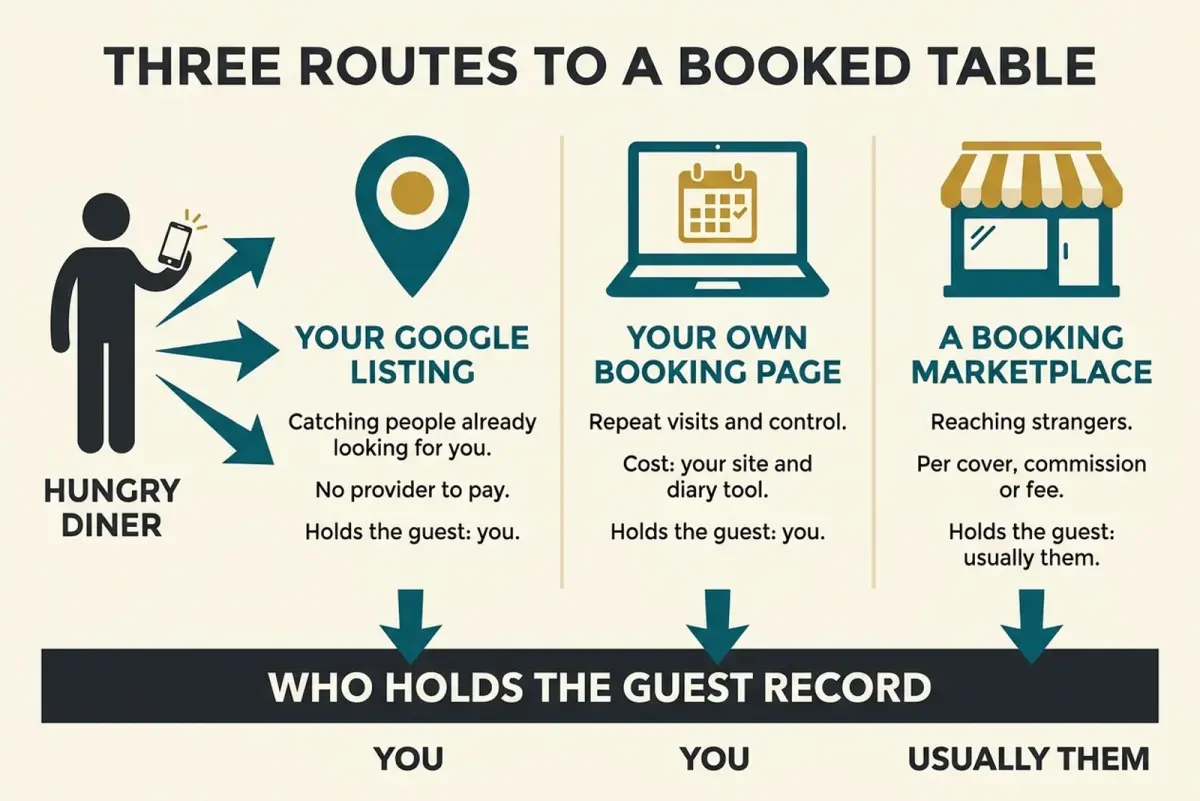
The three routes a booking can travel, and who holds the guest record.
| Route | Best at | Cost | Holds the guest |
|---|---|---|---|
| Google listing | Catching people already looking for you | No provider to pay | You |
| Your own page | Repeat visits, control | Site and diary tool | You |
| Marketplace | Reaching strangers | Per cover, commission or fee | Usually them |
The question worth agonising over is not which platform to sign with. It is which job you are paying it to do. Finding a stranger and re-booking last month's couple are different problems, and one product is rarely best at both. If you pick just one, start with the Google listing: there is no provider to pay, and it is where the search already ends.
Route One: The Booking Link on Your Google Listing
There is a booking button waiting on your Google listing, and it stays off until you decide otherwise.
Google Business Profile Help says a business that does not work with a booking provider can add its own link to its Business Profile. So with no integrated reservation partner in play, you can point the Google booking button at a page of your choosing, including one on your own site.
Related: Restaurant Google Business Profile covers claiming and tidying the listing first.
Two limits. Integrated partner availability varies by country, so check a UK profile. And a link is only as good as what it opens: land it on a contact form and you have advertised a button that cannot book.
Route Two: A Booking Page on Your Own Site
A booking page on your own site compounds, because every guest who books there is yours.
The test is not whether the page exists but whether it shows real availability. A form saying "we will get back to you" is a request, and a request is a phone call with extra steps: the diner still does not know if they have a table.
Then test it as a guest would. Hold your phone in one hand and book a table at your own restaurant for four on Saturday. Time it. Our working bar, and you should adjust it to your own menu and patience: Saturday's availability within three taps. Miss it and the booking flow is the fix, not a new logo in the footer. With no site yet, start at our restaurant website builder guide.
Related: Mobile restaurant website goes deeper on the phone experience.
Route Three: A Booking Marketplace
A marketplace is not really a booking system you are buying. It is an audience you are renting.
If you have just opened, or sit down a side street nobody walks past, a platform of diners looking for a table tonight fills a room faster than anything you build. Be clear what you are buying, because pricing follows it:
- Per booked cover. The bill rises exactly when you are busiest.
- Commission. Cost tracks spend, so a big table costs more.
- Flat subscription. Predictable, and it stops punishing a good December.
Rates change, so take numbers from the provider's own pricing page, not from any comparison article, this one included.
Why this matters: the models diverge exactly where it hurts. Do the arithmetic on a good month.
Imagine a fifty cover bistro taking 300 covers a month at £2 per cover on a £150 base. That is £750 in an ordinary month and £1,350 in a 600 cover December. A flat subscription would not have moved.
A second cost never appears on the invoice. Ask who holds the diner's details afterwards, whether you can export them, and check the account's current data settings before switching the widget on. A guest whose email lives only in someone else's system is one you cannot recognise next time.
What Your Booking Page Owes the Person Using It
A booking page is not only a sales surface. It is a legal one, the part platform comparisons never write.
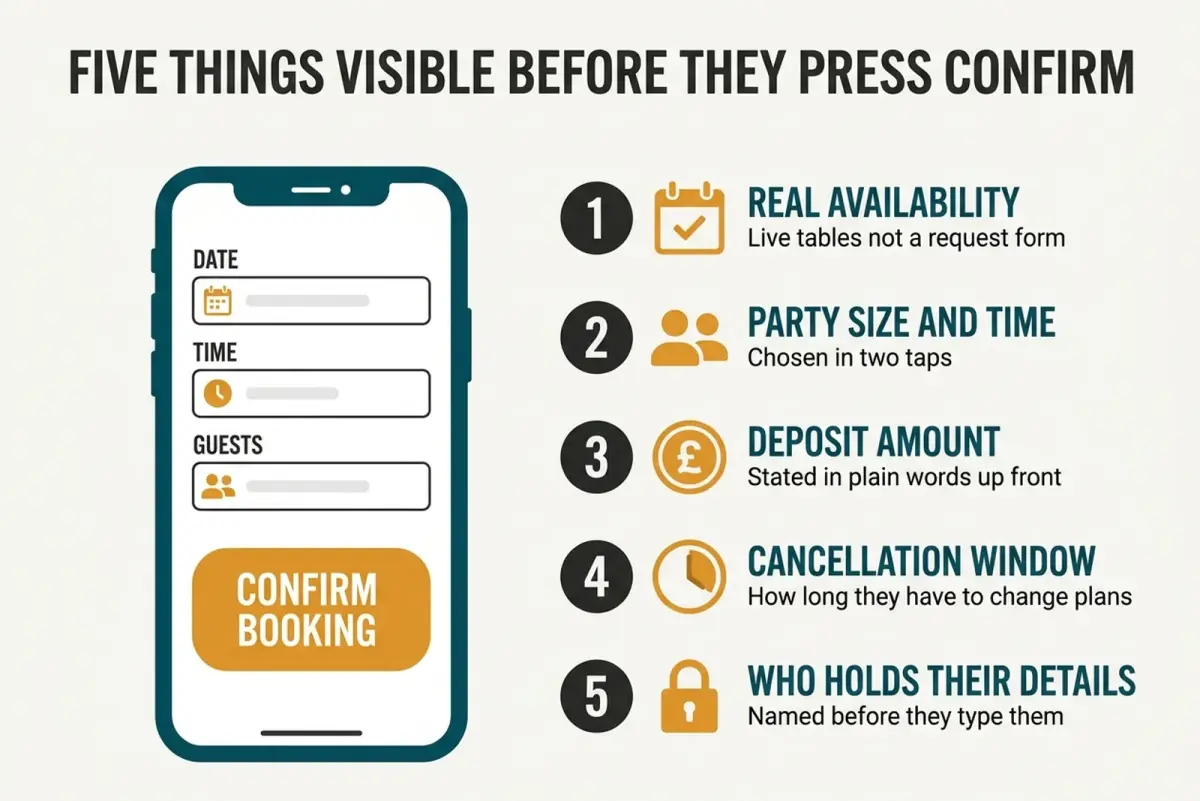
Five things a diner should see before they press confirm.
You are holding someone's personal details
The moment a diner types a name, phone number and email into your form, you are an organisation handling personal information. The Information Commissioner's Office states that under the Data Protection Act 2018, organisations processing personal information are required to pay a data protection fee unless they are exempt. The ICO sets the tier 1 fee at £52 for micro organisations, defined as a maximum turnover of £632,000 for the financial year or no more than 10 members of staff.
The deposit line has to be readable
The Consumer Rights Act requires a trader to ensure that a written term of a consumer contract is transparent, meaning it is expressed in plain and intelligible language and, where written, legible. That is a duty about how the term reads, not which software presents it. A deposit rule written in plain words satisfies it; one a guest cannot read or make sense of does not, wherever it lives. Putting the rule on the form itself, where the guest is already looking, is the cheap way to make sure it is read as well as readable.
Neither duty makes a platform compulsory. They are outcomes, and all three routes reach them. They also settle an argument owners have with themselves: the deposit line is not unfriendly. It is there so a guest who read it cannot be surprised afterwards.
The Thirty-Minute Floor
You do not need six platforms to take bookings well. You need the floor: three checks this week, ten minutes each as a budget, not a law.
- Ten minutes. Book a table at your own restaurant from your phone, one handed, and time it.
- Ten minutes. Check your Google listing's booking button lands on real availability.
- Ten minutes. Read your deposit wording as a guest with a babysitter booked would, then check your ICO tier.
Frequently Asked Questions
What is a restaurant booking website?
Any page or listing where a diner turns an intention into a confirmed table: your Google listing, your own site, or a marketplace listing.
Can I take bookings through my Google listing for free?
Yes, in the sense that no booking provider takes a cut: Google Business Profile Help says a business that does not work with a booking provider can add its own link to its Business Profile. The cost, if any, is whatever the page your link opens already costs you.
Should I use OpenTable or TheFork or my own booking page?
Ask what you are short of. Short of new diners, a marketplace sells discovery your own page cannot. Short of repeat visits, your own page wins.
Do I have to register with the ICO to take online bookings?
Taking names, phone numbers and emails is processing personal information. The Information Commissioner's Office states that under the Data Protection Act 2018, organisations processing personal information are required to pay a data protection fee unless they are exempt.
Can I charge a deposit or a cancellation fee?
Restaurants do, and the wording is what matters. The Consumer Rights Act requires a written term of a consumer contract to be transparent, expressed in plain and intelligible language and legible.
The Short Version
Key Takeaway
Your booking website is not a product you buy. It is the shortest path between a diner deciding and a table being held, and you choose how much of it you own.
If you would not finish your own booking flow while holding a pint, neither will they.
Weekly action:
- Time your booking journey on a phone, one handed
- Point your Google listing at real availability
- Put the deposit terms on the form itself
Start with the Google listing this week, then read our restaurant website cost guide. LocalBrandHub's visibility score gives you one number for how easily nearby customers find you online, the half of the problem happening before anyone reaches your book button. See what it covers.
Guide reviewed and last updated 13/08/2026. Fixed figures come from the named public sources below; the cover fee arithmetic is illustrative, not a quote.
For restaurants, salons, and local businesses
Need help with your marketing?
We help UK businesses turn social media into real results, not busywork.
Start freeSources
Get More Marketing Tips
Practical marketing tips for UK business owners, straight to your inbox. No spam, unsubscribe anytime.
About the Author
Local Brand Hub
Empowering UK Businesses
Local Brand Hub provides comprehensive business management tools designed specifically for UK local businesses to streamline operations, automate marketing, and grow revenue.
More articlesRelated Articles
 Marketing Tips
Restaurant Website Features: What Diners Actually Need
Restaurant website features that convert browsers to diners. What UK restaurants need: menus, bookings, mobile-first design.
 Marketing Tips
Digital Menu Boards for Restaurants: UK Costs and Guide
Compare digital menu board costs from £499-£7,000, see 38% sales uplift stats, and learn setup requirements. UK pricing and supplier guide for restaurants.
 Marketing Tips
Digital Menu Screens: A Practical Guide for UK Restaurants
Learn how digital menu screens can boost UK restaurant sales by 3-10%. Get realistic costs from £2,000, ROI timelines, and honest UK supplier advice.