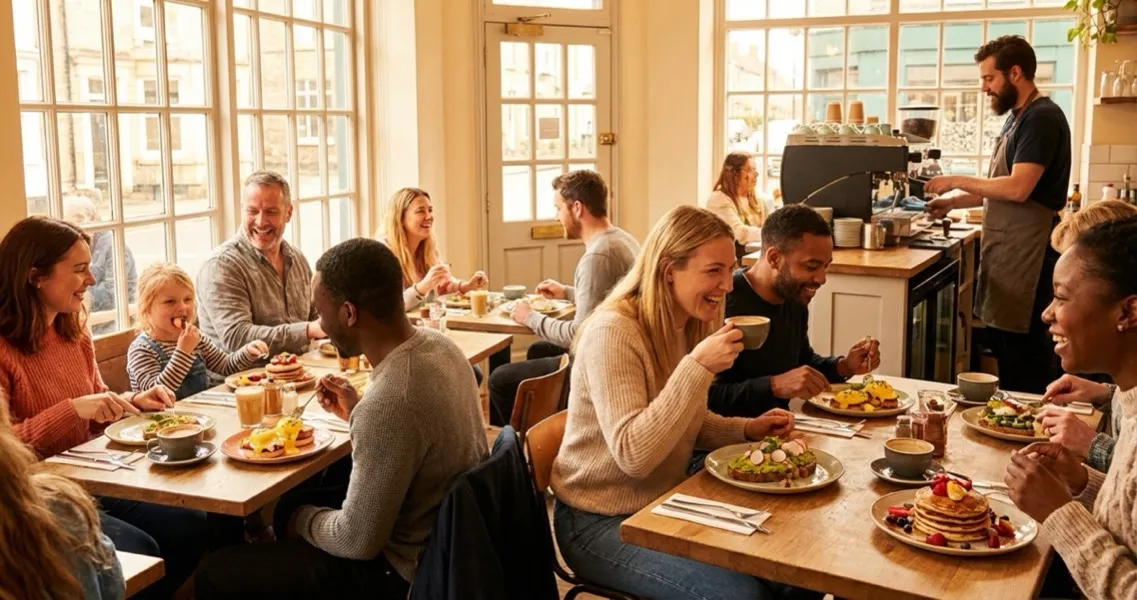
Master restaurant brunch marketing with this UK strategy guide covering menu design, pricing, social media and promotions that fill weekend tables.
You're paying rent on an empty dining room every Saturday morning, and UK breakfast occasions grew 13.7% in 2025. The demand is real. Smart restaurant brunch marketing turns those quiet morning tables into a reliable revenue stream by promoting a dedicated weekend brunch service to the people already looking for somewhere to eat.
What You'll Learn
- Why brunch taps into one of the UK's fastest-growing meal occasions
- How to price a brunch menu that protects margins without scaring guests away
- Which marketing channels tend to drive the strongest brunch bookings for independents
- Menu design principles that control food costs and keep perceived value high
- Social media tactics that make brunch promotion actually work on Instagram
- A realistic 30-minute weekly marketing plan so you do not burn out
Why Brunch Is a Revenue Opportunity You Cannot Ignore
First, let's look at the numbers. Breakfast and brunch is among the fastest-growing meal occasions in the UK in 2026. Out-of-home breakfast occasions grew 13.7% year-on-year according to 2025 Kantar Foodservice data. That is a significant shift: more people choosing to eat out in the morning than at almost any point in the 2010s.
So what does that mean for your weekend brunch strategy? It means an untapped revenue window.
Across UK restaurants, the same pattern comes up again and again. The kitchen sits idle between closing on Friday night and opening for Saturday dinner. A well-marketed brunch service turns those quiet hours into a real profit centre. Here is why the maths tends to work:
- Lower labour costs: brunch menus tend to be simpler, requiring fewer kitchen staff than a full dinner service
- Higher drink margins: cocktails like Bloody Marys and Bellinis often carry much stronger margins than typical dinner wine sales
- Faster table turns: brunch guests usually spend less time at the table than dinner guests, meaning more covers per shift
- New customer acquisition: brunch attracts demographics (younger groups, families, couples) who may not visit for dinner
Average restaurant profit margins in the UK sit between 3% and 6%. Adding a well-marketed brunch service is one of the few ways to grow revenue without raising prices or staying open later.
If you're thinking "I don't have the staff for another service," you might not need as many as you assume. For example, a 50-cover restaurant that runs dinner with four kitchen staff might only need two for brunch, since the menu is simpler and the prep overlaps with ingredients you already stock.
Related: Restaurant Menu Pricing: review your existing margins before launching any new service
How to Build a Brunch Menu That Sells Itself
With the business case clear, the next step is building a menu worth marketing. Even strong Instagram posts rarely save a forgettable restaurant brunch offering.
A brunch menu strategy is a framework that balances crowd-pleasers with signature dishes, keeping food costs controlled while giving guests a reason to photograph their plates and come back next weekend.
Start With Your Strengths
Before adding new dishes, look at what your kitchen already does well. If your dinner menu features excellent eggs Benedict, that translates directly. If you are known for smoked meats, build a brunch board around them.
For example, a Mediterranean restaurant might offer shakshuka with sourdough and za'atar yoghurt: still on-brand, still brunch-friendly, and using ingredients already in the walk-in.
The 60/30/10 Brunch Menu Structure
The 60/30/10 rule is a framework that divides your brunch menu into three categories. Use it as a rule of thumb for balancing familiarity with differentiation:
| Category | Percentage | Purpose | Examples |
|---|---|---|---|
| Classics | 60% | Familiar dishes guests expect | Full English, eggs Benedict, pancakes |
| Signatures | 30% | Unique dishes they cannot get elsewhere | Your twist on a classic, seasonal specials |
| Wildcards | 10% | Rotating items that create urgency | Limited-edition dishes, chef collaborations |
These ratios are a starting point. Adjust based on your venue and audience.
The classics keep risk-averse guests happy. The signatures give people a reason to choose you. The wildcards give regulars a reason to return. For a deeper look at structuring your brunch menu and specific dish ideas, see our guide to restaurant brunch menus.
If you're only offering the same full English as every other place on the high street you'll always lose to competitors who give guests something worth posting about.
Drinks: Where Your Brunch Margin Lives
One thing many restaurant owners overlook: A well-structured bottomless brunch package can often achieve gross margins significantly above a standard dinner main course.
Build your drinks offering around these three tiers:
- Bottomless packages: set a time limit (90 minutes is standard) and offer prosecco, Bellinis, or Bloody Marys
- Non-alcoholic options: fresh juices, speciality coffee flights, or mocktail packages
- Upsell tiers: basic prosecco at one price, premium cocktails at a higher tier
For ideas on structuring buffet-style brunch with strong margins, read our guide on brunch buffet menu ideas.
Ask yourself: would I pay what I am charging for this brunch experience? If the answer is not an immediate yes, your menu probably needs work.
Brunch Pricing Strategy for UK Restaurants
So your menu is taking shape. Now let's talk money. Getting your brunch pricing right can be the difference between a brunch that builds your business and one that costs you money each weekend.
Understand Your True Costs First
Before setting any prices, calculate your actual cost per brunch cover:
- Food cost: aim for a lower percentage than dinner since brunch ingredients like eggs, bread, and butter tend to cost less
- Labour cost: typically lower than dinner, since brunch menus need fewer hands on the line
- Overheads: heating, lighting, linen (often lower because brunch runs during daylight hours)
A good brunch should target an overall food cost percentage a few points below your dinner service.
Pricing Models That Work for Brunch
Below is a comparison of common pricing approaches. Keep in mind these ranges are approximate and vary by location:
| Model | Suited To | Typical Price Range | Margin Potential |
|---|---|---|---|
| A la carte | Restaurants testing brunch | Per-dish pricing | Moderate |
| Set menu | Consistent quality control | Two-course fixed price | Good |
| Bottomless packages | High-energy venues | Per-head flat rate | High |
| Tiered pricing | Broad customer base | Multiple options | Very good |
Prices reflect typical UK independent restaurant ranges as of 2026. Adjust for your area and positioning.
The tiered approach often works well for UK independents. Offer a la carte for guests who want one dish and a coffee, plus a set brunch deal for groups or celebrations.
Related: Restaurant Menu Engineering: learn how layout and positioning nudge guests toward higher-margin items
The Saturday vs Sunday Difference
Many restaurants price both days the same. That is often a missed opportunity. Saturday brunch tends to attract younger groups looking for a social occasion. They respond to bottomless deals and shareable plates. Sunday brunch leans toward families and couples wanting a relaxed meal.
For instance, a bistro might run bottomless brunch at £42 per head on Saturdays and a premium two-course set menu at £32 on Sundays. Different audiences, different offers, both profitable.
Restaurant Brunch Marketing Channels That Fill Tables
With your menu and pricing in place, the next challenge is getting people through the door. This is where your brunch marketing plan gets practical.
The Channel Priority Framework
Most marketing channels are not worth your limited time. Here is how to prioritise your effort:
| Channel | Effort | Impact | Suited To |
|---|---|---|---|
| Medium | High | Visual appeal, discovery | |
| Google Business Profile | Low | High | Local search, maps |
| Email/SMS | Low | Medium-High | Existing customers |
| Local partnerships | Medium | Medium | Community reach |
These ratings are a rule of thumb based on typical independent restaurant experiences. Your results may vary depending on location and audience.
For most UK restaurants, Instagram and Google Business Profile often offer the strongest return for the time invested. Start there, build consistency, then expand.
Google Business Profile: Your Free Brunch Billboard
This is often the lowest-effort, highest-impact channel available to independents. Update your Google Business Profile to include:
- Brunch-specific photos (at least 5)
- Your brunch hours as a separate service time
- A post announcing your brunch menu each week
- A direct booking link
A 2025 Yelp survey found 76% of people say social media has influenced their dining choices. Many of those decisions start with a Google search for "brunch near me."
Email and SMS: Your Quiet Powerhouse
If you're down two staff and barely keeping up with service, the last thing you want is a complicated marketing channel. That is what makes email and SMS so valuable: a simple Thursday evening text to your customer list fills weekend tables without creating extra work during the rush.
For instance, a neighbourhood restaurant might send: "This Saturday's brunch special: truffle scrambled eggs with sourdough, £14. Book your table. We filled up by 11am last week." That takes 30 seconds to write.
If you're reading this thinking "I don't have an email list," that's usually a sign your regular customers have no way to hear from you between visits.
Social Media for Your Brunch Service
Now that you understand which channels to prioritise, let's dig into the one that matters most for brunch: social media.
Brunch is one of the most social-media-friendly meals you can serve. The light is better, the food is more colourful, and people want to share their plates. Here's how to handle social media for brunch without it eating your week.
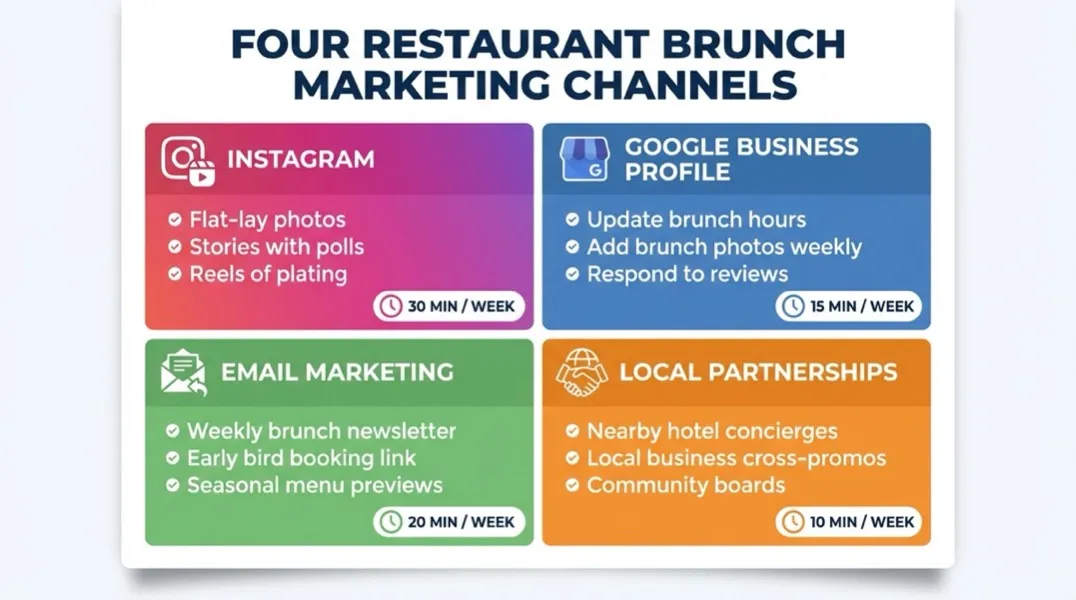
A weekly restaurant brunch marketing channel plan covering Instagram, Google, email and local partnerships
Instagram: Your Brunch Powerhouse
Many consumers use Instagram to discover new restaurants. For brunch, that share is likely higher because brunch food photographs well.
Your brunch content on Instagram should follow a simple weekly rhythm:
- Wednesday: Behind-the-scenes prep or menu tease (Reel or Story)
- Thursday: "This weekend's brunch menu" post with booking link
- Saturday/Sunday: Real-time Stories from service: food shots, busy tables, happy guests
- Monday: Reshare guest photos or reviews from the weekend
Reels tend to earn considerably more engagement than static posts. Even a 15-second clip of eggs being plated or a Bloody Mary being poured will outperform a polished food photo.
A neighbourhood bistro might film a quick Reel of their chef pouring hollandaise over eggs Benedict with the caption: "Saturday brunch, 10am-2pm. Last week's tables filled by 11. Book yours." Simple, visual, effective.
Best Time to Post
Post your Thursday "weekend menu" announcement between 6pm and 8pm: that is when people are planning their weekend and most likely to engage with brunch content on Instagram.
User-Generated Content: Free Promotion
Encourage guests to tag your restaurant by printing your Instagram handle on a table card or menu. Create a simple branded hashtag. Reshare tagged photos to your Stories regularly.
This costs very little and tends to build social proof faster than most paid campaigns.
Marketing your brunch is not about selling food. It is about making people hungry before they are hungry.
Brunch Promotion Ideas That Actually Work
Next, let's move from ongoing posting to one-off campaigns. Beyond your regular social media, you also need specific promotions to build initial momentum. These are the tactics that tend to move the needle.
Launch Promotions for Your Brunch
When launching a new brunch service, consider these approaches:
- Soft launch weekend: invite loyal dinner customers for a complimentary brunch tasting in exchange for feedback and social media posts
- Opening offer: 20% off or a free drink with every brunch booking for the first two weekends
- Local influencer invites: invite 3-5 local food bloggers for a complimentary brunch (micro-influencers with 2,000-10,000 followers often deliver better engagement than bigger accounts)
If you're reading this thinking "I can't afford to give away free brunch," think of it as a marketing spend, not a loss. One viral post from a local food blogger can fill tables for weeks.
Seasonal and Event-Driven Promotions
Some of the highest-revenue brunch dates are predictable. Plan for them months in advance:
| Event | Timing | Opportunity |
|---|---|---|
| Mother's Day | March | Premium set menu, gift packages |
| Easter | March/April | Family brunch, kids eat free |
| Bank holidays | Throughout year | Extended brunch hours |
| Christmas party season | Nov-Dec | Festive bottomless brunch |
Mother's Day alone is worth dedicated planning. For specific strategies, see our guide on Mother's Day brunch menus for restaurants.
Loyalty and Repeat Business
The real long-term value in brunch often comes from repeat business. A guest who visits once is nice. A guest who comes every Saturday is profitable.
- Stamp cards: visit 5 times, get a free brunch cocktail
- Weekday extension: once weekends fill up, test a Friday brunch to capture extra demand
- Birthday packages: offer a group package for celebrations (these often bring 6-10 guests per booking)
For instance, a wine bar running brunch might offer a "Saturday Regulars" card: fifth visit earns a free bottle of prosecco for the table.
Related: Restaurant Special Offers: structure promotions that drive revenue without eroding your brand
Common Restaurant Brunch Marketing Mistakes
You have the strategy, the channels, and the promotions. Before you launch, however, here are the mistakes that commonly trip up even experienced operators. Based on patterns reported by UK restaurant owners, these issues come up repeatedly.
1. Launching Without a Clear Identity
"We do brunch now" is not a marketing message. Define what makes your brunch stand out.
Is it the bottomless cocktails? The locally sourced full English? The all-day pancake stack? Pick a hook and build your messaging around it.
2. Underpricing to Attract Volume
It is tempting to price low to fill seats quickly. The problem is that brunch customers acquired through discounts rarely pay full price later.
For example, a cafe that launches brunch at £6.99 per dish struggles to raise prices six months later because guests anchor to that number. Price for margin from day one, and use limited-time offers to create urgency rather than permanent discounts.
3. Ignoring Operational Capacity
Few things hurt a new brunch service faster than a bad first visit. If your kitchen handles 40 covers per hour at dinner, that does not mean it can do 40 at brunch. The service flow is different. Test your capacity during a soft launch before you promote widely.
If you're thinking "I'll figure it out as we go," that rarely works. One weekend of bad reviews and slow service can damage your brunch reputation before it starts.
4. Posting Once and Expecting Results
Brunch marketing needs consistency. One Instagram post saying "we do brunch now" will not fill tables. You need weekly content, regular stories, and ongoing replies to comments. If writing fresh captions every week is the sticking point, a tool that can generate a week of brunch posts in minutes keeps the momentum going without eating your evenings. That is where the 30-minute plan below comes in.
If You Only Have 30 Minutes a Week
Finally, let's be realistic. All of the above might sound like a lot when you are already working a 12-hour shift. If you only have 30 minutes a week, focus on these three actions to build momentum consistently:
Info
This week, launch your brunch marketing foundation:
Day 1-2 (10 minutes): Update your Google Business Profile with brunch hours, 3 photos of your top dishes, and a booking link. Write one Thursday evening email or SMS announcing the weekend brunch menu.
Day 3-4 (10 minutes): Post one Instagram Reel or carousel showing your brunch prep or a signature dish. Include your location, brunch hours, and a booking prompt in the caption.
Day 5-7 (10 minutes): During Saturday or Sunday service, take 3-4 photos of food going out and happy tables. Reshare any guest tags to your Stories. Save your strongest photo for next week's brunch post.
That is it. Repeat weekly. In practice, a small bistro could batch all three tasks on Monday evening in one sitting rather than spreading them across the week. Consistency almost always beats perfection.
Weekly Action
Once your brunch marketing foundation is running, try adding one new task each month:
- Month 2: Plan your first seasonal promotion (Mother's Day, Easter, or the next bank holiday)
- Month 3: Launch a simple loyalty stamp card for repeat brunch guests
- Month 4: Approach one local business about a cross-promotion partnership
Key Takeaway
If you run a restaurant and want to see how Local Brand Hub can support your marketing, explore our restaurant marketing tools.
Key Takeaway
Here's a summary of the core restaurant brunch marketing strategies covered above:
- Brunch is among the fastest-growing meal occasions in the UK, with breakfast occasions up 13.7% year-on-year: strong marketing captures that demand
- Build your menu around the 60/30/10 structure: 60% classics, 30% signatures, 10% rotating wildcards
- Price your brunch to achieve a food cost 2-4 points below your dinner service, and consider tiered pricing to capture different customer types
- Instagram and Google Business Profile should be your first two marketing channels: they typically deliver strong returns for limited time
- Drinks packages (especially bottomless brunch) are where the strongest margins often sit, frequently achieving 65-70% gross margin
- Consistency in weekly restaurant brunch marketing matters far more than occasional bursts of promotion
FAQ
How much does it cost to launch brunch marketing?
Start-up costs vary. Many restaurants can launch brunch with little new spend because they already own the equipment and stock most ingredients. Budget £200-£500 for initial marketing costs: signage, social media, and soft launch meals. Staff training and menu trials are often the biggest expense.
What is the best day to offer brunch?
Choosing the best brunch day is a strategy that depends on your customer base and local area. Saturday and Sunday are the obvious picks, but they draw different crowds. Saturday brunch tends to pull social groups and younger diners who respond to bottomless deals. Sunday brunch often suits families and couples after a relaxed, quality meal. Start with the day that fits your existing diners, then add the other once you have demand.
How do I market brunch on a tight budget?
Focus on free marketing channels first: update your Google Business Profile, post consistently on Instagram (one Reel and 2-3 Stories per week), and send a weekly text or email to your existing customer list. Encourage guests to tag your restaurant for user-generated content. These cost almost nothing except time and are often more effective than paid advertising for independent restaurants.
How long does it take for restaurant brunch marketing to show results?
Most restaurants see steady weekend brunch numbers within 6-8 weeks of sustained effort. The first two weekends are for gathering feedback and tweaking the menu. By week four, word-of-mouth and social media typically start driving organic bookings. By week eight, you should have enough data to decide whether to expand hours or change your offering.
Should I offer bottomless brunch?
Bottomless brunch can be very profitable when set up correctly. Use a clear time limit (90 minutes), pick drinks with strong margins (prosecco, house cocktails), and pair with a set food menu to control costs. It does pull a specific crowd and may not suit every brand. Test it on Saturdays only before going permanent.
For restaurants, salons, and local businesses
Need help with your marketing?
We help UK businesses turn social media into real results, not busywork.
Start freeGet More Marketing Tips
Practical marketing tips for UK business owners, straight to your inbox. No spam, unsubscribe anytime.
About the Author
Local Brand Hub
Empowering UK Businesses
Local Brand Hub provides comprehensive business management tools designed specifically for UK local businesses to streamline operations, automate marketing, and grow revenue.
More articlesRelated Articles
 Marketing Tips
Mother's Day Brunch Menu for Restaurants
Plan your Mothering Sunday brunch menu with this UK guide. Covers menu design, promotion timelines, pricing strategies, and gift add-ons.
 Marketing Tips
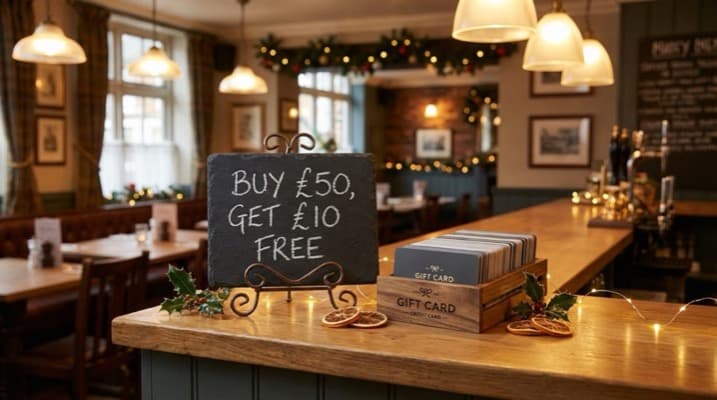
Restaurant Gift Card Discount: UK Deals & Promos
Explore restaurant gift card discount strategies including bonus card promotions, seasonal deals, corporate bulk pricing and UK dining gift card offers.
 Marketing Tips
Restaurant Group Dining Marketing: UK Guide
Proven group dining marketing strategies for UK restaurants. Boost private dining revenue with pricing, corporate outreach, and seasonal campaigns.