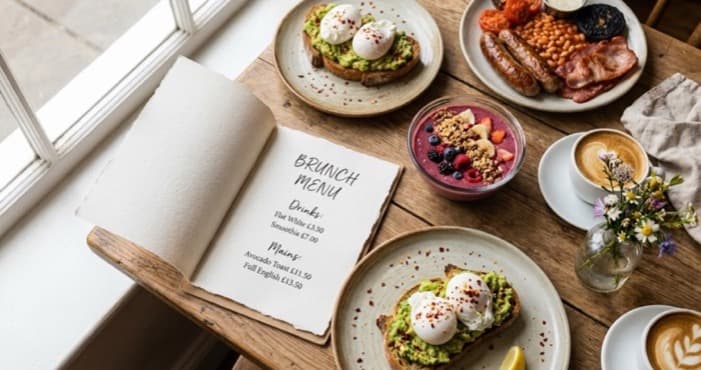
Design restaurant brunch menus that boost covers and profits. UK layout tips, pricing tiers, bottomless brunch options and dietary accommodations.
You're running brunch every weekend. The food's good, the Prosecco is chilled, your social posts look great. So why are covers still thin, average spend stuck, and half the tables picking the cheapest eggs on toast? The problem isn't the food. It's your menu.
Restaurant brunch menus guide guests toward your most profitable dishes while making every option feel worth ordering. A strong brunch menu blends layout psychology, clear categories, smart pricing and dietary labels into one page that works harder than your front-of-house team. For UK restaurants, where diners often spend £25 or under, getting it right means balancing perceived value with healthy margins.
Info
Related: Restaurant brunch marketing covers the full brunch strategy, from social media to table bookings. This guide focuses on designing a brunch menu that sells.
What You'll Learn
This guide walks you through designing a brunch menu that drives revenue:
- How to structure brunch menu categories so guests navigate without decision fatigue
- Layout and visual hierarchy principles for your menu
- Pricing tiers that work for UK brunch service, from value to premium
- How to design a bottomless brunch package that stays profitable and compliant
- Dietary accommodations that expand your customer base without overwhelming the kitchen
- A week-by-week action plan you can follow even during busy service
Your menu's structure shapes how guests experience the meal. Let's start with the categories that make a brunch menu work.
What Is a Good Menu for a Brunch?
First, let's get the foundation right. A good brunch menu is a framework that balances variety with focus, offering five to seven clearly defined categories that blend breakfast and lunch dishes.
If you're reading this thinking "my menu already has categories," look again. Most suffer from too many items crammed into vague sections.
Limit each category
Menu psychology research suggests limiting each category to around seven items prevents decision fatigue and helps guests order faster.
Core Brunch Menu Categories
Here are the categories that form a strong brunch menu:
| Category | Purpose | Example Items | Typical Count |
|---|---|---|---|
| Eggs & Classics | Anchor section | Eggs Benedict, eggs Royale, full English | 5-7 |
| Light & Fresh | Health-conscious | Avocado toast, grain bowls, smoothie bowls | 4-6 |
| Indulgent Plates | High-margin | Stacked pancakes, French toast, waffles | 3-5 |
| Savoury Mains | Lunch-leaning | Burgers, steak and eggs, croque monsieur | 4-6 |
| Sides & Extras | Upsell | Halloumi, smoked salmon, truffle fries | 5-8 |
| Drinks | Margin drivers | Cocktails, fresh juice, speciality coffee | 6-10 |
For example, a neighbourhood bistro might run five food categories plus drinks, keeping the total to 30-35 items. That feels generous while staying manageable for a smaller weekend kitchen crew.
Keep it concise
If your brunch menu needs more than two pages, you've got too many items. Cut the bottom performers and watch average spend climb.
The biggest mistake? Copying a competitor's categories without checking your own food cost data.
- Don't borrow a layout because it looks good
- Ask yourself: would a first-time guest find the right dish within 30 seconds?
- If not, your categories need work
Categories sorted. But even strong categories underperform without proper placement. Where each section sits on the page matters just as much as what's in it.
Brunch Menu Layout and Visual Hierarchy
With that foundation in place, layout becomes the priority. Your menu's layout isn't decoration. It's a sales tool. A well-designed menu layout can lift sales by up to 15% by making items easier to find and putting high-margin dishes where eyes naturally land.
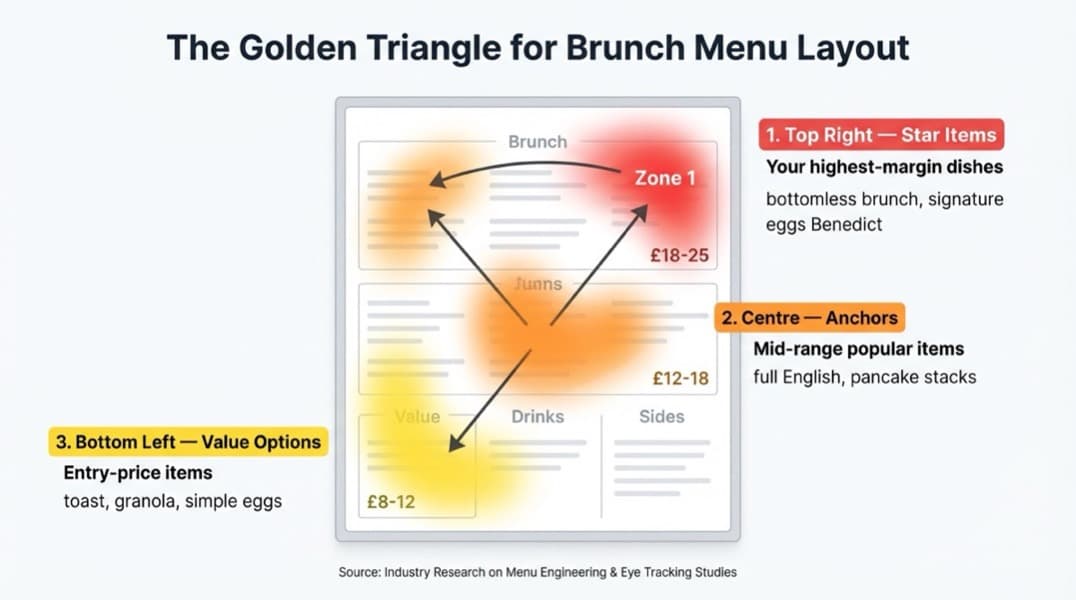
The golden triangle layout puts your highest-margin items where eyes naturally land.
The Golden Triangle for Restaurant Brunch Menus
Eye-tracking research shows customers scan a brunch menu in a predictable pattern: centre first, then top right, then top left. Place your highest-margin brunch items in these zones.
For a single-page brunch menu:
- Centre: Your signature brunch dish or sharing platter
- Top right: Indulgent plates (often your highest-margin category)
- Top left: Eggs and classics (anchor items guests expect)
Design Principles That Work
White space matters. Items surrounded by space draw attention. If every line on your menu is crammed edge-to-edge, nothing stands out.
Typography guides choices. Bold text, boxes, or a slightly larger font highlight profitable dishes. Keep body text at 12pt minimum and stick to two typefaces. The principles of menu engineering apply directly to brunch, and understanding restaurant menu pricing helps you present prices effectively.
Colour sets the mood. Brunch menus often lean toward lighter palettes. Pastels and white space reflect the daytime, social atmosphere. Use colour accents to spotlight profitable items.
If you can't tell whether your layout helps guests choose or just fills the page, that's usually a sign you need to simplify. A clean, single-page menu on quality card stock typically beats a cluttered design. Once the design is right, keeping every dish, price and dietary label in one place makes seasonal updates painless. That is where a dedicated menu and offers manager earns its keep.
Layout sorted. Now for the bit that really moves the needle: pricing.
Brunch Menu Pricing Tiers for UK Restaurants
Pricing strategy directly affects average spend. With brunch, this is where many owners fall apart.
- Price everything at a flat rate and guests have no reason to trade up
- Spread prices across clear tiers and you create a natural path to premium spend
The three-tier pricing framework is a structure that gives every guest a comfortable entry point while encouraging higher spend across your menu:
| Tier | Price Range | Purpose | Examples |
|---|---|---|---|
| Value | £8-£12 | Entry point, builds traffic | Eggs on toast, porridge, basic brunch bowl |
| Core | £13-£18 | Workhorse margin items | Full brunch plate, eggs Benedict, pancakes |
| Premium | £19-£26 | Anchor pricing, lifts perception | Sharing platter, steak and eggs, lobster Benedict |
Around 63% of UK consumers willingly pay more for fresh or seasonal ingredients. Your premium tier should highlight provenance. Words like "free-range," "locally sourced," and "hand-sliced" justify higher prices on your menu.
Pricing Principles That Work
- Use whole numbers. Drop the pennies. Clean prices feel more premium.
- Remove the pound sign from food items. "Eggs Benedict 14" reads cleaner than "£14.00."
- Anchor with your premium tier. A sharing platter at the top makes individual dishes feel more reasonable.
For instance, a gastro pub adding a "Brunch Royale Board for Two" at a premium price makes every other dish on the menu feel sensible. The board also generates social media content when guests photograph it, driving additional restaurant brunch marketing value.
Info
Related: Restaurant menu pricing covers food cost formulas and psychological pricing in depth.
Pricing tiers work for a la carte. But bottomless packages? They're what drive group bookings and can become your strongest revenue channel when done right.
How to Design a Profitable Bottomless Brunch Menu
Next, let's tackle packages. Bottomless brunch has become one of the biggest revenue drivers on brunch menus across the UK. Get the design wrong and it costs you money. Get the compliance wrong and it risks your premises licence.
The Package Structure
A profitable bottomless brunch pairs food and drinks within a set time window:
- Standard package: 90 minutes, combining a limited food menu with Prosecco or mimosas
- Premium package: 90-120 minutes, adding cocktails and premium food options
- Food: 2-3 courses from a reduced menu with 4-6 choices
- Drinks: Prosecco, mimosas, Bellinis, or selected cocktails
The key to profitability? A limited menu. Offer 4-6 food options instead of your full brunch menu. Fewer choices cut kitchen complexity and keep food costs predictable.
Limit the bottomless food menu
A London brunch spot running two bottomless tiers (a "Classic" with Prosecco and three food choices, and a "Luxe" adding cocktails and a premium food menu) cut food waste by roughly a quarter compared to offering the full menu.
Legal Compliance
UK licensing law treats unlimited alcohol promotions differently by region:
- England and Wales: Permitted provided it does not create a "significant risk" to licensing objectives. Venues must demonstrate responsible service with trained staff and a clear time limit.
- Scotland: Offering unlimited alcohol for a fixed price is prohibited under the Licensing (Scotland) Act. Scottish venues typically offer "boozy brunch" packages with a set number of drinks (often 3-5) instead.
Bottomless Brunch Checklist
- Time limit printed on the menu and booking confirmation
- Staff trained to pace service rather than rush refills
- Non-alcoholic bottomless option at a lower price point
- Drink consumption tracked per table
- Scotland-specific compliance if operating north of the border
If you're only listing bottomless drinks without time limits or training you'll always lose to competitors who treat it as a structured revenue system.
Warning
Don't do this: Treating bottomless brunch as a marketing gimmick without building proper compliance and profitability into the package design.
Info
Related: Restaurant Instagram marketing explains how to turn brunch table photos into bookings.
So you've got pricing and packages sorted. But there's another factor that decides whether groups book with you or the place down the road.
Dietary Accommodations on Restaurant Brunch Menus
Overlooking dietary needs on your menu leaves money on the table. Groups typically book brunch together, and one person's dietary restriction often decides where everyone eats.
What to Include
At minimum, your menu should clearly mark:
- Vegetarian (V) and Vegan (VG) options across multiple categories
- Gluten-free (GF) alternatives, not just salads
- Allergen information available on request (legally required under UK Food Standards Agency regulations)
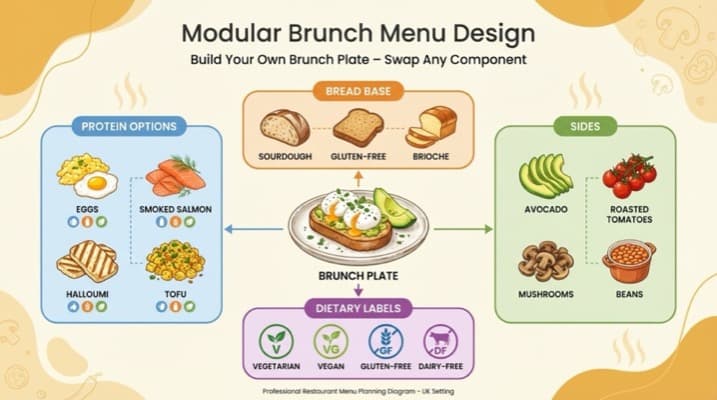
Modular dishes with swappable components keep dietary accommodations simple for the kitchen.
How to Design It Without Kitchen Chaos
The reality for most independent restaurants is that a separate dietary menu isn't practical. Instead, build flexibility into your existing menu:
- Modular dishes: Design core items with swappable components. For example, your eggs Benedict works with regular ham, smoked salmon (pescatarian), or grilled mushroom and spinach (vegetarian).
- Clear symbols: Use consistent icons next to each item rather than a separate section.
- One dedicated section: Include 2-3 dishes designed from the start as plant-based.
For instance, a Manchester cafe built three "base plates" (eggs, pancakes, grain bowl) with a customisable toppings menu. This approach cut kitchen complexity while offering over 20 possible combinations.
If you're thinking "I don't have time for all this," start with symbols and one vegan option per category. Small changes often make the biggest difference for group bookings.
Warning
Don't do this: Listing "gluten-free options available on request" at the bottom of the menu. If dietary guests can't see their options at a glance, they won't ask. They'll just pick a different restaurant.
Info
Related: Restaurant food photography tips can help you photograph your brunch dishes for social media and menu design.
What Is a Typical English Brunch?
Design principles aside, what actually goes on the plate? A typical English brunch is a framework that blends traditional full English breakfast elements with lighter, modern dishes served mid-morning through early afternoon. Most English restaurant brunch menus include eggs Benedict or eggs Royale alongside a full English option, sweet items like pancakes or French toast, and at least one lighter dish such as avocado on sourdough.
What separates brunch from breakfast? The social element and the drinks. Brunch implies leisure, company, and often a cocktail or fizz. Your menu should reflect that mood. Think of it as part of your wider restaurant marketing strategy for weekends.
Core items on a typical English brunch menu:
- Full English (or a curated "brunch fry-up" version)
- Eggs Benedict / eggs Royale / Florentine
- Pancakes, waffles, or French toast stack
- Smashed avocado on sourdough
- A brunch burger or steak sandwich
- Fresh juice, speciality coffee, and at least one cocktail option
Info
Your brunch menu is not a breakfast menu with a later start time. It is a social occasion disguised as a meal. Design it that way and average spend follows.
If You Only Have 30 Minutes a Week
Not ready for a full redesign? Here's a structured plan to improve your menu in stages:
This week, audit and improve your restaurant brunch menus
- Day 1-2: Print your current menu and mark each item's food cost percentage. Circle anything above 35%.
- Day 3-4: Reorganise items into the five core categories. Move your three highest-margin dishes into golden triangle positions (centre, top right, top left).
- Day 5-7: Add clear dietary symbols, remove pound signs from prices, and check that your pricing spans at least two distinct tiers. Print a test version and get front-of-house feedback.
Key Takeaway
If you run a restaurant and want to see how Local Brand Hub can support your marketing, explore our restaurant marketing tools.
Key Takeaway
Here's what to remember about designing an effective brunch menu:
- Structure your menu around five to seven clear categories with no more than seven items each
- Use the golden triangle layout to place high-margin items where eyes naturally land
- Create three pricing tiers (value, core, premium) to guide guests toward profitable choices
- Design bottomless brunch packages with a time limit, limited menu, and legal compliance built in
- Build dietary accommodations into your existing menu using modular dishes and clear symbols
- Start this week by repositioning your top three profit drivers and cleaning up your layout
Your restaurant brunch menus should work as hard as your kitchen does.
Weekly Action
This week, pick one area of your brunch menu to improve:
- Monday: Print your current menu. Circle the three highest-margin items and note where they sit on the page.
- Tuesday: Move those three items into golden triangle positions on a draft layout.
- Wednesday: Add dietary symbols (V, VG, GF) to every relevant item.
- Thursday: Remove pound signs from food prices and round to whole numbers.
- Friday: Print the revised menu and brief your front-of-house team.
- Weekend: Run the new menu for one service. Track average spend per cover.
Next Steps
Here is exactly what to do this week:
- Print your current brunch menu and highlight your three highest-margin items
- Move those items into the golden triangle positions on a draft layout
- Add dietary symbols and remove pound signs from food prices
- Test the revised menu during one weekend service
- Compare average spend before and after the changes
Based on our experience helping UK restaurant owners, even small changes typically lift average spend within the first weekend. Once you see results, work through the pricing tiers and dietary accommodations above.
Explore our brunch buffet menu ideas for the self-service format, or read more about menu engineering and menu pricing strategy to take your menu design further. You might also find our restaurant social media marketing guide useful for promoting your new menu.
Frequently Asked Questions
What is a good menu for a brunch?
A good brunch menu is a framework that balances variety with focus across five to seven clearly defined categories including eggs and classics, light and fresh options, indulgent plates, savoury mains, sides and drinks. Keep each category to roughly seven items so guests can choose quickly without feeling overwhelmed.
What finger food works well for brunch?
The finger food approach is a strategy that focuses on no-cutlery items: mini quiches, smoked salmon blinis, sausage rolls, bruschetta with various toppings, halloumi skewers, and avocado crostini. These work well for brunch buffet menus and sharing platters because they can be prepared largely in advance.
What are the best brunch buffet foods?
Strong brunch buffet options typically include scrambled eggs, bacon and sausage stations, a build-your-own pancake bar, fresh fruit platters, pastry baskets, smoked salmon, and a selection of salads and grain bowls. Focus on dishes that hold well at temperature and look appealing on display.
How many items should be on a brunch menu?
A well-designed brunch menu typically includes 25-40 items spread across five to seven categories. Cap each category at around seven choices to keep both the ordering process and kitchen operations running smoothly during busy weekend service.
Is bottomless brunch legal in the UK?
In England and Wales, bottomless brunch is legal provided venues demonstrate responsible service and the promotion does not create a significant risk to licensing objectives. In Scotland, unlimited alcohol for a fixed price is prohibited under the Licensing (Scotland) Act, so Scottish venues typically offer a set number of drinks within a timed brunch package instead.
Start by reviewing your current restaurant brunch menus against the categories and pricing tiers in this guide. Print your menu, circle the three highest-margin items, and go from there.
For restaurants, salons, and local businesses
Need help with your marketing?
We help UK businesses turn social media into real results, not busywork.
Start freeGet More Marketing Tips
Practical marketing tips for UK business owners, straight to your inbox. No spam, unsubscribe anytime.
About the Author
Local Brand Hub
Empowering UK Businesses
Local Brand Hub provides comprehensive business management tools designed specifically for UK local businesses to streamline operations, automate marketing, and grow revenue.
More articlesRelated Articles
 Tutorials
AI Menu Recommendations: Which Half You Can Actually Run
AI menu recommendations are two different jobs wearing one name. Work out which half your UK restaurant can actually run today, and what it costs to start.
 Marketing Tips
Restaurant Brunch Marketing: UK Strategy Guide
Master restaurant brunch marketing with this UK strategy guide covering menu design, pricing, social media and promotions that fill weekend tables.
 Marketing Tips
Upselling Techniques Food and Beverage Teams Really Use
The upselling techniques food and beverage teams really use, with the exact words for starters, drinks and desserts and the answer each one invites.