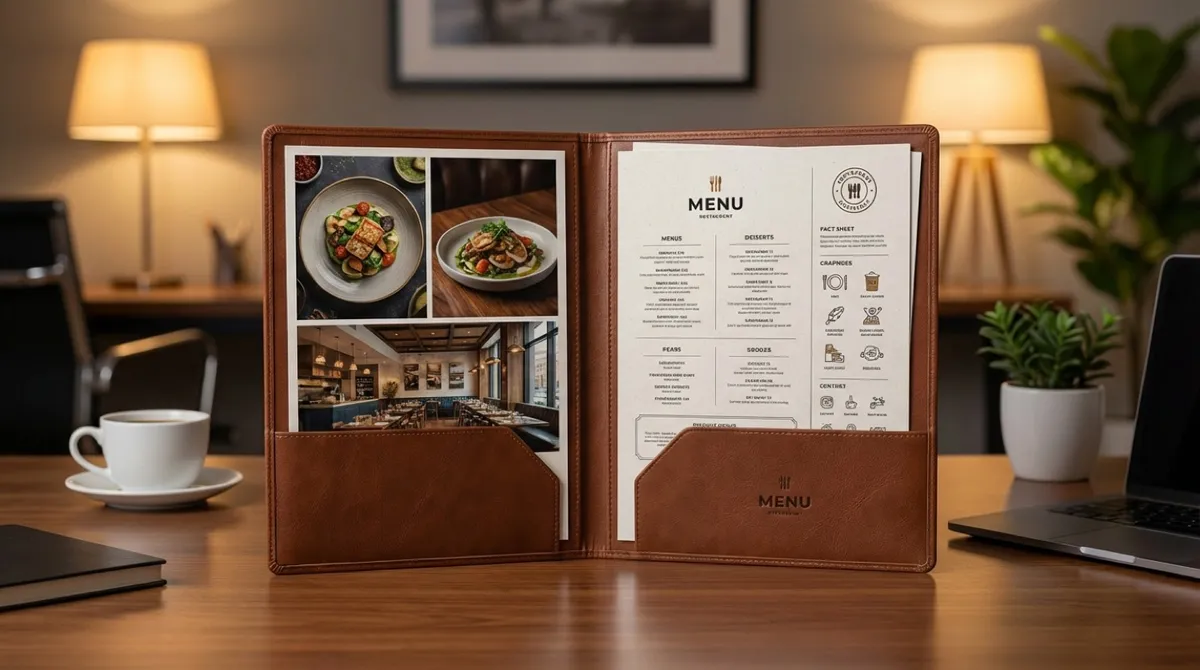
Watch the visual overview· 92 seconds
Build a restaurant media kit that gets UK journalists to say yes: the 7 must-have elements, design tips, and real examples you can copy.
You're scrambling through your phone gallery at midnight because a journalist emailed asking for your chef's biography, high-resolution photos, and a fact sheet. You type up a bio from memory and reply three days later. By then, the journalist has filed the story, featuring your competitor.
Your competitor had a restaurant media kit ready. You did not.
According to Cision's Global State of the Media Report (2025), journalists are significantly more likely to cover a brand that provides a comprehensive media kit. Having your materials ready is not a luxury. It is the difference between getting coverage and missing it.
Info
Related: Restaurant PR, complete guide to restaurant PR
What You'll Learn
- The 7 essential elements every restaurant media kit needs
- How to write a brand story journalists can quote directly
- Digital vs print media kit formats and when to use each
- Design tips that make your kit look professional on any budget
- Where to host your digital media kit for instant journalist access
What Is a Restaurant Media Kit?
First, let's define what we are building. A restaurant media kit is a pre-packaged collection of materials that gives journalists, bloggers, and influencers everything they need to write about your restaurant without chasing you for details. Think of it as your restaurant's CV for the press: a single document or folder that tells your story, provides the facts, and includes professional images ready for publication.
The media kit is a framework that contains seven core elements: your brand story, high-resolution photos, menu highlights, chef biography, a fact sheet, press clippings, and contact details. Get these right and you give every journalist a reason to cover you instead of the restaurant that sends blurry phone photos two days late.
Info
Related: Restaurant Press Release Template, press release templates
For example, a family-run Italian restaurant in Bristol might have a media kit with a one-paragraph origin story, five professional food photographs, a two-line chef biography, and a fact sheet, all in a shared Google Drive folder. When a food blogger reaches out, the owner sends one link instead of spending an hour gathering materials.
If you're thinking "this sounds like something only big chains need", it is actually the opposite. Large chains have PR teams who respond to press enquiries within hours. Independent restaurants do not. A media kit compensates for that by having your answers ready before anyone asks.
The 7 Essential Elements of a Restaurant Media Kit
Now that you understand what a restaurant media kit is, here's exactly what goes in it. Each element serves a specific purpose. Skip one and you create a gap that forces a journalist to do extra work, and journalists with 78 pitches in their inbox do not do extra work.
1. Brand Story (150-200 Words)
This is not your full autobiography. It is a tight narrative that answers three questions: Who are you? Why does your restaurant exist? What makes you different?
For example, a family-run Turkish restaurant in Manchester might write:
"Kaplan was founded in 2019 by siblings Elif and Kerem Demir, who grew up watching their grandmother prepare meze in their family kitchen in Istanbul. Frustrated by the gap between authentic Turkish home cooking and what was available in Manchester, they opened a 40-cover restaurant in the Northern Quarter serving dishes from their grandmother's handwritten recipe collection. Kaplan has since been named in the Manchester Evening News Top 50 Restaurants and holds a 4.8 rating on Google from over 600 reviews."
Notice what this does: it establishes origin, motivation, and credibility in four sentences. A journalist can quote this directly or use it as the basis for a feature introduction. Keep that same brand voice going everywhere else you publish, too. A social post generator helps you turn your story into consistent, on-brand social content that journalists notice when they look you up.
2. High-Resolution Photos
The single most important element. According to PR Newswire (2025), media materials with professional images receive significantly more engagement than text-only materials.
What to include:
- 3-5 hero food shots: signature dishes, professionally lit
- 2-3 interior shots: dining room, bar area, distinctive features
- 1-2 exterior shots: frontage and terrace if applicable
- Chef/owner portrait: professional headshot
Image Technical Requirements
Minimum 300 DPI for print, minimum 2000px wide for digital, JPEG format, descriptive filenames. Label each file clearly (e.g., "kaplan-lamb-shoulder-signature-dish.jpg" not "IMG_4392.jpg").
3. Menu Highlights
Do not include your entire menu. Include five to eight signature dishes with brief descriptions that tell a story rather than just listing ingredients.
Bad: "Lamb shoulder, roasted vegetables, jus. £18.50."
Good: "Slow-roasted Lake District lamb shoulder with heritage carrots, celeriac puree, and a rosemary jus, our most requested dish since opening. £18.50."
The second version gives a journalist something to write about. The first is a receipt.
4. Chef/Owner Biography
A one-paragraph biography covering career highlights, training, and philosophy. Include notable restaurants they have worked in and what drives their cooking. Leave out generic statements like "passionate about food". Every chef is passionate about food, so it is not a differentiator.
5. Fact Sheet
A quick-reference document with practical details journalists need:
| Detail | Example |
|---|---|
| Restaurant name | Kaplan |
| Location | 42 Thomas Street, Northern Quarter, Manchester, M4 1ER |
| Year opened | 2019 |
| Cuisine | Authentic Turkish home cooking |
| Covers | 40 indoor + 16 terrace |
| Price range | Mains £14-£22 |
| Opening hours | Tue-Sun 12:00-22:00 |
| Booking | kaplanmanchester.co.uk or 0161 XXX XXXX |
| Social media | @kaplanmcr on Instagram, Facebook, TikTok |
6. Press Clippings
Include any press coverage, reviews, or awards. Even a positive mention in a local blog counts. Format as pull quotes with publication name and date, or award logos with year. If you are new with no clippings, skip this section entirely. An empty press clippings section looks worse than none at all.
7. Contact Details
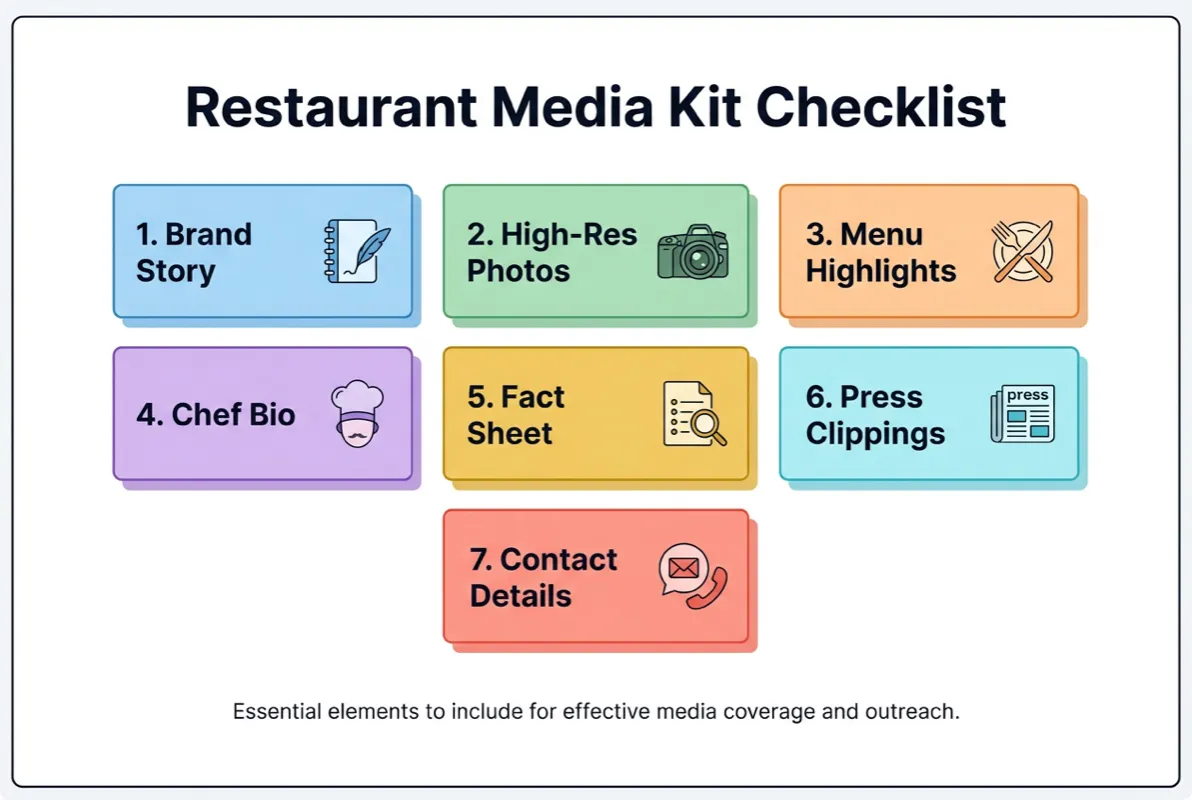
The 7 essential elements every restaurant media kit needs
Make it effortless for journalists to reach you. Include:
- Press contact name (a real person, not "info@")
- Email (checked daily)
- Phone (direct line or mobile: journalists work to tight deadlines)
- Social handles (all active platforms)
- Website (full URL)
If you're only listing a generic email address you'll always lose to competitors who give journalists a direct phone number and a named contact.
Don't Skip Press Clippings
Don't skip the press clippings section just because you think your coverage is not impressive enough. Even a mention in a local blog counts. An empty section looks worse than a modest one.
Digital vs Print Restaurant Media Kits
With that checklist covered, let's consider format. Most restaurant media kits in 2026 are digital-first: a PDF document plus images hosted in a shared folder (Google Drive or Dropbox) at full resolution.
Print media kits still matter for press events and grand openings. A branded folder with the fact sheet, a printed menu, and a card with a QR code linking to the digital image gallery makes a strong impression at press tastings.
The reality for most independent restaurants is that a well-designed PDF and a Google Drive folder covers the vast majority of media kit needs. Start there and create print materials only for specific events.
Design, Hosting, and Common Mistakes
Finally, here's how to make your restaurant media kit look professional without hiring a designer. You do not need a graphic designer. You need consistency and clarity.
Info
Related: Restaurant Website, integrating your media kit online
Design essentials:
- Match your restaurant's colours, fonts, and logo throughout
- One page per section: do not cram everything into a single document
- Label image files with descriptive names (not IMG_4392.jpg)
- Use free tools like Canva, Google Slides, or Adobe Express
Info
Related: How to Get Press Coverage for Your Restaurant, using your media kit
For instance, a seafood restaurant could use a Canva template with their navy blue brand colours and serif font throughout, matching the restaurant's menu design. The entire media kit might be just four pages: brand story, photo gallery thumbnails, menu highlights, and fact sheet with contact details.
Where to host: A dedicated page on your website (e.g., yourrestaurant.co.uk/press) linked to a Google Drive folder for full-resolution image downloads. Include the URL in your email signature and every press release.
Mistakes to Avoid
- Outdated information. The biggest mistake is leaving last year's menu or a previous chef's biography in your restaurant media kit. That does more harm than good. Update quarterly.
- Low-resolution images. If a journalist cannot use your photos in print, they will not use them at all.
- Generic brand story. "We are passionate about high-quality food" describes every restaurant. Be specific.
- No contact phone number. Journalists on deadline need to reach you quickly. Email-only frustrates them.
Quick Self-Assessment
Ask yourself: would a journalist with 30 seconds find everything they need in your media kit? If not, it needs an honest review.
If you're reading this thinking "I don't have time to build a media kit", you are not alone. Most independent restaurant owners feel the same way. But the 30-minute weekly action below breaks it into manageable steps.
If you run a restaurant and want to see how Local Brand Hub can support your marketing, explore our restaurant marketing tools.
Key Takeaway
Key Takeaway
- Seven elements give journalists everything they need: brand story, photos, menu highlights, bio, fact sheet, clippings, and contact details
- Professional high-resolution photos are the single most important element
- Start with a digital media kit (PDF plus shared image folder) and create print versions only for events
- Host your media kit on a dedicated website page and include the link in every press communication
- Update quarterly and always include a named contact with a direct phone number
Weekly Action
If you only have 30 minutes a week, do this:
- Day 1-2: Write your 150-200 word brand story using the three-question framework: Who are you? Why does your restaurant exist? What makes you different?
- Day 3-4: Gather your best five food photos and two interior shots; check they are high-resolution and label each file with a descriptive name
- Day 5-7: Create a fact sheet using the template in this guide and save everything in a shared Google Drive folder with a clean, shareable link
Frequently Asked Questions
How much does it cost to create a restaurant media kit?
The main cost is professional photography, which typically runs £200-£500 for a half-day shoot covering food, interior, and portrait photos. The rest (brand story, fact sheet, and formatting) can be done for free using Canva or Google Docs. If you have a friend with a good camera and food styling skills, you can reduce costs further, but professional lighting makes a noticeable difference in how publications use your images.
How often should I update my restaurant media kit?
Review your media kit at least quarterly. Update it immediately when you change menus, win awards, receive notable press coverage, or change key staff. An outdated media kit with last season's menu or a previous chef's biography creates confusion and undermines your credibility with journalists.
Do I need a media kit if I already send press releases?
Yes. A press release is for a specific announcement. A media kit is your permanent press resource. When a journalist receives your press release and wants to write a longer feature, the media kit gives them the background, images, and context to do so without chasing you for information. The two work together: the press release creates interest, the media kit enables coverage.
Should my media kit be on my website or just sent by email?
Both. Host a dedicated press page on your website with your media kit available for download, and send the link directly in press emails. The website version also appears in search results when journalists Google your restaurant name plus "press" or "media kit."
What if I am a new restaurant with no press clippings or awards?
Skip the press clippings section and focus on the other six elements. A strong brand story, professional photos, and a clear fact sheet are more than enough. Add clippings as you receive coverage.
For restaurants, salons, and local businesses
Need help with your marketing?
We help UK businesses turn social media into real results, not busywork.
Start freeGet More Marketing Tips
Practical marketing tips for UK business owners, straight to your inbox. No spam, unsubscribe anytime.
About the Author
Local Brand Hub
Empowering UK Businesses
Local Brand Hub provides comprehensive business management tools designed specifically for UK local businesses to streamline operations, automate marketing, and grow revenue.
More articlesRelated Articles
 Marketing Tips
How to Get Press Coverage for Restaurant Owners
Learn how to get press coverage for your restaurant with 10 proven UK tactics. Includes pitch templates, media lists, and timing strategies.
 Marketing Tips
Restaurant Opening Press Release: Template + Timeline
Free restaurant opening press release template with an 8-week PR timeline. Covers drafting, distribution, media invites, and post-opening follow-up.
 Marketing Tips
Restaurant PR: UK Guide to Earning Press Coverage
Build a restaurant PR strategy that earns press coverage and attracts food bloggers. Step-by-step guide to pitching UK journalists without an agency.