Free restaurant press release templates for menu launches, openings, awards, and seasonal events. Fill-in format with real UK examples.
You're launching a new seasonal menu next month and your head chef just won a regional award. These are stories worth telling, but you are staring at a blank page with no idea where to start. A restaurant press release template solves that, giving you a proven structure so you focus on the story, not the formatting.
That is exactly why the right press release template changes everything.
According to Muck Rack's State of PR Report (2025), journalists receive an average of 78 pitches per week, and fewer than 3% result in coverage. That means your restaurant press release template needs to work hard: roughly two sentences to prove it is worth reading.
Info
Related: Restaurant PR: complete guide to restaurant PR
What You'll Learn
- The anatomy of a press release that journalists actually read
- Fill-in templates for four common restaurant scenarios
- How to write a headline that earns opens instead of deletes
- Where to send your press release for maximum UK coverage
- Common mistakes that guarantee your release gets ignored
- How to adapt each template for email pitches and social media
Anatomy of a Restaurant Press Release
Before you fill in any template, you need to understand what makes a press release work. Journalists do not read press releases the way customers read menus. They scan for the news angle, check whether it is relevant to their audience, and decide in seconds whether to keep reading or delete.
Every effective restaurant press release follows the same structure. Get this right and the templates below become straightforward. Get it wrong and it does not matter how beautifully you write. Nobody will publish it.
The seven essential components:
- Headline: One sentence that communicates the news. No puns, no cleverness, just clarity. "Award-Winning Chef Opens Second Restaurant in Manchester" works. "A Taste of Something New!" does not.
- Subheadline: One supporting line that adds context or a key detail the headline cannot fit.
- Dateline: City and date. For UK press releases: "London, 17 February 2026."
- Opening paragraph: Who, what, when, where, why. A journalist should be able to write a short news item from this paragraph alone.
- Body paragraphs: Supporting details, quotes from the owner or chef, and context that makes the story interesting.
- Boilerplate: A standard "About [Restaurant Name]" paragraph used on every release.
- Contact details: Name, phone, email. Make it easy for journalists to reach you.
According to Cision's Global State of the Media Report (2025), 68% of journalists prefer press releases under 500 words. Keep it tight.
Lead with the story, not the restaurant
A gastropub announcing a new Sunday roast menu might lead with "The Crown & Anchor Launches All-Day Sunday Roast Menu Featuring Yorkshire Farms Beef" rather than "Exciting News from The Crown & Anchor." The first gives a journalist a story. The second gives them nothing.
If you're thinking "I'm a chef, not a writer," that is exactly why a press release template exists. The structure does the heavy lifting so you can focus on the details only you know.
Template 1: New Menu Launch Press Release
Now that you understand the structure, here's your first press release template. A menu launch is the most common reason restaurants send press releases, and the most commonly wasted opportunity. The news is not that your menu changed. The news is why it changed and what makes it different.
Fill-In Template
FOR IMMEDIATE RELEASE

[RESTAURANT NAME] LAUNCHES [SEASON/CONCEPT] MENU
FEATURING [KEY DIFFERENTIATOR]

[Subheadline with one compelling detail]

[CITY], [DATE]: [Restaurant Name], [one-line description and
location], announces the launch of its new [season/concept] menu
on [date], featuring [number] new dishes inspired by [source of
inspiration].

The new menu, developed by [head chef name and brief credential],
highlights [key theme, e.g. locally sourced ingredients, regional
traditions, dietary innovation]. Standout dishes include [dish 1
with brief description], [dish 2], and [dish 3].

"[Quote from chef or owner, personal, specific, and explaining
the thinking behind the menu]," said [Name], [Title] at
[Restaurant Name].

[Additional paragraph: pricing, availability, any special launch
events or tasting opportunities for press]

The [season/concept] menu is available from [start date] to
[end date/ongoing] at [Restaurant Name], [full address].
Reservations can be made at [booking link/phone number].

### About [Restaurant Name]
[2-3 sentences: when opened, cuisine type, key accolades, what
makes it distinctive]

### Media Enquiries
[PR Contact Name] | [Email Address] | [Direct Phone]
Menu photography and chef headshot available on request.
Info
Related: Restaurant Catering Marketing: announce your catering service
Making This Template Work
The difference between a menu launch that gets coverage and one that gets ignored usually comes down to the "why." Every restaurant updates their menu. What makes yours newsworthy?
Strong angles include:
- A partnership with a named local supplier or farm
- A chef's personal story or cultural background influencing the menu
- A response to a food trend with a genuine twist
- Dietary innovation (entirely plant-based, allergen-free options)
If you're only sending generic announcements you'll always lose to competitors who give journalists a story worth telling.
Template 2: Restaurant Opening Press Release
Next, here's a press release template for the single most important announcement you will ever make. An opening press release carries more weight than any other type because you only get one launch. According to Google (2025), new business listings receive significantly more views in their first 30 days than established ones. Your press release needs to capitalise on that window.
Info
Related: Restaurant Opening Press Release: opening-specific press releases
Fill-In Template
FOR IMMEDIATE RELEASE

[RESTAURANT NAME] TO OPEN IN [AREA/NEIGHBOURHOOD],
BRINGING [CUISINE TYPE/CONCEPT] TO [CITY]

[Subheadline: opening date, chef name, or key concept detail]

[CITY], [DATE]: [Restaurant Name], a new [cuisine/concept]
restaurant from [owner/chef name and brief background], will open
at [address] on [opening date].

The [number]-cover restaurant will serve [brief menu description]
in a [brief interior description]. [One sentence on what gap it
fills in the local dining scene.]

"[Quote from owner, why this location, what inspired the
concept, what diners can expect]," said [Name], [Title].

[Chef paragraph if different from owner: background, previous
roles at notable restaurants, cooking philosophy]

[Practical details: opening hours, price range, booking
information, soft launch dates if applicable]

A press preview and tasting will be held on [date]. To attend
or arrange an interview, contact [name] at [email].

### About [Restaurant Name]
[2-3 sentences covering the concept, team, and vision]

### For Press Enquiries
[Owner Name] | [Owner Email] | [Owner Mobile]
Interior photography, chef biography, and sample menus on request.
Info
Related: Restaurant Grand Opening Marketing: launch marketing strategies
Use the human angle
A new Vietnamese restaurant in Birmingham might lead with the chef's story of growing up cooking pho with their grandmother in Hanoi, rather than simply announcing another Asian restaurant. The human angle is what turns a business listing into a feature story.
Template 3: Award or Recognition Press Release
When it comes to earned credibility, this press release template might be the easiest to write. Awards give you free credibility, but only if you tell people about them. Many restaurant owners win awards and never send a press release, assuming the awarding body will handle publicity. They rarely do, at least not with your restaurant as the focus.
Fill-In Template
FOR IMMEDIATE RELEASE

[RESTAURANT NAME] WINS [AWARD NAME] AT [CEREMONY/ORGANISATION]

[Subheadline: what the award recognises, how many were nominated]

[CITY], [DATE]: [Restaurant Name] in [location] has been
named [award title] at the [ceremony/organisation name] [year],
recognised for [specific reason, e.g. "its innovative approach
to sustainable British dining"].

The award, now in its [Nth] year, recognises [what the award
category honours]. [Restaurant Name] was selected from [number]
nominees across [region/country].

"[Quote from owner or chef, gratitude, what the award means
for the team, future plans]," said [Name], [Title].

[Background paragraph: when the restaurant opened, other recent
achievements, what makes the win significant in context]

[Restaurant Name] is located at [address] and is open [hours].
Reservations: [booking details].

### About [Restaurant Name]
[Standard boilerplate]

### Media Contact
[PR Contact] | [Direct Email] | [Mobile Number]
Award ceremony photography and high-resolution venue images
available for download at [media kit link].
Local awards punch above their weight
A seafood restaurant in Whitby that wins an award at the local tourism awards might lead with "Whitby Chippy Wins North Yorkshire Tourism Award 2026, Selected from 42 Competitors." That kind of headline gives a journalist the story, the scale, and the local angle, all in one sentence. Local media love award stories because they are easy to verify, positive, and hyperlocal.
The reality for most independent restaurants is that a small award from your council or tourism board can generate as much local coverage as a national accolade, if you write the press release.
Template 4: Seasonal Event or Promotion Press Release
Finally, here's a press release template for your most repeatable PR opportunity. Seasonal press releases give you regular reasons to reach out to journalists. Christmas menus, Valentine's Day offers, summer terrace openings, bank holiday specials: each one is a reason to contact journalists and remind them you exist. Mapping these dates out and planning your seasonal campaigns in advance keeps you ahead of the editorial calendar.
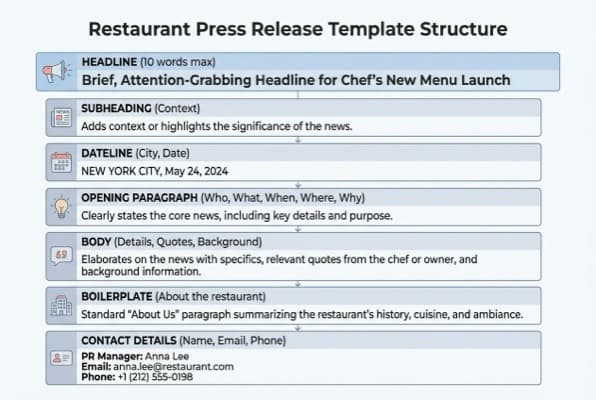
The anatomy of an effective restaurant press release: every template in this guide follows this structure.
Fill-In Template
FOR IMMEDIATE RELEASE

[RESTAURANT NAME] ANNOUNCES [EVENT/PROMOTION NAME]
FOR [SEASON/OCCASION] [YEAR]

[Subheadline: dates, pricing, or standout feature]

[CITY], [DATE]: [Restaurant Name] in [location] is launching
[event/promotion name], running from [start date] to [end date],
featuring [key offering].

[Paragraph describing the event: what it includes, pricing per
person, any exclusive elements like live music, special menus,
or guest chef appearances]

"[Quote from owner, why this event, what makes it different
from last year or from competitors]," said [Name], [Title].

[Practical details: dates, times, pricing, how to book, any
early-bird offers or group discounts]

[Restaurant Name] is located at [address]. For reservations
and enquiries: [booking details].

### About [Restaurant Name]
[Standard boilerplate]

### Bookings and Press
[Events Manager Name] | [Booking Email] | [Restaurant Phone]
Event photography, full menu PDF, and venue capacity details on request.
Time your seasonal pitches
A restaurant in Edinburgh might send a seasonal press release in October announcing a Burns Night supper with haggis tasting flights and live poetry. That gives journalists a timely, specific angle rather than a generic "we have a January menu."
According to UKHospitality, the festive season is one of the most lucrative periods of the year for UK hospitality venues. A well-timed press release sent six weeks before Christmas can secure coverage in "best Christmas menus" roundup articles that drive bookings for weeks.
If you're thinking "journalists won't care about our Christmas menu," they absolutely do. This press release template works precisely because seasonal roundups are a staple of local food journalism. Local food writers and lifestyle journalists actively compile seasonal roundups and need restaurants to pitch to them.
How to Customise Your Restaurant Press Release
Now that you have all four press release templates, here's how to customise each one. A press release template is a starting point, not a finished product. The restaurants that get consistent coverage adapt each release to feel specific and human rather than corporate and generic.
Info
Related: Restaurant Media Kit: supporting materials
Writing Headlines That Get Opened
Your headline determines whether a journalist reads your press release or deletes it. According to PR Newswire (2025), press releases with specific, factual headlines receive 30% more engagement than those with vague or promotional language.
Headlines that work:
- "Edinburgh Chef Launches Zero-Waste Tasting Menu Using 100% Scottish Ingredients"
- "Independent Curry House Wins Best Restaurant at Manchester Food Awards 2026"
Headlines that fail:
- "Exciting New Dining Experience Coming Soon"
- "We're Thrilled to Announce Our Latest Innovation"
Quotes That Sound Human
The quote is often the only part a journalist uses verbatim.
Bad quote: "We are delighted to announce this exciting new development and look forward to welcoming guests."
Good quote: "We have been testing this menu for four months. The smoked haddock kedgeree alone went through eight versions before my sous chef finally stopped arguing with me about the egg."
If you can't tell whether your quote brings personality or just fills space, that's usually a sign it needs rewriting. Ask yourself: would I read this quote aloud to a friend without feeling embarrassed?
Info
Related: How to Get Press Coverage for Your Restaurant: broader press coverage tactics
Common Press Release Mistakes to Avoid
However, even the best press release template will fail if you make these errors. Here are the six most common mistakes.
1. Writing an advert instead of news. "Come and try our amazing new menu!" is advertising. "Chef launches seasonal menu using ingredients from three named local farms" is news. A tapas bar in Bristol might write "New tapas menu available" (advert) versus "Bristol tapas bar sources ingredients from three Andalusian producers for authentic regional menu" (news). The second gives a journalist something to work with.
2. Burying the news. The biggest mistake is saving your news angle for the third paragraph. Put the most important information first. Do not build up to it.
3. Forgetting high-quality images. According to PR Newswire (2025), press releases with images receive significantly more views than text-only releases.
4. Sending to everyone at once. If you're only blasting your press release to a generic media list you'll always lose to competitors who send personalised pitches to 15 relevant journalists.
5. No follow-up. If you're only sending a press release once and never following up you'll always lose to competitors who treat the follow-up as part of the process. A polite follow-up three to five days later doubles your chances of a response.
6. Missing contact details. Many press releases omit a direct phone number. Journalists work to deadlines. If they cannot reach you quickly, they move on. Every press release template in this guide includes a contact section for exactly this reason.
Remember the golden rule
A press release is not about you. It is about giving a journalist a story they can tell their readers. The moment you stop writing about yourself and start writing for the journalist, your coverage rate changes. A press release does not sell food. It sells the story behind the food.
Which press release template should you use?
| Scenario | Template | Best Angle | Lead Time |
|---|---|---|---|
| Menu refresh | Template 1 | Named suppliers, chef story | 3-4 weeks |
| Brand new opening | Template 2 | Chef journey, local gap | 6-8 weeks |
| Won an award | Template 3 | Scale of competition, credibility | 1-2 weeks |
| Seasonal event | Template 4 | Timely hook, unique offering | 5-6 weeks |
For most UK restaurants, Template 1 (menu launch) and Template 4 (seasonal event) offer the most repeatable press release opportunities throughout the year.
Frequently Asked Questions
How long should a restaurant press release be?
Keep your press release template under 500 words when filled in. Journalists receive dozens of pitches daily and will not read a full-page document. Your opening paragraph should contain all the essential information (who, what, when, where, and why) so that even a quick scan gives them the story. Additional detail goes in the body paragraphs for those who read further.
When should I send a restaurant press release?
Send your first press release six to eight weeks before opening day. This gives journalists time to plan coverage and allows you to follow up with a second release closer to the date. For seasonal events like Christmas menus, send at least six weeks in advance to catch roundup articles.
Do I need a PR agency to send press releases?
No. Most independent UK restaurants can handle their own PR with a good press release template and a targeted media list. A PR agency becomes worthwhile when you are opening multiple sites, launching a nationally newsworthy concept, or simply do not have time to build journalist relationships yourself. For a single site, the templates in this guide are a strong starting point.
Should I include pricing in a press release?
Include pricing in your press release template when it is part of the story: for example, a tasting menu at a specific price point or an event with a per-head cost. Avoid including your full menu prices. If a journalist needs detailed pricing, they will ask, and that gives you another opportunity to engage with them directly.
How do I find food journalists in my area?
Start with your local newspaper's food section and note the bylines. Having a great press release template means nothing without the right people to send it to. Search Instagram and X for food bloggers in your city. Check journalism directories like Muck Rack or Gorkana. Build a list of 15-20 relevant contacts and keep it updated as journalists move between publications.
If you run a restaurant and want to see how Local Brand Hub can support your marketing, explore our restaurant marketing tools.
Key Takeaway
Key Takeaway
- Every press release needs seven components: headline, subheadline, dateline, opening paragraph, body, boilerplate, and contact details
- Keep it under 500 words: journalists scan, they do not read
- Lead with news, not promotion: what happened, not how excited you are
- Use specific, factual headlines instead of vague teaser language
- Write quotes that sound like a real person, not a corporate statement
- Build a targeted media list of 15-20 relevant contacts rather than blasting hundreds
- Always include high-resolution images and make it easy to reach you by phone
- Adapt each press release template to your specific story and voice
- Template 1 (menu launch) and Template 4 (seasonal event) offer the most repeatable opportunities throughout the year
For restaurants, salons, and local businesses
Need help with your marketing?
We help UK businesses turn social media into real results, not busywork.
Start freeGet More Marketing Tips
Practical marketing tips for UK business owners, straight to your inbox. No spam, unsubscribe anytime.
About the Author
Local Brand Hub
Empowering UK Businesses
Local Brand Hub provides comprehensive business management tools designed specifically for UK local businesses to streamline operations, automate marketing, and grow revenue.
More articlesRelated Articles
 Industry Insights
Restaurant PR Agency: UK Costs, Red Flags and Tips
Find the right restaurant PR agency in the UK. Covers typical costs from £1,500 to £5,000 per month, how to evaluate agencies, and red flags to avoid.
 Marketing Tips
Restaurant Outdoor Signage: A-Boards & More
Choose the right restaurant outdoor signage for your UK venue. Compare A-boards, projecting signs, fascia options, costs and planning permission rules.
 Marketing Tips
Restaurant Signage: Types, Costs and UK Regulations
Complete guide to restaurant signage for UK owners. Covers fascia signs, A-boards, LED lighting, menu boards, costs, materials and planning regulations.