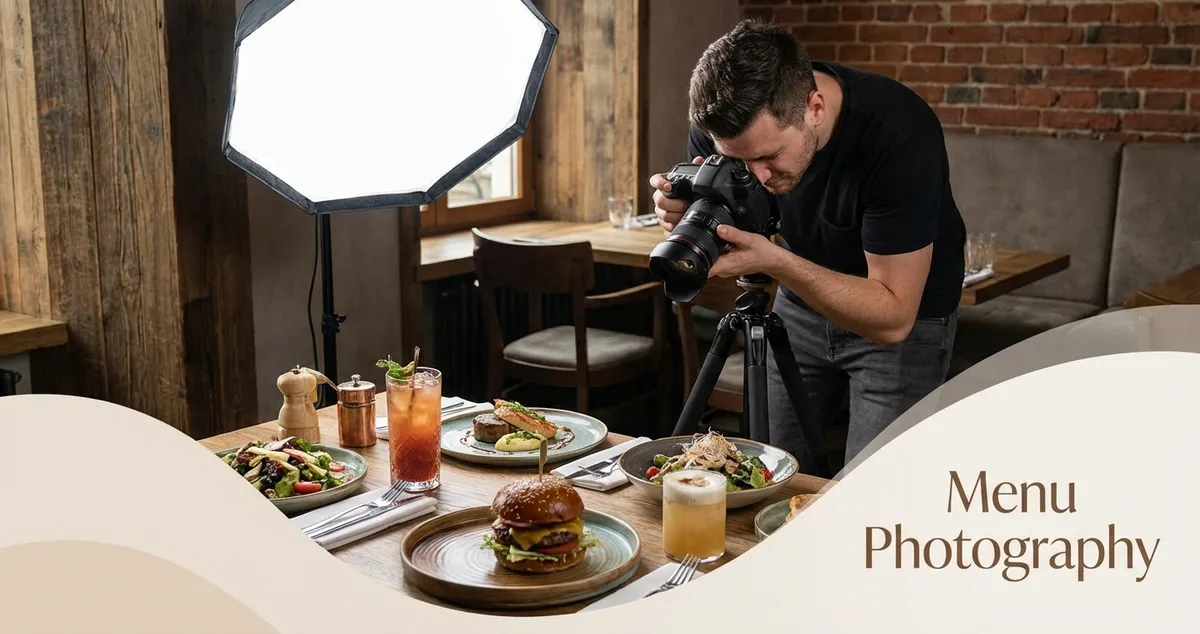
Master restaurant menu photography with the 20-60-20 lighting rule and 3:1 ratio. Learn equipment, angles, and styling for UK restaurants.
You've just spent hours updating your menu. The descriptions are perfect. The pricing is spot-on. But there's one problem: why do customers keep ordering the same three dishes whilst your £18 signature dish sits untouched? Week after week, your highest-margin items remain invisible to customers who never make it past familiar options.
The difference often comes down to your menu photography. Restaurant menu photography uses specific lighting ratios, composition angles, and styling techniques to make dishes irresistible. Professional photos generate increased orders for featured items, whilst poor photos actively reduce sales compared to no images at all. If you're only photographing dishes when you remember to do it you'll always lose to competitors who schedule dedicated photography sessions weekly.
This guide covers professional restaurant menu photography techniques, from lighting setups to composition rules that make dishes irresistible.
What You'll Learn in This Restaurant Menu Photography Guide
By the end of this guide, you'll understand:
- How to photograph food for menus using natural and artificial light
- The 20-60-20 and 3:1 lighting rules that professionals rely on
- Whether menu pictures genuinely increase sales (spoiler: they do, but only if done correctly)
- Equipment requirements from phone cameras to professional setups
- Common mistakes that make food look unappetising
Table of Contents
- How to Photograph Food for a Menu
- The 20-60-20 Lighting Rule
- Should Menus Have Pictures?
- The 3:1 Lighting Rule
- Equipment Essentials
- Common Mistakes to Avoid
- Creating a Photography Brief
- Frequently Asked Questions
How to Photograph Food for a Menu?
Let's start with the fundamentals. Restaurant menu photography requires consistent lighting, the right angle, and careful styling to make dishes look as good as they taste in person.
The Fundamentals
Natural window light, a 45-degree shooting angle, and realistic plating create images that increase orders for photographed menu items.
If you're thinking "I don't have time for a full photography session", you're not alone. Most independent restaurants struggle to find time between service shifts. The good news: once you understand the fundamentals, you can photograph five menu items in under 30 minutes.
Step 1: Set Up Your Lighting
Start with your lighting setup. Natural light typically works well for most dishes: position your setup near a large window between 10am-2pm when sunlight is brightest but not harsh. Use a white reflector on the opposite side to fill shadows.
Step 2: Follow the Process
- Set up your space: Clear a 1-metre area near your light source. Use a neutral background (white, wood, or slate depending on your brand).
- Style the dish: Plate exactly as customers will receive it. Don't over-garnish or add elements that won't be on the actual plate.
- Choose your angle: Shoot at 45° for most dishes (the "natural eating angle"). Use 90° overhead shots only for flat dishes like pizzas or salads.
- Focus on the hero element: If it's a steak, the meat should be in sharp focus. Everything else can fall slightly softer.
- Take multiple shots: Photograph each dish at least 5 times with slight variations. You'll need options when designing your menu.
- Work quickly with hot food: Steam and gloss disappear within minutes. Have your setup ready before plating.
Why Composition Matters
The difference between a photo customers scroll past and one that makes them order? Often just the angle and lighting.
The 45-Degree Rule
That 45-degree angle mimics how people naturally view food when sitting at a table.
For example, an independent Italian restaurant might photograph their house-made ravioli at a 45-degree angle with window light from 11am, using a dark wooden board as the base. The steam is visible because they photographed within 60 seconds of plating. The result: ravioli orders rose within the first week.
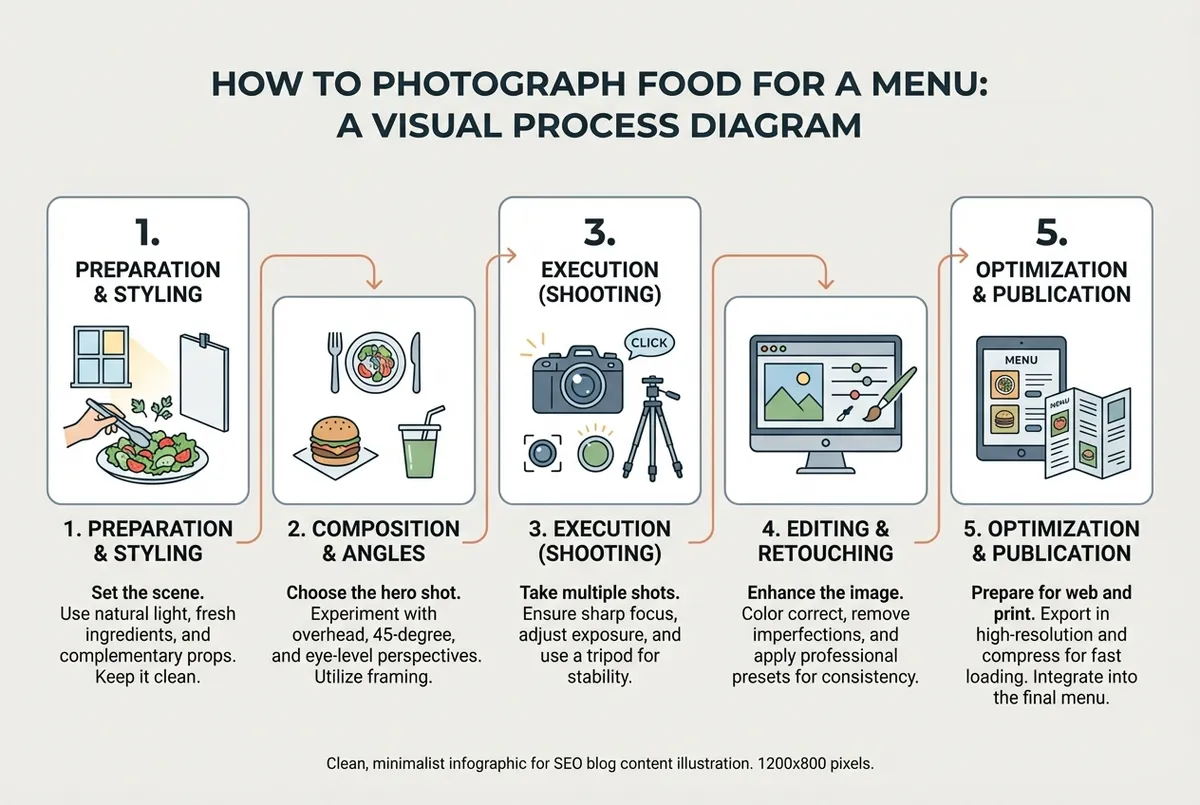
The five-step menu photography process
A gastropub using this approach might photograph their signature beef Wellington at a 45° angle with window light from the left, using a dark slate background to emphasise the golden pastry. The result: a photo that communicates quality before the customer reads a single word.
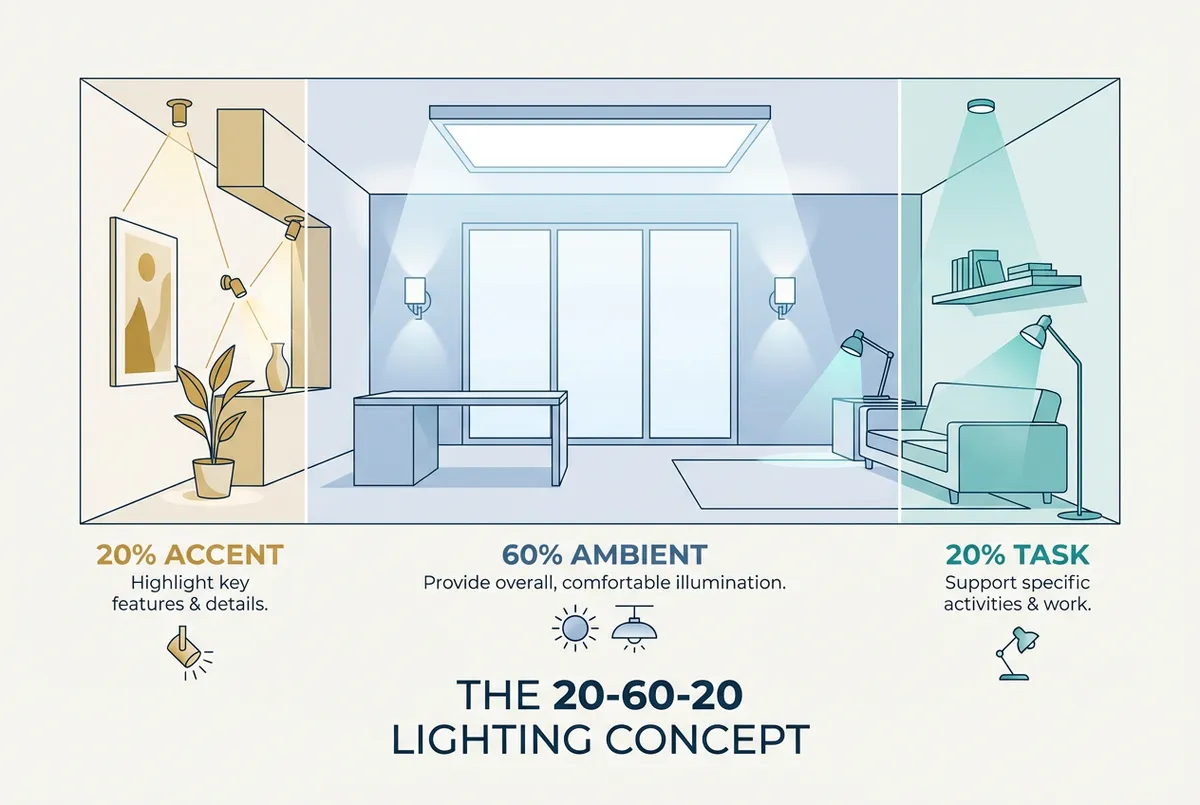
What Is the 20-60-20 Rule in Photography?
Now that you understand the basics, let's explore lighting ratios. The 20-60-20 rule is a lighting ratio where your key light provides 60% of illumination, fill light adds 20%, and backlighting contributes the remaining 20% to create depth and dimension.
Why This Matters
This rule typically addresses a frequent problem in restaurant menu photography: flat, lifeless images. When you rely on a single light source, dishes look two-dimensional.
Lighting Creates Dimension
The 20-60-20 ratio creates natural shadows and highlights that make food look three-dimensional and appetising.
How to Apply It
- Key light (60%): Your main light source, typically a window or softbox positioned at 45° to your dish
- Fill light (20%): A reflector or secondary light that softens shadows on the opposite side
- Backlight (20%): Light from behind that creates rim lighting, separating the dish from the background
The backlight is where most amateur photographers go wrong. That subtle glow around the edges of your food, the one that makes steam visible and creates separation, comes from proper backlighting. Without it, dishes blend into backgrounds.
Ideal Dishes for 20-60-20 Lighting
The 20-60-20 ratio is particularly effective for plated dishes with height, such as burgers, stacked sandwiches, or layered desserts.
For instance, a burger restaurant using this lighting setup might:
- Position their window (key light) on the left at 60% intensity
- Place a white foam board reflector (fill light) on the right at 20% intensity
- Add a small LED panel behind the burger (backlight) at 20% intensity
The backlight creates a visible rim of light around the top bun and makes the lettuce glow slightly: details that turn a decent burger photo into one that makes customers crave it.
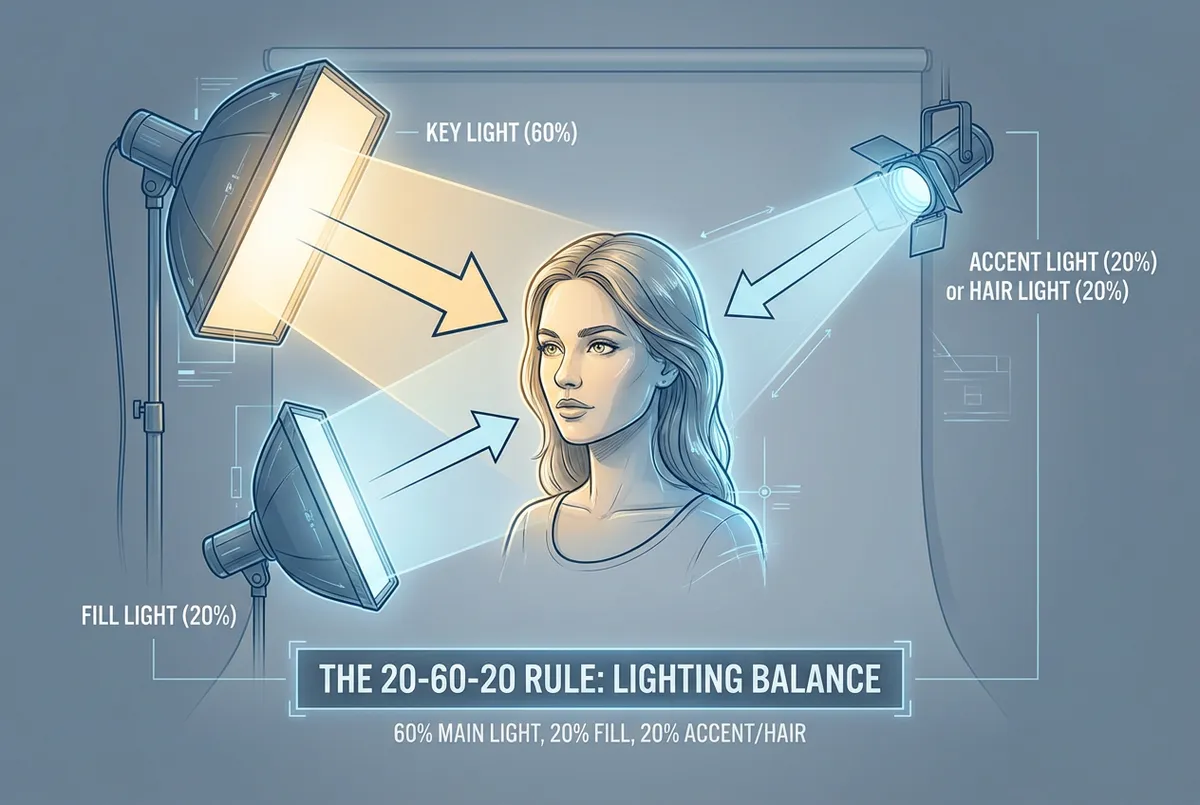
The 20-60-20 lighting rule: 60% key light, 20% fill, 20% backlight
If you're thinking "I don't have three lights", you don't need them. One window, one white reflector board (£15), and one small LED light on a stand does the job for most menu photography.
Test Your Setup
For restaurant menu photography, photograph your bestselling dish first as a test. If the results look professional, you've got your setup right. If not, adjust your lighting ratio before photographing the rest of your menu.
So you understand lighting ratios. But should you even bother with photos?
Should Restaurant Menus Have Pictures?
With that lighting knowledge in place, here's the bigger question. Restaurant menus with professional photos typically see increased orders for photographed items, but only when images meet quality standards: poor photos can reduce orders instead.
The data supports pictures, but with a critical caveat: quality matters more than presence. Research from Menu Gallery UK found that professional photos generate 30% more orders for featured items, but menus with poor-quality images can actually decrease orders by up to 20% compared to no photos at all.
When Photos Work (and When They Don't)
| Scenario | Use Photos? | Reason |
|---|---|---|
| Signature dishes | Always | Highest-margin items benefit most from visual appeal |
| Complex dishes | Yes | Help customers understand unusual ingredients or presentations |
| Visual showstoppers | Yes | Impressive plating drives orders |
| High-value items | Yes | Photos justify premium pricing |
| Budget constraints | No | Poor-quality photos can reduce orders, better to skip |
| Fine dining minimalism | Usually no | High-end aesthetic often excludes photos |
| Simple items (e.g., chips) | No | Obvious items don't need visual confirmation |
Note: This table reflects typical restaurant decisions based on research on digital menus, which suggests visual menus can increase order values. Individual results vary by restaurant type, target audience, and photo quality.
Real-World Application
Ask yourself: would you order from your own menu based on the photos alone? If the answer is no, your photos might actually be reducing orders.
For instance, a bistro with five signature dishes might photograph only those items: their venison Wellington, seafood risotto, and three seasonal specials. They skip photos for standard items like chips or salads. The result: customers confidently order high-margin items they might otherwise skip, whilst the menu maintains a clean, upmarket aesthetic.
The reality for most independent restaurants: if you're competing with chains that have professional menu photography you'll always lose customers who compare menus before choosing where to eat. They're making that decision on their phones before they walk through your door. That's exactly why it pays to get those finished shots onto your online menu and product listings, where prospective diners actually compare you.
Once you've decided photos are worth the investment, you'll need to understand lighting ratios. The 3:1 rule is simpler than the 20-60-20 approach but equally important.
What Is the 3:1 Rule in Photography?
Building on the 20-60-20 rule, here's a simpler approach. The 3:1 lighting rule is a framework where your key light should be three times brighter than your fill light, creating natural-looking shadows with definition whilst avoiding harsh contrast.
Why This Rule Matters
This ratio typically prevents two common problems:
- Completely flat lighting (when both lights are equal)
- Overly dramatic shadows (when the difference is too extreme)
The 3:1 ratio mimics natural light conditions, similar to how light falls in a well-lit room with windows.
How to Achieve the 3:1 Ratio
If you're using a window as your key light and a reflector as fill, position the reflector farther away from your subject. The inverse square law means light intensity drops rapidly with distance: moving your reflector twice as far achieves roughly a 3:1 ratio without any technical equipment.
Using Artificial Lighting
For artificial lighting, your key light should be roughly three times the power of your fill light, or use your camera's light meter to verify the ratio.
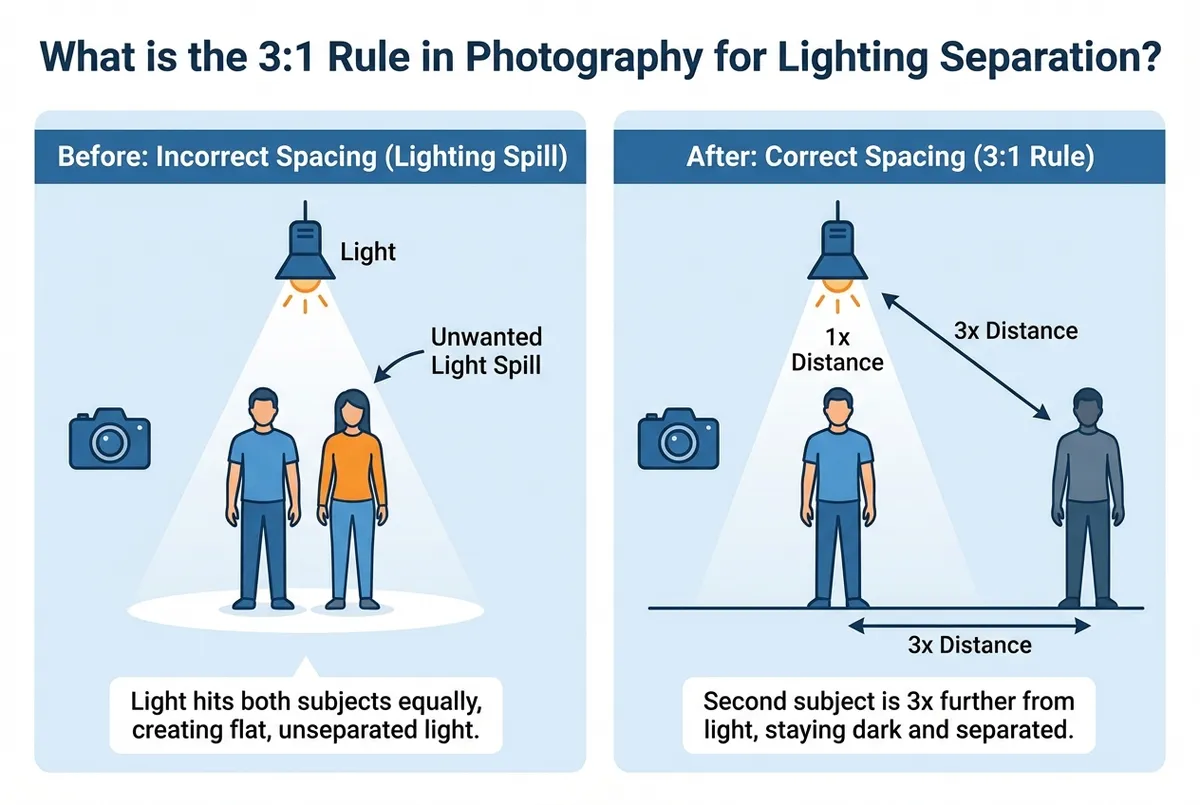
The 3:1 lighting ratio creates natural shadows without harsh contrast
When the 3:1 Ratio Makes the Biggest Difference
The 3:1 rule particularly matters for dishes with texture: steaks, grilled vegetables, or crusty bread. That ratio is what makes grill marks visible and crust look crispy rather than flat and lifeless.
For instance, a steakhouse photographing their ribeye might use window light as the key (positioned right) with a white foam board as fill (positioned left, but twice as far from the steak). The result: visible char marks, dimensional meat, and highlights that make the fat marbling obvious.
Now that you understand the lighting fundamentals, what equipment do you actually need?
Equipment Essentials for Menu Photography
Now let's talk gear. You don't need expensive equipment to create usable menu photography. If you're worried about investing thousands in equipment before knowing whether photography works for your restaurant, start with the minimum viable setup below. Most restaurants can achieve professional results with a modest setup.
Minimum Viable Setup
- Camera: A recent smartphone (2025 or later) or entry-level DSLR
- Lighting: Window light + white reflector board + small LED panel
- Backgrounds: 2-3 backdrop boards matching your brand (wood, slate, white)
- Tripod: Basic model to prevent camera shake
When to Upgrade
Once you've mastered basics, consider:
- Full-frame camera: Better in low light conditions
- Macro lens: For close-up detail shots
- Softbox lighting kit: Consistent results regardless of weather
The Real Equipment Problem
The biggest mistake restaurants make isn't insufficient equipment: it's inconsistent photography. If you're only photographing when it's sunny and you have free time you'll always lose to competitors who schedule weekly photography sessions regardless of weather. A £300 setup used correctly and consistently beats a £3,000 setup used sporadically with no technique.
For restaurants, salons, and local businesses
Need Professional Menu Photography?
If you're running a restaurant and need help creating a full menu photography suite without investing in equipment, LocalBrandHub offers professional food photography services specifically for UK restaurants. We handle lighting, styling, and editing so you can focus on what you do best, running your restaurant.
Get in TouchEven with the right equipment and lighting knowledge, certain mistakes sabotage your results.
Common Menu Photography Mistakes to Avoid
However, even with proper equipment and lighting knowledge, certain mistakes ruin restaurant menu photography. These errors turn appetising dishes into something customers scroll past.
Critical Mistakes
- Flash photography: Direct flash creates harsh shadows and makes food look flat: that rarely works for menu photography. Use natural light or continuous LED lighting instead.
- Wrong white balance: Food shot under warm kitchen lights looks orange. Food under cool office lights looks blue. If customers say "it looked different in the photo" when their dish arrives that's usually a sign your white balance is off. Set custom white balance or shoot RAW to correct in editing.
- Over-editing: Cranking saturation makes food look artificial. Don't over-saturate colours or you'll end up with photos that look nothing like the actual dish. Subtle adjustments maintain appetite appeal.
Composition Errors
- Inconsistent angles: Choose one primary angle (45° for most dishes, 90° for flat items) and stick with it across your entire menu for visual cohesion.
- Cluttered backgrounds: Props should enhance, not distract. If a garnish or utensil doesn't add to the story, remove it.
Timing Matters
Shooting hot food whilst cold: Steam and gloss disappear within minutes. Have your setup ready before plating. If you're only photographing dishes when the kitchen has downtime you'll never capture the fresh-plated appeal that makes food irresistible.
The Colour Accuracy Problem
Colour accuracy is critical: customers who receive dishes that don't match the menu photo are often disappointed, even when the food itself is excellent. That's usually a sign your white balance is off during shooting.
With equipment sorted and mistakes to avoid noted, you're ready to plan your first session.
Creating a Menu Photography Brief
Finally, let's plan your session. Before your photography session, create a shot list and brief. This prevents wasted time and ensures consistency across your entire menu. Without a brief, most restaurants end up re-shooting a large share of their menu photos because angles or styling don't match.
What to Include in Your Brief
- List of dishes to photograph (prioritise high-margin items)
- Preferred angles for each dish type (45° for most, 90° for flat items)
- Background choices that match your brand (wood, slate, white)
- Styling requirements (garnishes, props, plating standards)
- Delivery format (web resolution for digital menus, print resolution for physical menus)
Technical Specifications
For physical menus, you'll need images at 300 DPI. For digital menus and websites, 72 DPI at 1200px wide is sufficient. Shoot at the highest quality your camera allows: you can always reduce resolution but can't add it later.
For instance, a cafe planning their menu photography might create a brief specifying: all photos shot at 45°, white wooden board background, natural props only (cutlery, napkins), window light with reflector, and delivery at 1200px wide for their digital menu boards.
Weekly Action
This Week's Action Plan
This week, audit your current menu photography or plan your first session:
- Day 1-2: Select your five highest-margin dishes that would benefit most from photography
- Day 3-4: Test your lighting setup with one dish: photograph it five times with slight variations
- Day 5-7: Review your test shots. If they're usable, schedule a full menu photography session. If not, identify what needs improvement (lighting? angle? styling?)
Still have questions? Here are the most common ones from restaurant owners.
Frequently Asked Questions
Here's what restaurant owners commonly ask about menu photography.
Can I use my smartphone for restaurant menu photography?
Yes. Smartphones produce professional-quality menu photos when used correctly. The key is understanding lighting: a smartphone with proper natural light and a reflector often beats a DSLR with poor lighting. Focus on mastering the 20-60-20 lighting ratio and 45-degree angles rather than investing in expensive cameras initially.
How many menu items should have photos?
Start with your five highest-margin dishes and signature items. Photographed items tend to receive more orders, but you don't need photos for every dish. Prioritise items that are visually impressive, expensive, or complex enough that customers need visual confirmation before ordering.
What's the optimal time to photograph menu items?
Between 10am-2pm when natural window light is brightest but not harsh. Avoid early morning or late afternoon when light becomes too warm or dim. Consistency matters: photograph all menu items within the same two-hour window to maintain colour consistency across your entire menu.
Do I need to hire a professional photographer?
Not initially. Most restaurants should start by learning the fundamentals themselves: it's more cost-effective and gives you control over updating menu photos as dishes change. Consider hiring a professional once you've mastered the basics and need high-volume photography for a full menu refresh or if your brand positioning requires exceptional photography quality.
What basic equipment do I need for menu photography?
A minimum viable setup includes: a smartphone (2025 or later) or entry-level DSLR, window light plus a white reflector board (around £15) and a small LED panel, 2-3 backdrop boards matching your brand aesthetic (wood, slate, white), and a basic tripod to prevent camera shake. Most restaurants achieve professional results with this modest setup costing under £300 total.
Key Takeaways: Restaurant Menu Photography
If you run a restaurant and want to see how Local Brand Hub can support your marketing, explore our restaurant marketing tools.
Key Takeaways: Restaurant Menu Photography
Professional restaurant menu photography isn't about expensive equipment: it's about understanding light, composition, and how to make food look as appealing in photos as it tastes in person. With the right restaurant menu photography techniques, any restaurant can create images that drive orders.
Remember These Key Points
- The 20-60-20 lighting rule creates dimension: 60% key light, 20% fill, 20% backlight
- The 3:1 ratio prevents flat lighting whilst avoiding harsh shadows
- Menu photos increase orders for photographed items, but only when quality is high
- Natural window light plus a reflector beats poor artificial lighting every time
- Consistency matters more than perfection: choose one style and apply it across your entire menu
Start with your signature dishes. Master the restaurant menu photography fundamentals. Then expand to your full menu. The investment, whether time or budget, pays for itself in increased orders within weeks.
For UK restaurants
Need Professional Restaurant Photography?
Get expert help showcasing your dishes in the best possible light.
Contact LocalBrandHubGet More Marketing Tips
Practical marketing tips for UK business owners, straight to your inbox. No spam, unsubscribe anytime.
About the Author
Local Brand Hub
Empowering UK Businesses
Local Brand Hub provides comprehensive business management tools designed specifically for UK local businesses to streamline operations, automate marketing, and grow revenue.
More articlesRelated Articles
 Marketing Tips
Restaurant Photography: Complete UK Guide (£150-£2,000)
Restaurant photography guide: market rates (£150-£2,000), lighting rules, shot list, when to hire pro vs DIY for UK venues.
 Marketing Tips
Restaurant Photography Pricing UK: What to Charge in 2026
UK restaurant photography pricing typically ranges from £150-£800 per session. Learn day rates, hourly pricing, the 20-60-20 rule, and regional variations.
 Marketing Tips
DIY Restaurant Photography: Complete Guide for UK Venues
Shoot professional-looking food photos with your smartphone. Step-by-step lighting, styling, and editing tips for UK restaurants.