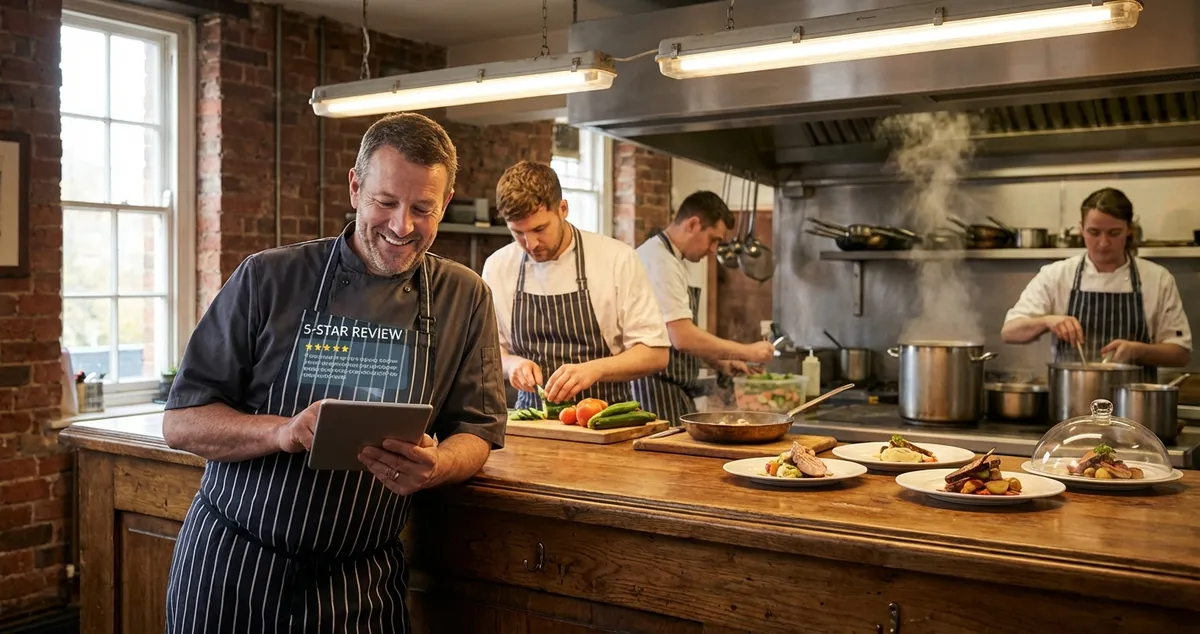
Watch the visual overview· 90 seconds
Restaurant review response examples for five-star, mixed and angry reviews, plus the four part shape and what UK rules let you put in a public reply.
A good restaurant review response does four things in about forty words. It uses the guest's name, names one specific from their visit, adds a line only someone who works there would know, and gives them a reason to come back with no condition attached. Every example below is that shape, cut to fit the review.
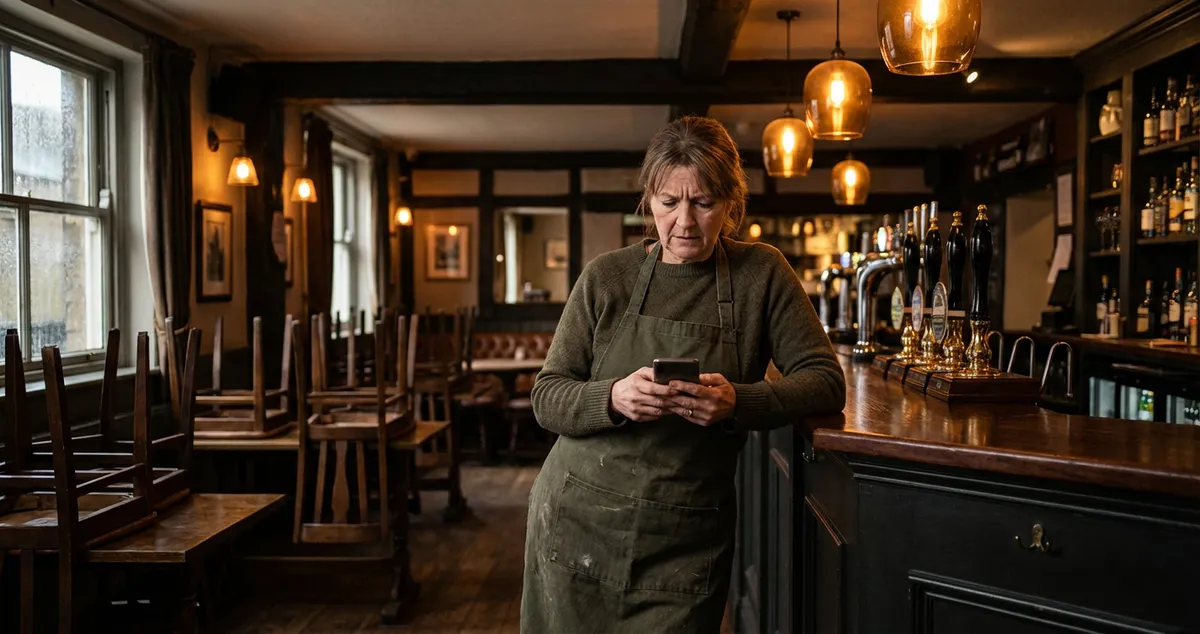
Half eleven, last table gone, and there it is on your phone: three stars, chips were cold, staff lovely. You can answer it badly now or well tomorrow. Before you choose, it is worth knowing who you are actually answering.
Not the reviewer. Open any restaurant listing and look at how the replies are displayed: each one sits publicly under the review it answers, signed by the business rather than by whoever typed it. The guest who wrote it has moved on to Tuesday. The strangers scrolling your Google reviews at half six on a Friday, thumb hovering between you and the place across the road, have not.
A review reply is not customer service performed in public. It is the only part of your listing that a stranger reads in your own voice, and it stays there for years. Write it for them.
What follows is the shape, then worked replies for the reviews you actually get, then the rule that changed in 2025 and quietly made a favourite line of the template lists unusable.
What Is an Example of a Good Response to a Positive Review?
A good response to a positive review repeats something specific the guest mentioned, adds a detail they could not have known, and leaves the door open. Thirty seconds of work. The specific is the part everyone skips, and it is the only part that proves a human read the review rather than a rota'd assistant clearing a queue.
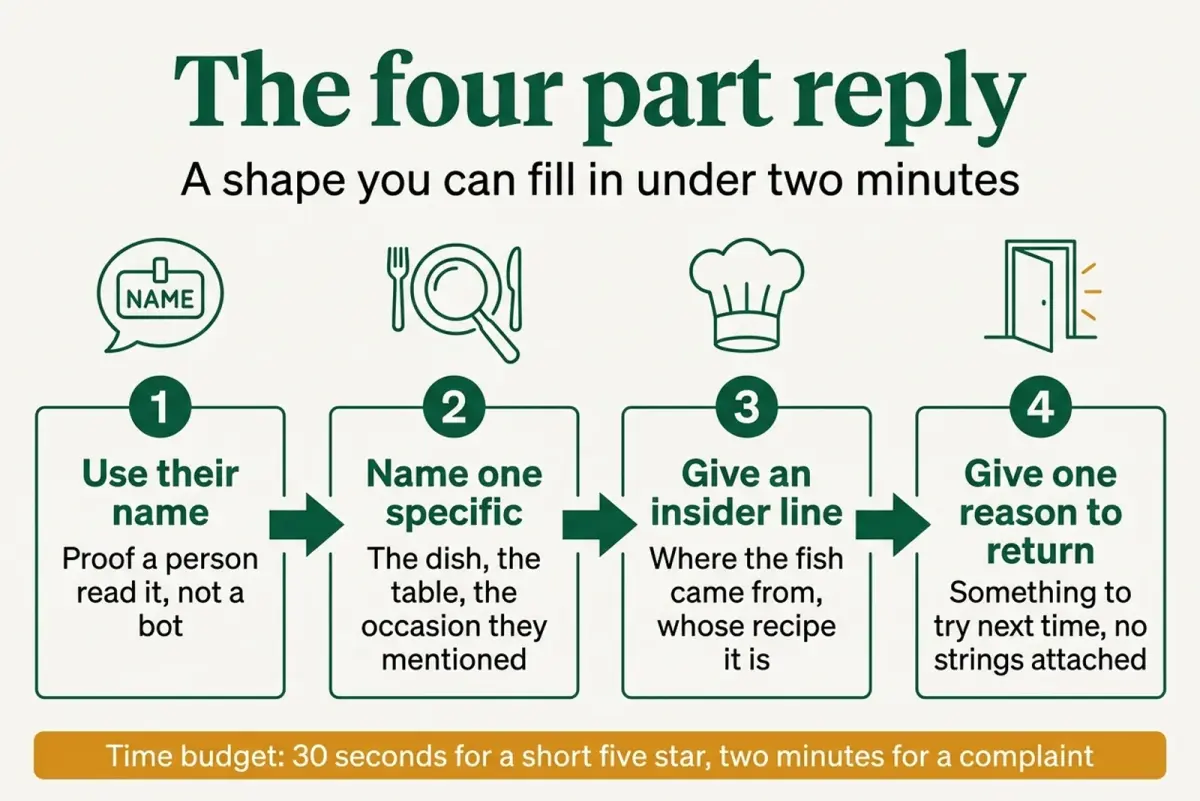
The four part shape carries a furious paragraph and a one line five star alike. On the short ones you keep the name and drop whatever the review gives you nothing for.
The four parts, in the order they go on the page:
- Their name. Proof a person read it.
- One specific. The dish, the table by the window, the anniversary they mentioned.
- An insider line. Where the fish comes from, whose recipe it is, why the bread takes two days.
- An open door. Something to try next time, with no condition attached to it.
Here is that shape doing the work on three real-world review types. Names and dishes are invented; the structure is not.
They praised the food:
"Thanks for this, Sarah. Glad the lamb shank landed, it is Marco's grandmother's recipe and he still makes the gremolata to order. If you are back in the autumn, ask about the mutton, it only runs when our farm in Cumbria has it."
They praised the service:
"James, this made Emma's whole week and I have printed it for the pass. She noticed the anniversary card in your coat pocket, which is very Emma. Come back for the next one and we will keep the corner table."
They praised the room:
"Thank you, Priya. The banquettes came out of a closed-down cinema in Bolton and we spent a fortnight arguing about the colour, so this is a good day. The back room is quieter if you fancy a long lunch."
Read each one aloud. If you would not say it standing at the table, it is not ready. That single test kills more corporate mush than any checklist.
Pre-write the personalised half
Keep a note on your phone with six insider lines, one per signature dish. Sourcing, whose recipe, how long it takes. Ninety seconds to write once, and the personalised half of every future reply is already done.
Related: Restaurant review management, for the routine around the replies.
What Are 5-Star Positive Review Examples, and What Do You Say Back?
Five star reviews arrive in about five flavours, and each one hands you a different opening. The trick is answering the compliment they actually paid rather than the one you wish they had.
| What they praised | What they typically write | What you say back |
|---|---|---|
| Food quality | "Best fish and chips I have had in years" | Name the supplier or the technique |
| Service | "Our waiter was so attentive" | Name the person, tell them it reached them |
| Atmosphere | "Such a cosy little place" | Explain one deliberate choice you made |
| Value | "Huge portions for the price" | Reinforce it without apologising for the price |
| Occasion | "Made my mum's birthday" | Acknowledge the occasion, invite the next one |
Adapt the angle to your room. A tasting menu and a Friday chippy do not sound alike, and should not.
Not every review deserves an essay. A bare five stars with no words has nothing to personalise, so do not manufacture warmth you have not earned.
"Thank you, Michael. Much appreciated."
"Cheers, Alex. See you next time."
"Thanks for the stars, Rebecca. Hope the walk home was drier than ours."
Short is not lazy. Short is honest when there is nothing to work with, and it keeps your thirty seconds for the reviews that will actually be read.
How Do You Respond to a Bad Restaurant Review?
Own the fault in the reviewer's own words, skip the explanation, say what has changed, and move the repair off the page. Five sentences is a sensible working limit, because the longer a reply runs the more of it is spent defending, and the defence is the part a stranger scrolling past takes away.
The instinct is to explain. It was a Saturday, the chef was down, the delivery came late. All true, and all of it sounds like an excuse to a person who paid full price for cold chips. The explanation is the fastest way to lose the room.
Cold food:
"Mark, cold mains are not something I am going to talk you out of, and I am sorry. We have changed how the pass runs on Saturdays since your visit. If you email me at hello@yourrestaurant.co.uk I would like to sort this out with you directly."
Slow service:
"Hi Dana, forty minutes for starters is too long and I can see from the book that Saturday got away from us. We have added a runner on weekend evenings. I am at hello@yourrestaurant.co.uk if you will let me put it right."
A review you do not recognise:
"Thank you for this, and I am sorry. I cannot find the booking, so I may be missing something. Would you email me at hello@yourrestaurant.co.uk with the date? I would rather understand it than guess."
Notice what none of them do. They do not argue about who was right, they do not mention the other twelve tables that had a lovely evening, and they do not attach an offer to the apology in public. There is a reason for that last one, and it is the rule that changed under everyone's feet in 2025.
Can You Offer a Free Meal in a Review Response?
You can apologise with a gesture. You cannot trade a gesture for a review. Submitting, or commissioning another person to submit or write, a fake consumer review or a consumer review that conceals the fact it has been incentivised, is a banned practice under the UK unfair commercial practices regime. A free dessert offered on the condition that someone writes something nice is a commissioned review, and unless the reader can see the dessert was part of the deal, it conceals what it cost you.
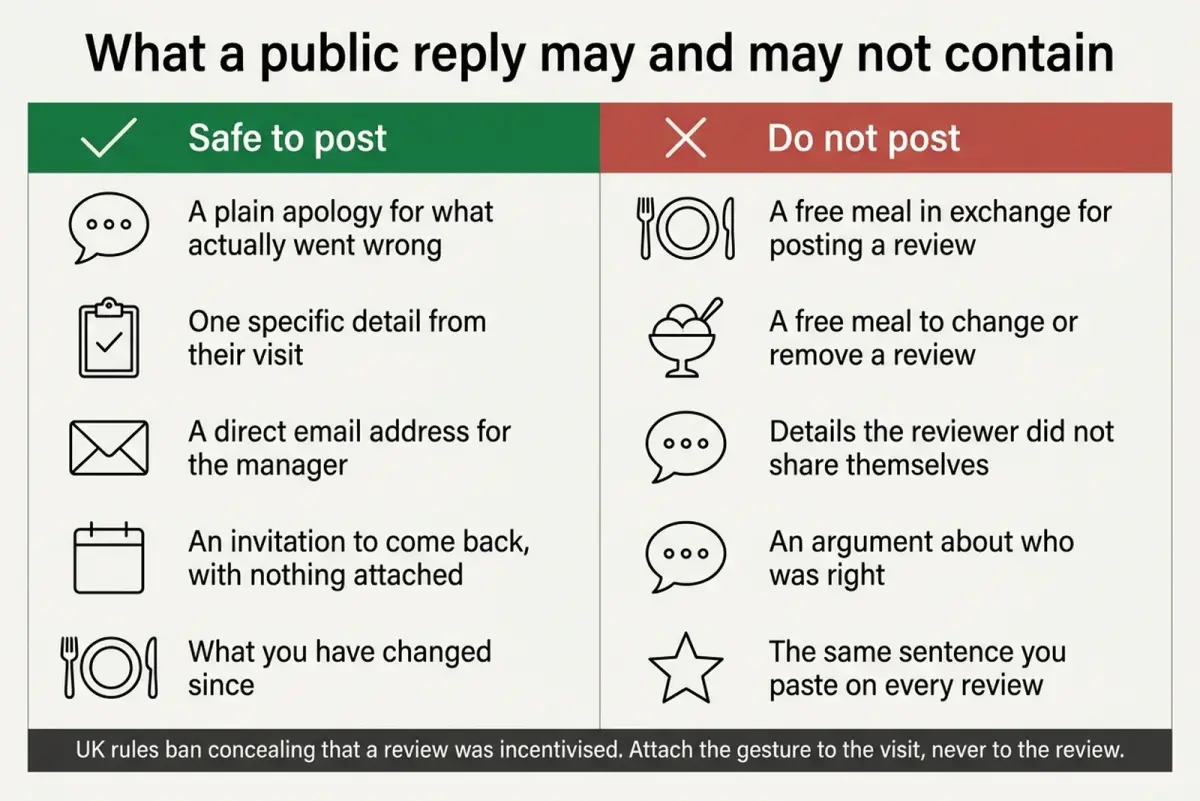
Service recovery on the left. On the right, an incentive attached to a review, which is a different thing entirely.
Hold the distinction, because it is narrow. "Come back and let us cook for you properly, on us" attaches the gesture to a visit. "Your next dessert is on us, just mention this review when you book" attaches it to the review. That second version is the one an earlier draft of this very guide recommended, in bold, as a way to win a fence-sitter round.
None of this is old law being dusted off. Those provisions came into force in April 2025 under the Digital Markets, Competition and Consumers Act 2024, which gave the Competition and Markets Authority the ability to deliver more effective consumer protection. Advice written before that date was given in good faith. That does not make it safe to copy now.
Under the same regime, a company that infringes consumer protection law can be fined up to 10% of its global turnover. A ceiling written as a share of turnover scales with whoever it lands on, so that headline figure describes the exposure of the largest offenders, not of a forty cover dining room. Read it as scale, not as permission. The reason to stop trading desserts for stars is that the practice is a named banned practice rather than a matter of taste, and the sentence in your reply is public evidence of it either way.
The point: an apology can carry a free meal. A review cannot carry a price.
Related: What to do about fake restaurant reviews, which sits on the other side of the same rules.
How Do You Reply Professionally When There Is No Time?
Book one twenty minute slot a week, work the queue in priority order, and accept that a short reply posted beats a perfect one drafted in your head during service. Professional here means consistent, not polished.
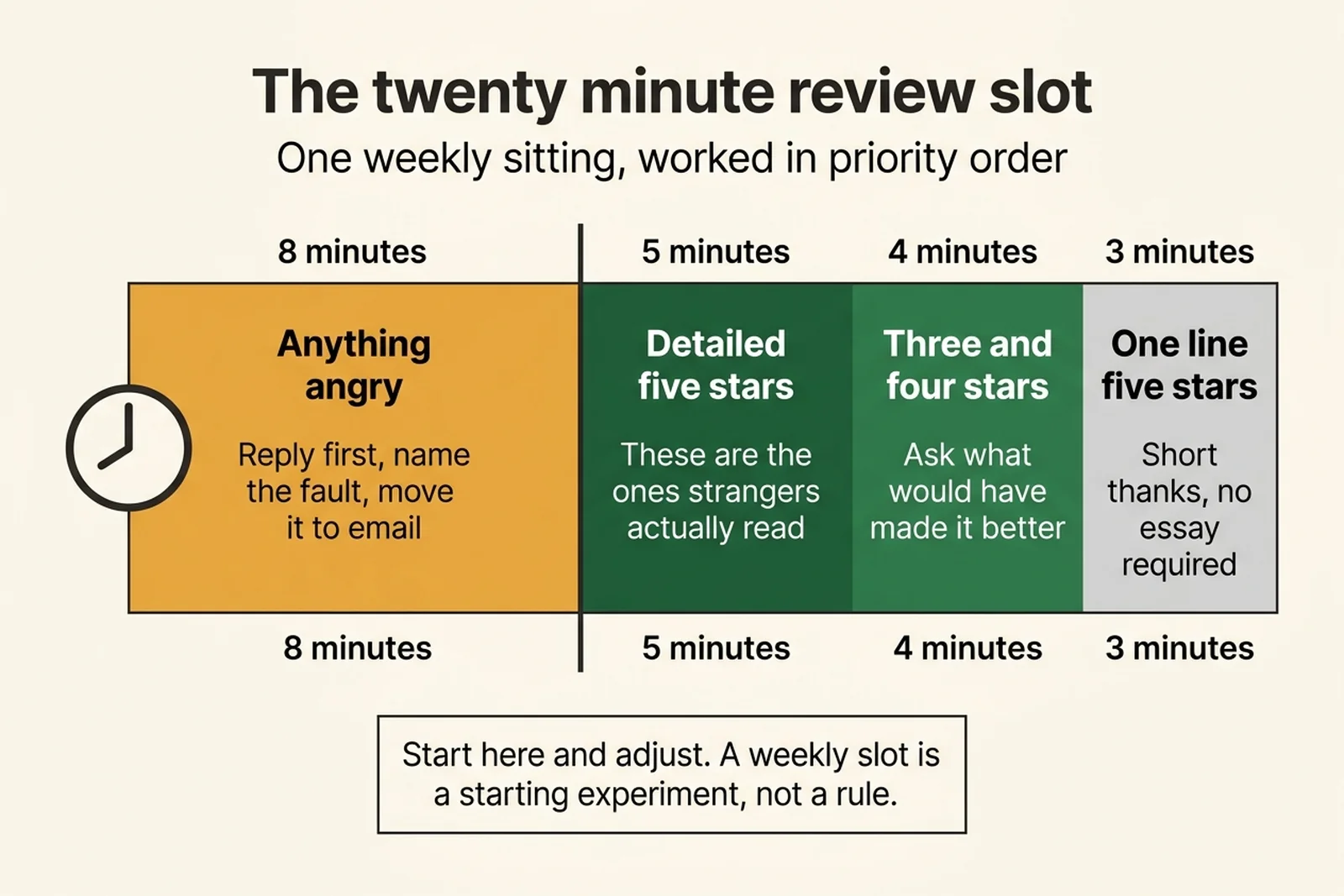
Treat the twenty minutes as a starting experiment. If your queue is longer, or angrier, move the boundaries.
Priority order, because the queue is never empty:
- Anything angry, first. Until you reply, the complaint stands as the only account of that evening.
- Detailed five stars, second. A long compliment gives you the most to work with, so it makes the best shop window.
- Three and four stars, third. Ask what would have made it better, and ask it like you want the answer.
- Bare five stars, last. One line each, and no guilt about it.
The cadence is not a law of physics. A weekly slot is a starting point you adjust once you see how full the queue actually gets, and there is nothing magic about the number twenty. What matters is that it happens on the same day each week, because the alternative is a fortnight of silence and then a panicked evening of catch-up replies that all sound identical.
Why this matters: if you are reading this thinking you barely have time to breathe, you are not imagining it. Marketing gets squeezed into whatever gap survives between service, ordering and staffing. The reply queue is one of the few marketing jobs where twenty consistent minutes tends to beat a heroic afternoon, because the audience for it arrives in a trickle rather than a wave.
LocalBrandHub keeps your reviews, your social posts and your product listings in one place so an unanswered review does not sit for a fortnight before anyone notices, and the Monday report email tells you what is working. If you would rather grow the queue than manage it, start with how to get more Google reviews for your restaurant.
Frequently Asked Questions
How quickly should I reply to a restaurant review?
Sooner is better for anything critical, because until you answer it, the complaint is the whole of what the next person sees. There is no magic window, so treat any fixed deadline as a starting experiment rather than a rule: pick a weekly slot, see whether your queue clears, and tighten it if angry reviews are sitting longer than they should.
Should I reply to every single review?
Reply to everything with words in it. A bare star rating with no comment gives you nothing to personalise, so a one line thank you is honest and enough. If you have to choose, critical reviews and detailed compliments earn the time, because those are the two that give a stranger something to weigh: how you handle a bad night, and what you are proud of.
What are good 5-star review reply examples for a restaurant?
The strongest ones are short and specific: thank the guest by name, repeat the thing they praised, add a detail only the kitchen would know, and suggest what to try next time. "Thanks for this, Sarah. Glad the lamb shank landed, it is Marco's grandmother's recipe." That is the whole job.
Can I use AI to write review replies?
For a first draft, yes, and it will save you the blank page. It cannot supply the specific, because it does not know that the banquettes came out of a closed cinema in Bolton or that Emma spotted the anniversary card. Add that yourself before posting, or you will publish twenty replies that read like one.
Can I offer a free dessert to someone who left a bad review?
You can offer to make it right on their next visit. What you cannot do is make the offer conditional on them posting or rewriting a review, because commissioning a review that hides the fact it was incentivised is a banned practice under the UK regime. Keep the gesture attached to the meal, and take the detail to email rather than the public thread.
What if the review is fake, or meant for a different restaurant?
Reply once, calmly and factually, without accusing anyone in public, then report it through Google's reporting flow. A measured reply is what the next reader judges you on even when the review is nonsense, and a defensive one makes an invented complaint look plausible.
Weekly Action
- This week: open your Google Business Profile and count the reviews from the last month with no reply. That number is your backlog, and it is usually smaller than it feels.
- Then: write your six insider lines into a note on your phone, one per signature dish, so the personalised half of every reply is pre-written.
- Then: put a repeating twenty minute slot in the diary on the same day each week and clear the backlog in priority order.
Key Takeaways
Key Takeaway
- Write the reply for the next reader, not the reviewer. It sits publicly under their review and it outlives the meal by years.
- The shape is name, one specific, one insider line, one open door. Thirty seconds for a short review, two minutes for a hard one.
- On a bad review, own the fault in their words, skip the explanation, and move the repair to email.
- Attach a gesture to the next visit, never to the review. Commissioning a review that conceals it was incentivised is a banned practice under the UK regime in force since April 2025.
- A weekly slot in the diary beats good intentions. Angry first, detailed five stars second.
For restaurants, salons, and local businesses
Need help with your marketing?
We help UK businesses turn social media into real results, not busywork.
Start freeSources
Get More Marketing Tips
Practical marketing tips for UK business owners, straight to your inbox. No spam, unsubscribe anytime.
About the Author
Local Brand Hub
Empowering UK Businesses
Local Brand Hub provides comprehensive business management tools designed specifically for UK local businesses to streamline operations, automate marketing, and grow revenue.
More articlesRelated Articles
 Marketing Tips
Fake Restaurant Reviews: Spot, Report and Protect
Learn how fake restaurant reviews work, why they're illegal in the UK, and practical steps to protect your restaurant's reputation from fraud.
 Marketing Tips
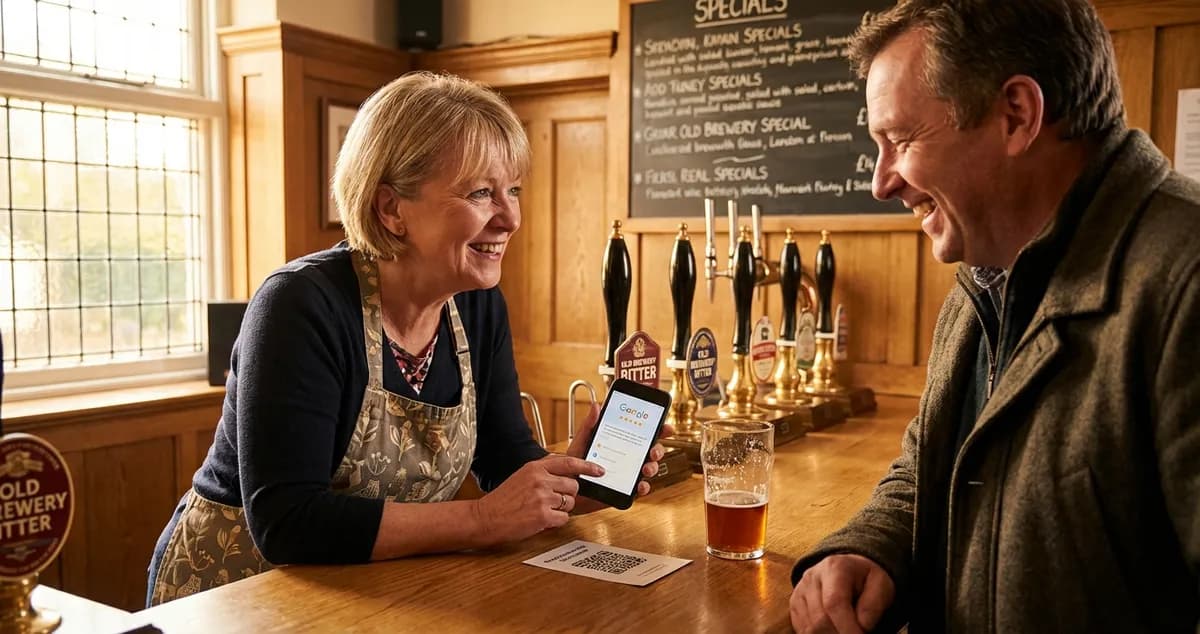
How to Get More Google Reviews: 7 Proven Strategies
How to get more Google reviews for your UK business. 7-step system covers legal methods, optimal ratings, and strategies that fit your busy schedule.
 Marketing Tips
How to Get More Google Reviews for Restaurant: 6 Steps
How to get more Google reviews for restaurant success: 6 proven steps UK owners use, including staff scripts, timing tips, and response templates.