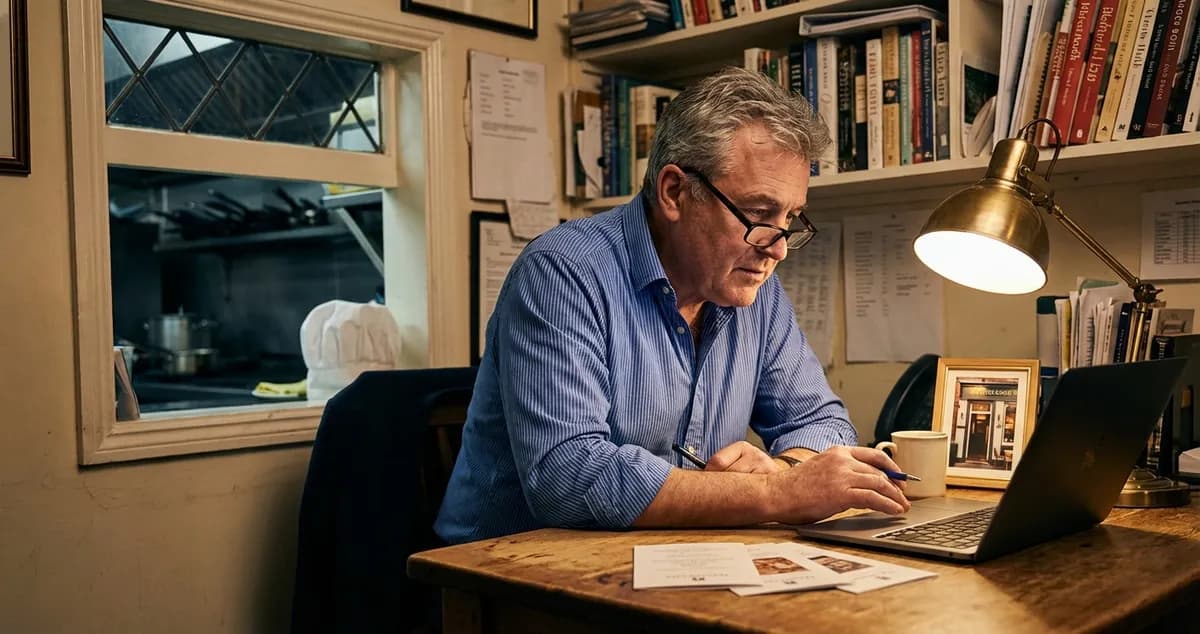
How to respond to restaurant reviews with proven templates and real-world UK examples. Turn negative feedback into repeat customers.
You check your phone after a 12-hour shift. Three new Google reviews. Two are lovely. One tears into your chips. "Soggy." "Overpriced." "Wouldn't return." Your stomach drops. You want to defend yourself, explain the context, maybe point out that this person arrived twenty minutes before close. But responding angry never ends well.
If you're reading this thinking "I don't have time for this review management stuff", you're not alone. Most restaurant owners feel the same way.
Here's the thing: how you respond to restaurant reviews matters more than whether the review is fair. According to a 2024 BrightLocal consumer survey, 88% of consumers would use a business that responds to all its reviews, compared to just 47% who would consider one that doesn't respond at all. That means your response isn't just for the person who complained. It's for every potential customer reading that exchange before deciding whether to book a table.
This guide covers exactly how to respond to restaurant reviews, whether positive, negative, or somewhere awkwardly in between. You'll get practical templates, timing guidance, and real examples you can adapt for your own restaurant.
Why this matters: Research from Harvard Business School found that a one-star increase in Yelp ratings leads to a 5-9% increase in revenue for independent restaurants, and higher ratings also strengthen your visibility score so you surface more often in local search.
What You'll Learn
- How to respond to bad restaurant reviews without sounding defensive
- The timing that makes a difference (and what's "too slow")
- Templates you can adapt for negative, positive, and mixed reviews
- How to turn complaints into opportunities for customer recovery
- When to take conversations offline
How Do You Respond to a Bad Restaurant Review?
With that context in mind, let's start with the most common challenge when you respond to restaurant reviews: someone's left a scathing review, and you need to respond without making things worse.
Responding to restaurant reviews when they're negative is a framework that combines acknowledgment, apology, and action. The five-step response framework means acknowledging the customer's experience, apologising sincerely without making excuses, and offering a way to make things right. The goal isn't to win an argument. It's to show future readers that you take feedback seriously and genuinely care about your guests.
The Five-Step Framework
- Thank them for the feedback: Even if it stings. This signals maturity.
- Apologise for their experience: Not "sorry you feel that way." Actually apologise.
- Acknowledge the specific issue: Show you read what they wrote.
- Explain what you're doing about it: Keep it brief. One sentence.
- Invite them back: Offer your email or phone for direct contact.
Example Response to a Bad Review
"Hi Sarah, thank you for taking the time to share your feedback. I'm sorry your fish and chips didn't meet expectations, especially given how important this dish is to us. I've spoken with our kitchen team about consistency during busy periods. I'd love the chance to welcome you back and show you what we're really about. Please email me directly at [email] so I can arrange this personally. Tom, Owner"
Notice what this doesn't do: it doesn't argue about whether the chips were actually soggy. It doesn't make excuses about being short-staffed. It doesn't suggest the customer is wrong.
If you're thinking "but what if they ARE wrong?", that doesn't matter. The response isn't about being right. It's about what 50 other people will think when they read it.
For example, a gastropub in Manchester received a one-star review complaining about slow service during a busy Saturday. Instead of explaining they were short-staffed, the owner simply apologised, acknowledged the wait was unacceptable, and offered a complimentary starter on their next visit. The reviewer returned, updated to four stars, and became a regular.
Info
Now that you understand the basic framework, let's look at the specific language that makes responses feel genuine rather than corporate.
How to Politely Respond to a Negative Review
Building on the five-step framework above, politely responding to a negative review requires separating your emotional reaction from your professional response. The key is reading the review, stepping away for at least ten minutes, then writing with empathy rather than defence.
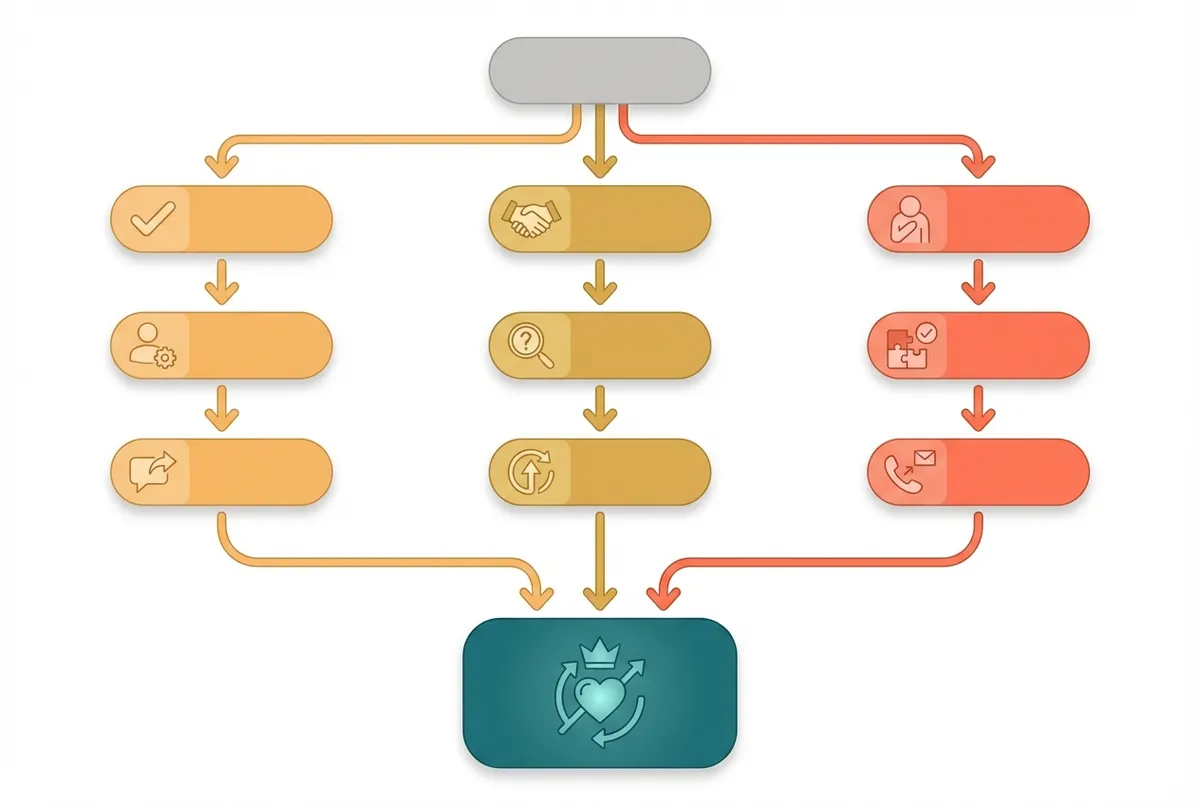
A step-by-step process for turning negative reviews into professional responses
The Timing Question
Most reputation management experts recommend responding within 24-48 hours. Too fast can seem reactive. Too slow suggests you don't care. According to BrightLocal research, 93% of consumers expect a business to respond to their reviews, so responding promptly signals that you value customer feedback.
For restaurants specifically, aim for 24-48 hours. This gives you time to:
- Investigate what actually happened
- Speak to the staff who were working
- Cool down if the review made you angry
- Craft a thoughtful response
What to Avoid
- Defensive language: "Actually, our chips are award-winning" sounds petty
- Blame shifting: "The supplier sent us lower quality that day" sounds like an excuse
- Arguing publicly: Even if you're right, you look bad
- Copy-paste responses: People can tell, and it feels dismissive
- Ignoring the review: Research shows consumers are nearly twice as likely to use a business that responds to reviews (88%) versus one that doesn't respond at all (47%), according to BrightLocal
If you can't tell whether your responses sound genuine or scripted, that's usually a sign you're overthinking it. Read your draft aloud. If it sounds like something a robot would say, rewrite it.
A Template You Can Adapt
"Hi [Name], thank you for your honest feedback about your recent visit. I'm genuinely sorry that [specific issue] didn't meet the standard we set for ourselves. [Brief acknowledgment or action]. I'd really appreciate the opportunity to make this right. Please reach out to [contact method] so we can discuss this further. [Your name], [Role]"
For instance, a London bistro uses a variation of this template for every negative review, changing only the specific details. They report that a significant portion of complainers who receive personalised responses return within three months.
So you've got the framework for bad reviews. But what happens when the review isn't terrible, just lukewarm?
How to Respond to a Not So Good Review
Moving beyond clearly negative feedback, not so good reviews, the three-star "it was fine" variety, can be trickier than outright negative ones. They often lack specific complaints, making it harder to address what went wrong.
Understanding the Three-Star Review
These reviews typically mean:
- Something was missing, but the customer can't articulate what
- Expectations weren't met, but nothing was actively bad
- They had a forgettable experience (which is its own problem)
Response Strategy
For mediocre reviews, your goal is to get more information without sounding desperate.
Example:
"Hi Mark, thank you for dining with us. I noticed you gave us three stars, and I'd genuinely like to understand how we could have made your experience better. If you have a moment, I'd appreciate hearing what would have made it a five-star visit. Please feel free to email me at [email]. [Name]"
This approach:
- Doesn't assume you know what was wrong
- Shows genuine curiosity
- Invites private conversation
- Demonstrates you care about improvement
If you're thinking "is it worth responding to three-star reviews?", yes. Every response signals to potential customers that you're engaged and attentive. The reality for most independent restaurants is that these middle-ground reviews outnumber both the glowing and the terrible ones.
If you're only responding to negative reviews you'll always lose to competitors who respond to everything.
What Is the Most Appropriate Response to a Food Quality Complaint?
With those lukewarm reviews handled, let's tackle the trickiest category: complaints about your actual food. Food complaints hit differently because they question your core product, and how you respond to food quality reviews often determines whether someone gives you a second chance.
Categories of Food Complaints
| Complaint Type | Response Approach |
|---|---|
| Taste preference | Acknowledge subjective, offer alternative |
| Temperature issues | Apologise, explain what you're changing |
| Portion size | Thank them, consider if pricing matches expectation |
| Quality/freshness | Take seriously, investigate immediately |
| Food safety concern | Prioritise, respond privately, document everything |
Handling Serious Food Complaints
If someone mentions food safety (undercooked meat, allergic reaction, foreign objects), this requires immediate escalation:
- Respond publicly within hours: Show you're taking it seriously
- Move to private communication: "Please contact me directly at [phone]"
- Document everything: Staff statements, kitchen logs, supplier records
- Consider compensation: Not an admission of guilt, but goodwill
- Follow up: Check they received your private message
Public response example:
"[Name], this is extremely concerning to read and absolutely not the standard we hold ourselves to. I want to investigate this personally and urgently. Please contact me directly at [phone/email] as soon as possible. [Name], Owner"
For Less Serious Food Complaints
"Hi [Name], I'm sorry to hear the lamb wasn't cooked to your preference. We aim for medium-rare on our rack of lamb, but I appreciate that everyone has different tastes. Next time, please let your server know and we'll happily adjust. I hope you'll give us another try. [Name]"
Info
Related: Restaurant Review Response Examples
Additional Strategies for Tricky Reviews
With food complaints covered, let's look at the edge cases that trip up even experienced restaurant owners. Beyond the basics, successful restaurant owners develop strategies for the trickier situations you'll encounter.
The Competitor or Fake Review
Unfortunately, fake reviews happen. If you suspect a review is fake (reviewer has never visited, details don't match your restaurant, competing restaurant owner):
- Don't accuse publicly: You'll look paranoid even if you're right
- Respond professionally: "We can't find a booking under this name, but we'd love to discuss your experience"
- Flag to the platform: Google, TripAdvisor, and others have processes for disputing fake reviews
- Document the pattern: If it's a campaign, you'll need evidence
Info
The Serial Complainer
Some people complain everywhere. Check their review history. If they've given one star to 30 restaurants:
- Still respond professionally (others are watching)
- Keep it brief
- Don't offer excessive compensation (it encourages the behaviour)
- Focus on showing empathy without over-apologising
The Review That's Actually a Compliment
Sometimes people leave three or four stars with glowing text. They might not understand the rating system, or they reserve five stars for "perfect."
"Hi [Name], thank you for such lovely feedback about our Sunday roast! We're delighted you enjoyed it. We noticed you rated us four stars, if there's anything that would have made it five, we'd genuinely love to know. Hope to see you again soon!"
Templates for Common Review Scenarios
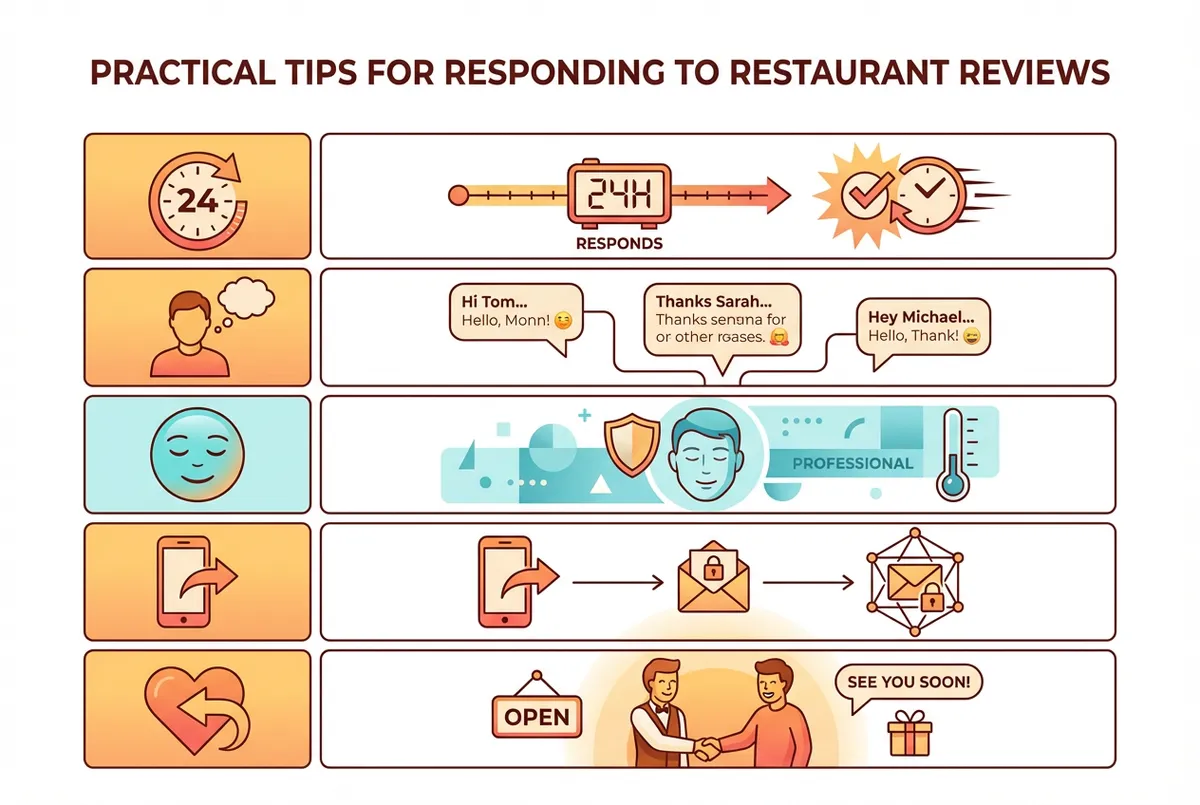
Quick-reference tips for responding to every type of restaurant review
You've now got strategies for every type of review. Let's put it all together with ready-to-use templates you can adapt on a quiet Wednesday night.
Positive Review Response
For example, a Sheffield curry house responds to every five-star review within 24 hours. Their average Google rating increased from 4.2 to 4.6 in six months.
"[Name], thank you so much for this wonderful review! We're thrilled you enjoyed the [specific dish/experience mentioned]. Your kind words mean a lot to our team. We look forward to welcoming you back soon!"
When you respond to positive reviews, keep responses:
- Brief (they don't need a novel)
- Specific (mention something they mentioned)
- Warm without being over-the-top
Mixed Review Response
"Hi [Name], thank you for taking the time to share your experience. I'm glad you enjoyed the [positive element], and I'm sorry the [negative element] didn't match. We're always working to improve, and your feedback helps. I hope we'll have the chance to welcome you back."
Response to No-Comment Reviews
Sometimes people leave stars with no text. These are still worth responding to:
"Thanks for taking the time to rate us, [Name]! If you have a moment, we'd love to hear what would make your next visit even better."
Frequently Asked Questions
How long should a restaurant review response be?
Keep responses brief, ideally 2-4 sentences for positive reviews and 4-6 sentences for negative ones. Long responses can seem defensive. The goal is to acknowledge, address the key issue, and invite further conversation privately.
Should I respond to every restaurant review?
Yes, aim to respond to every review when possible. Responding to positive reviews encourages more of them, while responding to negative reviews shows potential customers you care. If time is limited, prioritise negative reviews first.
Can I delete negative Google reviews?
You cannot delete reviews others have written, but you can flag reviews that violate Google's policies (spam, fake reviews, off-topic content). Google will investigate and may remove them if they breach guidelines. For legitimate negative reviews, your best approach is a thoughtful response. See our guide on how to remove Google reviews for the full process.
How quickly should I respond to a negative review?
Aim for 24-48 hours. This gives you time to investigate what happened and craft a thoughtful response, while still showing you're attentive. The majority of consumers expect business owners to respond to reviews, so a prompt reply demonstrates you take feedback seriously.
What if a review contains false information?
Respond professionally without directly calling the reviewer a liar. You might say: "We're unable to find a booking under this name, but we'd be happy to discuss your experience." Then flag the review to the platform for investigation if you believe it's genuinely fake. See our fake restaurant reviews guide for the full reporting process.
Key Takeaway
Key Takeaway
Learning how to respond to restaurant reviews effectively isn't about winning arguments, it's about showing potential customers you genuinely care. Use the five-step framework: thank, apologise, acknowledge the specific issue, explain what you're doing, and invite them back. Respond within 24-48 hours, keep it brief and professional, and never copy-paste. Remember: 88% of consumers would use a business that responds to all its reviews, compared to just 47% for one that doesn't respond at all. Your responses are being read by far more people than just the original reviewer.
If you run a restaurant and want to see how Local Brand Hub can support your marketing, explore our restaurant marketing tools.
This Week's Action Plan
Day 1-2: Set up Google Alerts for your restaurant name so you never miss a review.
Day 3-4: Respond to your three most recent reviews using the five-step framework in this guide.
Day 5-7: Create a simple response template document you can adapt quickly.
This takes 30 minutes total, not 30 minutes per day. Consider a review management tool that aggregates reviews from Google, TripAdvisor, and Facebook in one place.
For UK restaurant owners
Simplify Your Local Marketing
LocalBrandHub shows independent restaurants their Google rating and review count with a link straight to Google to reply, alongside a local SEO checklist.
Start FreeGet More Marketing Tips
Practical marketing tips for UK business owners, straight to your inbox. No spam, unsubscribe anytime.
About the Author
Local Brand Hub
Empowering UK Businesses
Local Brand Hub provides comprehensive business management tools designed specifically for UK local businesses to streamline operations, automate marketing, and grow revenue.
More articlesRelated Articles
 Marketing Tips
Fake Restaurant Reviews: Spot, Report and Protect
Learn how fake restaurant reviews work, why they're illegal in the UK, and practical steps to protect your restaurant's reputation from fraud.
 Marketing Tips
How to Get More Google Reviews: 7 Proven Strategies
How to get more Google reviews for your UK business. 7-step system covers legal methods, optimal ratings, and strategies that fit your busy schedule.
 Marketing Tips
How to Get More Google Reviews for Restaurant: 6 Steps
How to get more Google reviews for restaurant success: 6 proven steps UK owners use, including staff scripts, timing tips, and response templates.