
Which salon website builder actually takes bookings? A UK guide to Wix, Squarespace, GoDaddy and WordPress, and what the plan price leaves out.
The salon website builder to pick is whichever one lets a client book a treatment on a domain you own, with no builder branding on the page. Wix, Squarespace, GoDaddy and WordPress can all get you there. What separates them is which tier gets you there, and what gets billed separately from the plan.
You find out which plan you actually bought at nine on a Tuesday evening, when a client taps Book on your shiny new site and lands on a form telling her to ring you tomorrow.
That is when last month's research gets marked. Roundups score these platforms on templates and drag and drop editors. Almost none of them scores the thing a salon is buying: a stranger becoming a Saturday appointment while you are mid balayage.
Related: Salon Website and SEO is the pillar. If bookings are the whole reason you are here, the beauty salon booking system guide covers the other half.
If you have started this twice and abandoned it twice, nothing below assumes otherwise.
About this guide: written for a UK salon owner choosing between clients. Check every platform detail below against that company's own page on the day you buy, because plans move and this one is dated. No plan prices appear, for a reason the third section explains.
Check what you already have before you buy anything
Open your booking system and look at the page your clients see. If you take appointments through a salon booking platform, check whether it already gives you a public page with your treatment list, your hours and a working Book button. For a solo lash tech with a full column, a page like that may already do most of the job.
What it is not doing is holding an address you own. Your page sits on the marketplace's domain, one tab from a browse list of every rival within a couple of miles, and the pages ranking for treatments in your town can as easily be theirs as yours. Ownership of the address is the property that decides this, not whether the page looks professional.
Picture a two chair salon taking every booking through a marketplace app in 2026. Treatments, prices and hours are live and correct. Search the salon's name and the top result is the marketplace's page rather than the salon's, with a competitor three streets away sitting just under it.
Which is why the honest comparison is builder plus booking against booking alone, rather than builder against nothing.
Which salon website builder should a UK salon pick?
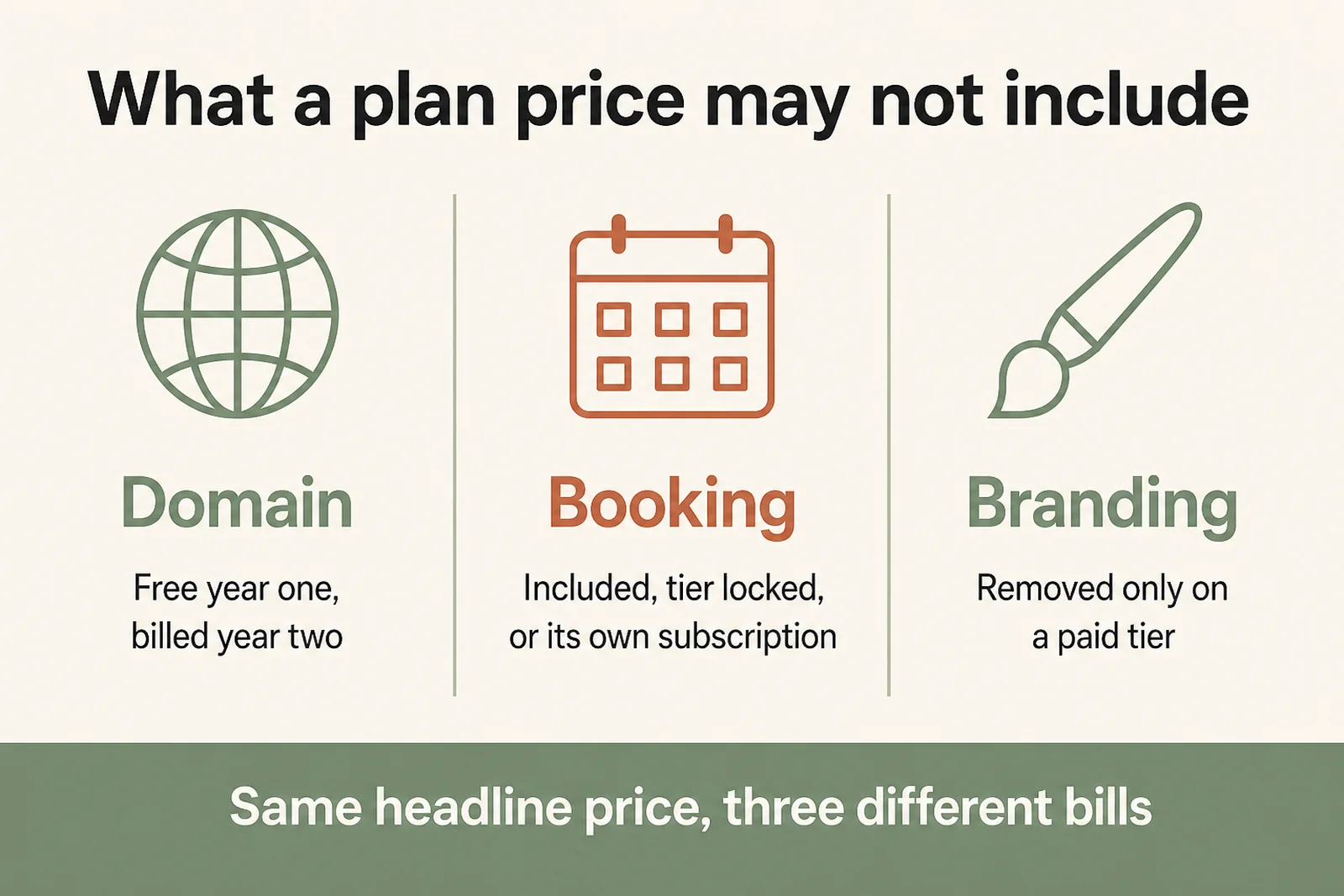
Three things a plan price treats differently, which is why similar figures bill differently.
Four general purpose builders cover almost every salon that is not hiring a developer or using its booking platform's own site product, and they differ less in what they do than in how much assembly they expect.
Wix
Wix runs its own scheduling product, which is the argument for keeping the site and the diary under one login. Pricing is where it gets vague. The plans page states that "Prices and currency vary by location. USD prices displayed for reference only", and when we looked we could not find a tier named for bookings or card payments on it. So do not take a tier from a roundup and do not take one from here either. Start the free trial, add a booking to a test treatment page, and let the upgrade prompt tell you which plan it wants before any money moves.
Squarespace
The right answer when the brand is the product. For a brow studio where the grid is the pitch, its templates hold a standard Wix takes effort to match. Read the plan page closely, though, because appointments do not ride along with the site. Its help centre lists what sits outside a website plan: "The following are separate Squarespace services and require their own subscriptions: Acuity Scheduling, Bio Sites, Domains, Email Campaigns, Google Workspace, and Unfold." Scheduling and the domain are on it.
GoDaddy
The fastest route from nothing to live, useful when the alternative is six more months of an Instagram bio link. In its Websites + Marketing product, booking is built in rather than bolted on: the help centre walks you through adding a section by "searching for Online Appointments, which is under the Scheduling category". That is the product to ask for by name, because GoDaddy sells more than one way to have a website and they do not all work like this one. Where a builder offers a free tier, treat it as rehearsal: builder branding and a builder subdomain are the usual price of not paying, and the pricing page will say which tier removes them.
WordPress
The most control and the least hand holding, and two different products wearing one name. Self hosted WordPress.org means hosting you buy, updates you apply and a plugin you choose. Hosted WordPress.com is the one with plans. WordPress.com states that "Installing plugins is available on all WordPress.com paid plans: Personal, Premium, Business, and Commerce plans", so a booking plugin needs a paid plan before it needs choosing. Worth it with a developer on call, rarely for two chairs.
Why this matters: the tier you pick is the one you are still on in three years, because moving a salon site between builders means rebuilding it. Buy for the diary you want, not the one you have this month.
Whichever wins, the layout decisions are identical. The salon website design guide covers what belongs above the fold, and the salon website template guide covers which pages to build first.
Why the advertised price is never your bill
A price table copied out of a review is not your bill, and that includes the one this article used to carry. Wix's plans page says so itself: "Prices and currency vary by location. USD prices displayed for reference only."
A figure quoted in a review was true for one country, in one currency, during one promotional window. It is not a price. It is a souvenir.
The gap between that number and your bill lands in the same three places:
- The domain. Bundled for a first year, or a separate subscription
- The booking tool. Included, tier locked, or sold as its own product
- The branding. Usually removed by upgrading, on the tier the pricing page names
Squarespace bills two of those separately by its own account. Self hosted WordPress hands you the domain and the hosting instead of billing them inside a plan.
Which makes the only comparison worth having one you build yourself, with four tabs open.
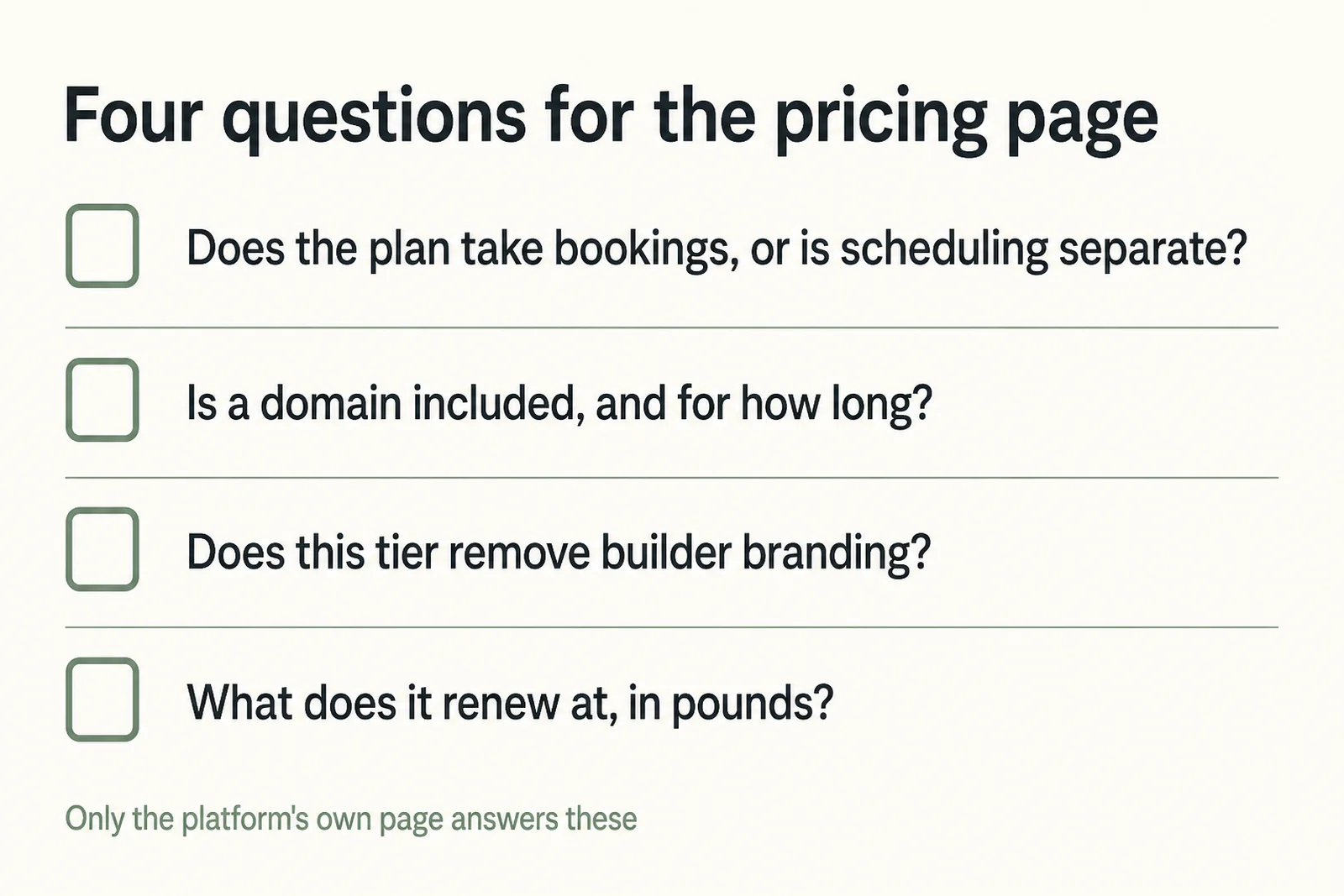
Four answers settle what roundups fudge across three thousand words.
| Ask this on the pricing page | Why it settles the argument |
|---|---|
| Does the plan take bookings, or is scheduling separate? | A site that cannot book is a rented brochure |
| Is a domain included, and for how long? | Year one free is common, year two is not |
| Does the tier remove builder branding? | Entry tiers usually keep it |
| What does it renew at, in pounds? | The renewal is the number you live with |
Rule of thumb, not a rating: the right column is our judgement, and only the platform's own page answers the left.
Fill it in for two builders and the decision makes itself. For the wider software bill, the salon software pricing guide is the companion.
What a UK salon website has to show
GOV.UK guidance for limited companies states that on business letters, order forms and websites you must show the company's registered number, its registered office address, where the company is registered, and that it is a limited company. If your salon trades as a limited company, the site has to carry those four details before launch.
Where they sit is your call, not the rule's. The template footer is the practical place, because it is repeated on every page instead of sitting on one. If you are a sole trader, this particular rule is a company rule rather than yours, and an invented company number is worse than none.
What your booking form should ask for, and nothing more
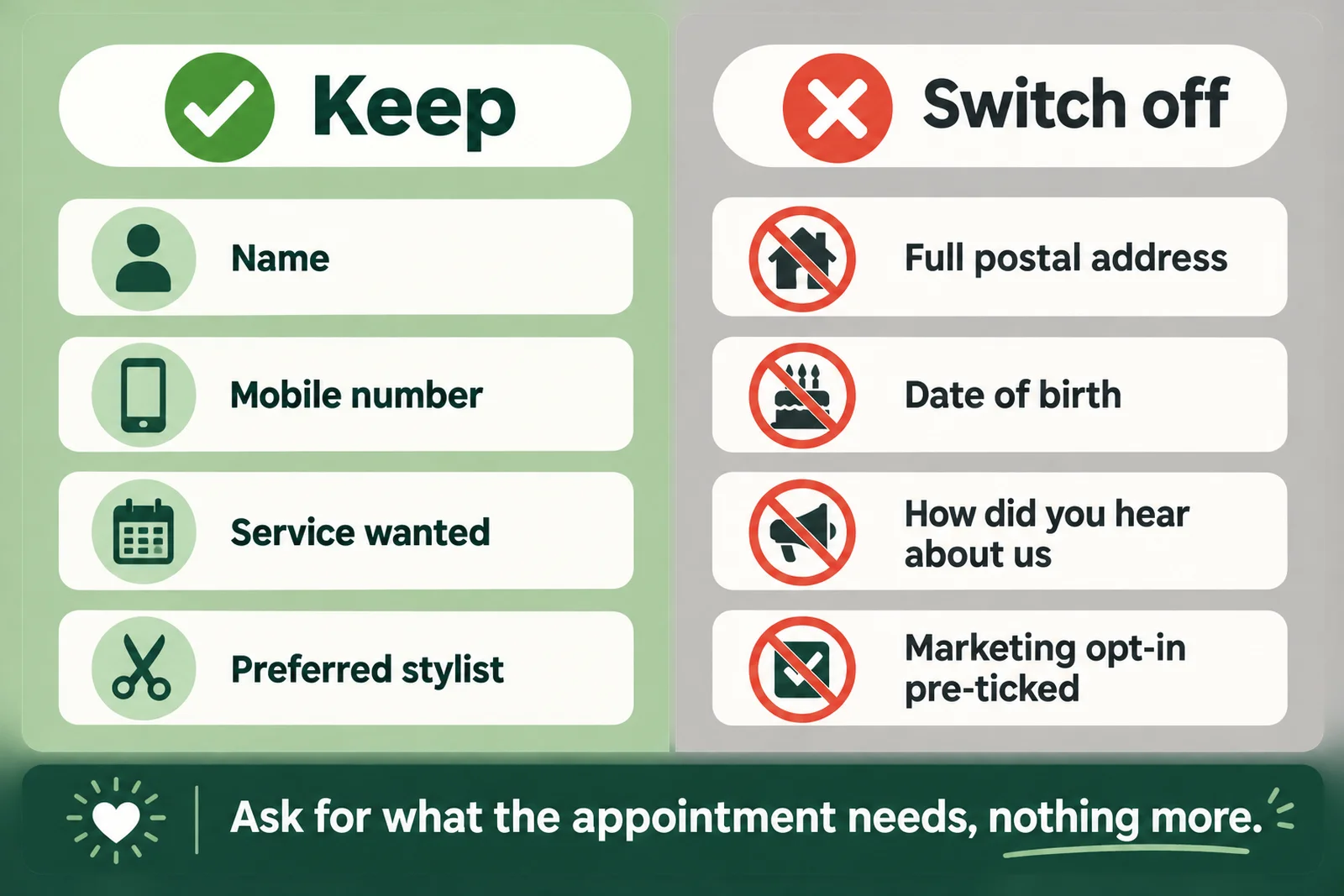
Four fields run an appointment. The rest are the template's idea, not yours.
Booking forms offer more fields than you need, and some ship with extras already switched on.
The ICO's guide to the data protection principles states that personal data shall be adequate, relevant and limited to what is necessary in relation to the purposes for which it is processed. The ICO sets that test; the list is yours to draw up. For a treatment booking ours comes to four things:
- The client's name
- One contact route you will actually use to confirm
- The treatment
- The time
Date of birth, full postal address and gender need a reason beyond the template offering the box.
One exception earns its place. A patch test question before colour or lashes earns its place, because you cannot deliver the treatment safely without the answer. Ask it, and say on the form why you are asking and who sees it. Deposit card details belong with the payment provider, never a field you can read.
Before switching any on, open the booking tool's account and data settings and check who sees the entries and where they are held.
Getting found once the site is live
A live site is not a found one. ONS data as at March 2024 counts 49,320 hairdressing and beauty salon enterprises in the United Kingdom on its tax and payroll registered measure. You are not ranking against all of them, only against the handful in your own town, which is a shorter list and a harder one.
What follows launch is a short list: treatment pages carrying the words clients type, hours agreeing everywhere, photographs that are yours rather than the template's. The SEO for beauty salon guide sequences it. LocalBrandHub gives you a visibility score, one number for how easily nearby customers can find you online, which beats admiring your homepage.
Frequently Asked Questions
What is the best website builder for a hair salon?
The one whose plan takes an appointment on a domain you own with no builder branding on the page. Wix, Squarespace, GoDaddy and WordPress get there by different routes, so pick the cheapest tier clearing all three, priced in your own currency.
Do I need a website if I already use a salon booking system?
Not for bookings, which your booking page already does. You need one for the part the marketplace keeps, the address. Your listing sits on its domain beside every rival nearby, and the pages that rank can be theirs rather than yours.
Why do salon website builder prices differ from the ones quoted in reviews?
Because a builder's headline price is not one number worldwide. Wix's own plans page states that prices and currency vary by location and that the prices it displays in dollars are for reference only. A figure copied into a review months ago was another currency or another window.
Can I build a salon website for free?
You can, but a free tier is a showroom for the builder rather than a shopfront for you. Expect a subdomain and builder branding until you pay, and check the builder's own pricing page for which tier removes them.
What does a UK salon website legally have to show?
If the salon trades through a limited company, GOV.UK guidance states that business letters, order forms and websites must show the registered number, the registered office address, where the company is registered and that it is a limited company. Sole traders sit outside that rule.
What should a salon booking form ask for?
Our shortlist is a name, one contact route you will use to confirm, the treatment and the time. The ICO's guide to the data protection principles says personal data must be adequate, relevant and limited to what is necessary, so a date of birth needs a reason beyond the box being there.
The salon website and SEO guide starts where the platform choice ends.
The one test worth running
Key Takeaway
Before paying, do this on the two platforms you are down to. Build one treatment page with three services and connect the booking tool. Then book yourself from your phone, in the dark, without logging in.
A Book button that ends in "ring us tomorrow" is not a booking system. It is a shop door with a note taped to it. Whichever platform sends a real confirmation email while you are still standing there is your salon website builder, and the plan that got you there is the plan.
Weekly Action
- Answer the four pricing page questions for two builders, in pounds, at checkout
- Build one treatment page on the winner and book yourself from your phone
- Put the company footer details into the template, not onto one page
For restaurants, salons, and local businesses
Need help with your marketing?
We help UK businesses turn social media into real results, not busywork.
Start freeSources
Get More Marketing Tips
Practical marketing tips for UK business owners, straight to your inbox. No spam, unsubscribe anytime.
About the Author
Local Brand Hub
Empowering UK Businesses
Local Brand Hub provides comprehensive business management tools designed specifically for UK local businesses to streamline operations, automate marketing, and grow revenue.
More articlesRelated Articles
 Marketing Tips
SEO for Beauty Salon: How to Get Found on Google
Step-by-step SEO for beauty salon owners who want to rank on Google. Covers Google Business Profile, keywords, reviews, and local citations.
 Marketing Tips
7 Best Salon Website Templates for UK Salons
Compare the 7 best salon website templates for UK beauty salons. Reviewed for mobile responsiveness, booking integration, and ease of customisation.
 Marketing Tips
Salon Website and SEO: Complete Guide for UK Salons
How to build a salon website and SEO strategy that ranks on Google and fills your diary. Design, templates, builders, and local SEO for UK salons.