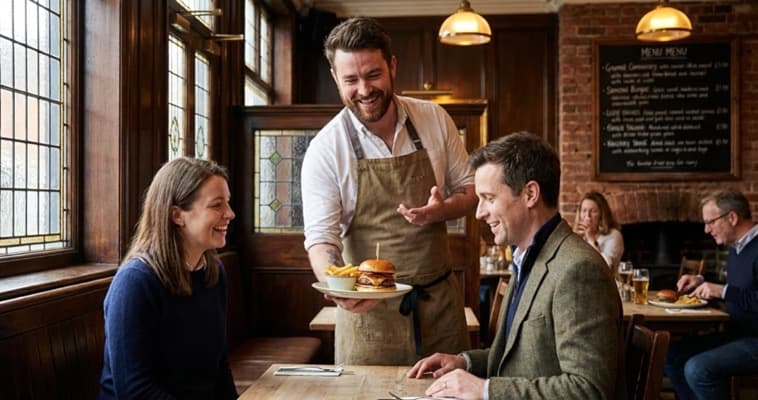
Learn the 5 suggestive selling techniques for restaurants: descriptive language, pairing, upgrades, limited offers and personal recommendations explained.
You're clearing tables, running food and keeping the floor moving — but your team isn't selling a thing. Every order taken without a recommendation is money your restaurant will never recover.
The five suggestive selling techniques for restaurants are descriptive language, pairing suggestions, premium upgrades, limited-time offers and personal recommendations. These suggestive selling techniques are a framework that helps front-of-house staff guide customers toward higher-value orders without feeling pushy, scripted or aggressive.
What You'll Learn
- What are the 5 suggestive selling techniques for restaurants and why they matter
- How to apply each suggestive selling technique with real scripts your staff can use tonight
- Which technique suits different restaurant types and service styles
- How to train your team in suggestive selling techniques without making them sound like robots
- A side-by-side comparison showing when to use each of the 5 suggestive selling techniques for restaurants
Industry data shows restaurants using suggestive selling techniques typically see a 15-25% lift in average cheque value (NRA, 2025). Your staff clear plates, take orders and keep the floor running after a 12-hour shift. But when a customer asks "what's good here?" your team shrugs and says "everything's nice." That is not a sales technique. That is a missed opportunity worth thousands of pounds a year.
So what are the 5 suggestive selling techniques for restaurants that actually change the number on the bill? The difference between suggestive selling and being pushy comes down to one thing: genuine helpfulness. When it is done well, customers feel looked after rather than sold to.
Related: Restaurant upselling techniques — our complete hub guide covering all upselling strategy
This guide answers what are the 5 suggestive selling techniques for restaurants with practical scripts, concrete examples and a clear plan you can introduce to your team this week. Whether you run a gastropub or a quick-service takeaway, these upselling techniques translate directly to higher average spend per head. Last updated February 2026 to reflect current UK hospitality data and industry research.
Pro Tip
Knowing what are the 5 suggestive selling techniques for restaurants does not require bigger menus or bigger budgets — it requires better conversations between your staff and your customers.
What Is Suggestive Selling in Restaurants?
First, before answering what are the 5 suggestive selling techniques for restaurants in detail, it helps to understand what suggestive selling actually means. Suggestive selling in restaurants is a framework that guides customers toward additional or higher-value menu items through helpful, well-timed recommendations. Unlike hard selling, suggestive selling works because it frames the suggestion as a benefit to the customer rather than a push for more revenue. Knowing what are the 5 suggestive selling techniques for restaurants helps you build this framework systematically rather than leaving it to chance.
The difference between upselling and suggestive selling is subtle but important. The upselling approach is a framework that focuses on moving the customer to a pricier version of what they have already chosen.
However, suggestive selling is broader — it includes:
- Recommending complementary items
- Highlighting specials and limited-time dishes
- Sharing personal favourites from the menu
Both fall under the umbrella of upselling techniques in food and beverage, but suggestive selling techniques feel more conversational.
If you're thinking "my staff are too busy for this during a Saturday rush," you are not alone. The reality is that suggestive selling does not require longer conversations. It requires better ones. For example, a server who says "the sea bass is beautiful tonight" instead of just "are you ready to order?" has used a suggestive selling technique without adding a single second to the interaction. A single well-placed sentence can add pounds to every table.
1. Descriptive Language
Now that the basics are covered, here is the first of what are the 5 suggestive selling techniques for restaurants. Descriptive language means using vivid, sensory words to make menu items sound more appealing. Instead of saying "we have a chocolate cake," your server says "we have a warm dark chocolate fondant with a molten centre." The food is the same. The words change everything. Nobody ever ordered "slow-roasted lamb that falls off the bone" and felt oversold.
Research from Cornell University found that descriptive menu labels increased sales of those items by up to 27% compared to plain labels (Wansink, Cornell Food and Brand Lab, 2025). That is not a small margin. That is the difference between a quiet Wednesday night and a profitable one.
How to Use Descriptive Language
Of all suggestive selling techniques, descriptive language is the easiest to implement. Focus on texture, temperature, origin and preparation method. "Slow-braised," "hand-stretched," "locally sourced" and "served bubbling" all trigger stronger responses than plain descriptions.
Script example:
"Tonight's special is a slow-roasted lamb shoulder — it's been in the oven for about eight hours, and it falls apart on the fork. It comes with buttery mash and seasonal greens."
A gastropub using descriptive language might train staff to describe the fish pie as "our chef's fish pie with sustainably caught haddock, king prawns and a golden cheddar crust" rather than simply "fish pie." That extra detail gives the customer a reason to order it.
Related: Menu engineering — how to position and describe dishes for maximum impact
2. Pairing Suggestions
Building on descriptive language, the second of what are the 5 suggestive selling techniques for restaurants takes things further. Pairing suggestions involve recommending complementary items that enhance what the customer has already ordered. Wine with steak. Garlic bread with pasta. A side salad with a burger.
Additionally, this suggestive selling technique works because it feels helpful rather than transactional — you are completing their meal, not inflating the bill.
According to the National Restaurant Association, restaurants that train staff on pairing suggestions typically see average cheque increases of 15-25% (NRA, 2025). For a restaurant serving 200 covers a week, even a modest increase per table adds up substantially over a month.
How to use it: Among suggestive selling techniques for restaurants, timing matters most with pairings:
- Time the suggestion immediately after the main order
- Use the word "with" rather than "and"
- "That goes beautifully with our house Malbec" sounds like advice
- "Would you like a glass of wine and some garlic bread?" sounds like a shopping list
Script example:
"Great choice on the ribeye. Our house Malbec goes really well with it — the sommelier paired them specifically. Would you like a glass?"
For instance, an Italian restaurant might train servers to suggest a specific side dish with every pasta order: "The burrata works brilliantly alongside that — it's fresh in this morning." That single sentence can add several pounds to the table.
3. Premium Upgrades
Next, you have got the language and the pairings down. Here is the third of what are the 5 suggestive selling techniques for restaurants. Premium upgrades encourage customers to choose a higher-value version of something they have already decided to buy.
Double espresso instead of single. Large pizza instead of medium. Aged steak instead of the standard cut. The customer has already committed to the category — you are simply offering a better version of that same item.
One key to premium upgrades is making the price difference feel small relative to the experience gain. "For just £2 more, you get the 35-day dry-aged sirloin instead of the standard" frames the upgrade as a bargain rather than an expense.
How to use it: This suggestive selling technique works best when you present the upgrade as a natural extension, not a separate decision:
- "For just a little more" reduces price sensitivity
- "If you really want to treat yourself" frames it as indulgence, not expense
Script example:
"We do the regular fish and chips, but for just £3 more you get the beer-battered halibut fillet — it's a much meatier fish. Honestly, it's worth it."
If you're thinking "my customers already know the menu," consider this: many diners scan the page, pick something familiar and close the menu. They do not see the premium option unless someone points it out. That's usually a sign your service team could be doing more to highlight your best dishes.
4. Limited-Time Offers
Moving on from upgrades, the fourth of what are the 5 suggestive selling techniques for restaurants taps into psychology. Limited-time offers create urgency by highlighting items that will not be available indefinitely. Seasonal specials, weekly features and "while stocks last" dishes tap into the fear of missing out — a well-documented driver of purchasing decisions.
A survey by Technomic found that 64% of UK consumers said limited-time menu items make them more likely to visit a restaurant (Technomic, 2025). Scarcity drives action. When something is always available, there is no reason to order it on any given visit.
How to use it: This suggestive selling technique requires consistent pre-service briefings:
- Brief your team on the specials before every service
- Give them one sentence about why the dish is special and when it ends
- "We're only running this until Friday" is more compelling than "it's on the specials board"
Script example:
"Just so you know, we've got a wild mushroom risotto as our midweek special — the mushrooms are foraged locally. It's only on until Thursday, and we've been selling out by 8pm."
A neighbourhood bistro might introduce a "Chef's Friday Special" that changes weekly. Staff announce it at every table. The time pressure and exclusivity make it a natural talking point, and customers begin asking about it before they are even told — which is exactly the behaviour you want.
If you're only running the same menu week after week with no specials you'll always lose to competitors who create urgency and give customers a reason to visit this week rather than "sometime." Stale menus lead to stale revenue — that rarely works long term.
5. Personal Recommendations
Finally, the fifth of what are the 5 suggestive selling techniques for restaurants relies on something no script can replicate. Personal recommendations tend to be the strongest suggestive selling technique because they carry genuine enthusiasm.
Furthermore, when a server says "I had that for my staff meal and it's honestly one of my favourite things on the menu," the customer hears authenticity, not a sales pitch.
People often trust personal recommendations ahead of generic menu prompts (TouchBistro, 2025). Diners are significantly more likely to follow a server's personal recommendation over a generic upsell prompt (TouchBistro, 2025). The human element makes the difference.
How to Use Personal Recommendations
Encourage every team member to try the dishes and develop genuine favourites. A recommendation that comes from real experience is typically more convincing than a memorised script. Strong suggestive selling techniques typically do not sound like selling at all. Restaurants that give staff freedom to share what they genuinely enjoy tend to see this technique outperform scripted upsells consistently.
Script example:
"If you like seafood, I'd really recommend the pan-seared sea bass — I had it last week and the crispy skin is amazing. It's probably my favourite thing on the menu at the moment."
For example, a casual dining chain might ask each server to choose a "personal pick" for the shift and share it naturally when customers ask for suggestions. When the enthusiasm is real, customers respond. When it is forced, they tune out.
Your menu is not a list. It is a conversation waiting to happen. Here is a question worth asking yourself: when was the last time every member of your team actually tasted the dishes they are selling?
Comparison: All 5 Suggestive Selling Techniques at a Glance
Now you have the full answer to what are the 5 suggestive selling techniques for restaurants — here is how they compare side by side.
Use this table to choose which technique to introduce first, based on your venue type and service style.
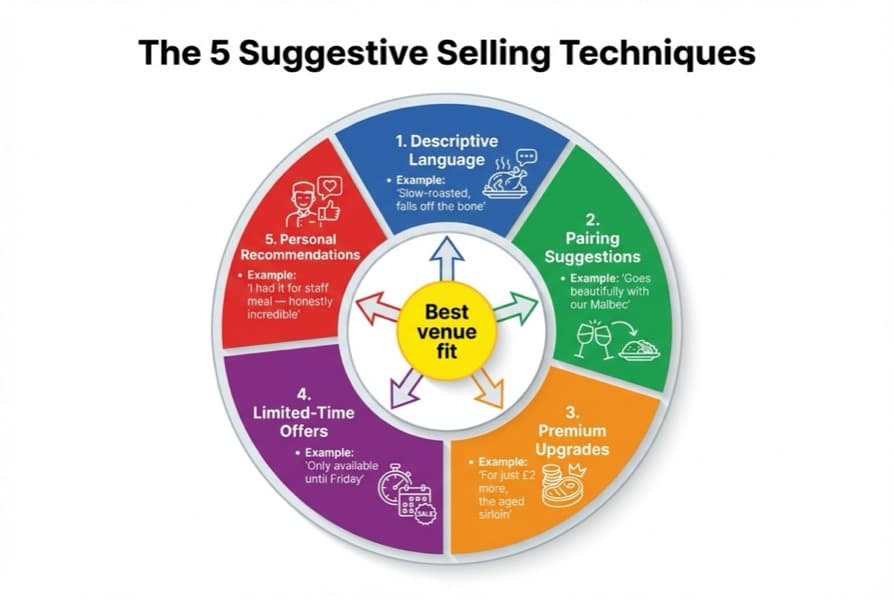
All 5 suggestive selling techniques compared at a glance
Side-by-Side Comparison
| Technique | Ideal For | When to Use | Example Phrase | Revenue Impact |
|---|---|---|---|---|
| Descriptive Language | All restaurants | Describing specials and premium items | "Slow-roasted, falls off the bone" | Up to 27% increase on described items |
| Pairing Suggestions | Full-service dining | After main order is placed | "That goes beautifully with..." | 15-25% average cheque increase |
| Premium Upgrades | Restaurants with tiered pricing | When customer has chosen a category | "For just £2 more..." | Varies by price gap |
| Limited-Time Offers | Venues with rotating menus | Start of the meal, before ordering | "Only available until Friday" | 64% of diners say it drives visits |
| Personal Recommendations | All restaurants | When asked "what's good?" | "Honestly, my favourite is..." | Highest trust and conversion |
Where to Start
For most UK restaurants, starting with personal recommendations and descriptive language — the simplest of what are the 5 suggestive selling techniques for restaurants — often delivers the fastest results because they require zero menu changes and minimal staff training.
If you're only relying on the menu to do the selling you'll always lose to competitors who train their staff to have better conversations at the table. What are the 5 suggestive selling techniques for restaurants if not essential tools? They are not optional extras — they are the difference between average spend staying flat and growing steadily each month.
If You Only Have 30 Minutes a Week
You now know what are the 5 suggestive selling techniques for restaurants — here is how to start implementing them even on a packed schedule. If you only have 30 minutes a week, do this:
- Day 1-2: Pick one dish from your menu. Write a single descriptive sentence for it using texture, temperature and origin. Share it with your team before service
- Day 3-4: Ask each server to name their genuine favourite dish. That becomes their personal recommendation for the week
- Day 5-7: Brief the team on one pairing suggestion — a specific drink with a specific main course. Listen during service and note how many times they use it
Weekly Action
- Each week, pick a different suggestive selling technique to practise
- Week one: descriptive language. Week two: pairings. Week three: upgrades
- Rotate through all five over a month and track which drives the biggest lift in average spend per head
Quick-Start Suggestive Selling Techniques Checklist
- Every server can describe at least three dishes using sensory language
- Each team member has a genuine personal recommendation ready
- Staff know the current specials and when they end
- At least one pairing suggestion is briefed before every service
- Premium upgrade options are highlighted on table menus or verbally
- The team understands the difference between suggestive selling and being pushy — which is what makes what are the 5 suggestive selling techniques for restaurants work in practice
FAQ
Here are the most common questions readers ask about what are the 5 suggestive selling techniques for restaurants — with direct, practical answers.
What are the five suggestive selling techniques?
There are five answers to what are the 5 suggestive selling techniques for restaurants: descriptive language, pairing suggestions, premium upgrades, limited-time offers and personal recommendations. Each works by guiding the customer toward a higher-value order through helpful, well-timed suggestions rather than aggressive selling. Most restaurants see the best results by combining two or three of what are the 5 suggestive selling techniques for restaurants rather than relying on just one.
What is the difference between upselling and suggestive selling in a restaurant?
The difference between upselling and suggestive selling is a framework that separates two related but distinct approaches. Upselling specifically means encouraging a customer to choose a more expensive version of their current order, such as upgrading from a regular to a large portion.
Suggestive selling is the broader practice that includes upselling alongside recommending complementary items, highlighting specials and sharing personal picks. In practice, the two overlap significantly, and most effective upselling techniques in food and beverage use elements of both approaches.
How do you train restaurant staff in suggestive selling techniques?
If you are wondering what are the 5 suggestive selling techniques for restaurants and how to teach them, start with a pre-service briefing covering one technique at a time. Teach what are the 5 suggestive selling techniques for restaurants incrementally — one per week — rather than all at once. Have every team member taste the specials so their recommendations are genuine. Provide specific scripts as starting points but encourage staff to adapt them to their own voice. Role-play common scenarios during quiet moments. Track results weekly by monitoring average spend per head — if it rises, the training is working.
Does suggestive selling feel pushy to customers?
When done well, suggestive selling feels like good hospitality rather than a sales tactic. It typically comes down to timing, tone and sincerity. A server who enthusiastically describes a dish they genuinely enjoyed feels helpful. A server who pushes the most expensive wine regardless of the meal feels pushy. If customers are declining every suggestion, that's usually a sign the approach needs refining rather than abandoning.
What is an example of suggestive selling in a restaurant?
An example of suggestive selling in a restaurant is a framework that combines two or more of what are the 5 suggestive selling techniques for restaurants in a single interaction. A customer orders a steak. The server says, "Great choice — our house Malbec was specifically paired with the ribeye, and it really brings out the flavour. Would you like a glass?" This combines pairing suggestion with descriptive language. The customer feels guided rather than pressured, and the restaurant adds a drink sale to a food order.
Related: Restaurant upselling techniques — the complete hub guide covering all upselling strategy for UK restaurants
Now you know what are the 5 suggestive selling techniques for restaurants — start with one this week. Brief your team before service, pick a single dish to focus on, and measure average spend at the end of the week. The gap between restaurants that grow their revenue and those that stay flat often comes down to what happens in the ten seconds between a customer opening the menu and placing an order. Every conversation at every table is a chance to help someone have a better meal — and that is the real answer to what are the 5 suggestive selling techniques for restaurants.
Key Takeaway
Key Takeaway
The five suggestive selling techniques for restaurants are descriptive language, pairing suggestions, premium upgrades, limited-time offers and personal recommendations. Suggestive selling isn't about pressure — it's about helping customers discover a better version of the meal they were already going to have. Start with personal recommendations and descriptive language for the fastest results with zero menu changes.
- Descriptive menu language can increase item sales by up to 27%
- Pairing suggestions typically lift average spend by 15-25%
- Personal recommendations carry the highest trust because they feel genuine
- Limited-time offers drive urgency — 64% of UK diners say they influence their visit
- Start with one technique this week and rotate through all five over a month
For independent restaurants, cafes, and hospitality venues
Need help with your restaurant marketing?
We help UK restaurants turn social media into bookings, not busywork.
Get in TouchAbout the Author
Local Brand Hub
Empowering UK Businesses
Local Brand Hub provides comprehensive business management tools designed specifically for UK local businesses to streamline operations, automate marketing, and grow revenue.
More articlesRelated Articles
 Marketing Tips
Restaurant Gift Card Discount: UK Deals & Promos
Explore restaurant gift card discount strategies including bonus card promotions, seasonal deals, corporate bulk pricing and UK dining gift card offers.
 Marketing Tips
Restaurant Gift Card Marketing: Strategy & ROI Guide
Learn how restaurant gift card marketing drives new customers and revenue. Covers platforms, pricing, seasonal strategy and ROI tracking for UK eateries.
 Tutorials
Upselling Examples Restaurant Script: Ready-to-Use
Ready-to-use upselling script phrases your UK team can practise tonight. Covers starters, mains, desserts and drinks with real phrasing.