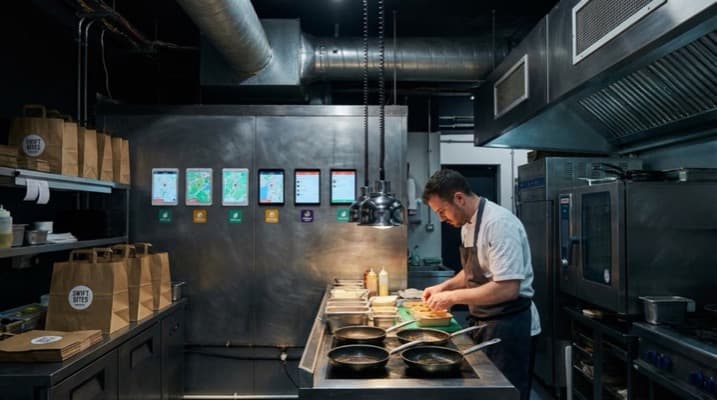
Learn how to set up and run a dark kitchen in the UK. Covers equipment, delivery platforms, food safety, staffing, and managing virtual brands.
A dark kitchen is a delivery-only commercial kitchen with no dine-in area, no shopfront, and no front-of-house staff. This guide covers everything you need to set up and run one in the UK, from equipment and layout to delivery platform integration, food safety compliance, and managing multiple virtual brands from a single kitchen.
Info
Related: See our ghost kitchen marketing hub for the complete guide to building a delivery-only brand.
You have signed the lease, bought the equipment, and listed your first menu on Deliveroo. Three weeks in, orders are trickling, your packaging leaks, and you just failed a hygiene inspection you did not know was coming. Running one sounds simple until the reality hits.
In this guide, you will learn:
- What equipment and layout you actually need
- How to integrate with Deliveroo, Uber Eats, and Just Eat without losing your margins
- UK food safety and hygiene requirements you cannot skip
- Day-to-day operations, staffing, and packaging that keeps food intact
- How to run multiple virtual brands from a single kitchen
Dark kitchens, sometimes called ghost kitchens or cloud kitchens, have become a significant part of the online food retail landscape in England, with many now operating across the country. If you need the full breakdown of what they are and how the models differ, our guide to ghost kitchens covers that. This article focuses on the practical side: getting one up and running.
The opportunity is real. But so are the operational details that separate profitable kitchens from expensive mistakes.
Kitchen Layout and Equipment You Actually Need
First, the space itself. Your layout needs to prioritise speed and workflow, not aesthetics. There are no customers walking through, so every square metre should serve the food production line.
Essential equipment:
- Cooking: Commercial range, fryer, griddle
- Refrigeration: Walk-in fridge, prep fridges, freezer
- Prep: Stainless steel tables and sinks
- Ventilation: Extraction system and odour control
- Tech: Order management screens and printer
- Packaging: Dedicated packing station
Total equipment costs typically run between £30,000 and £75,000 depending on menu complexity and brand count. If you are working from a shared kitchen space, much of this is often already provided.
Why layout matters
A kitchen with the wrong layout wastes minutes per order in unnecessary movement. Over a full service, that lost time adds up to hours of wasted labour every week.
Layout principles that matter:
- Linear workflow: Ingredients enter at one end, finished orders leave at the other. No backtracking. For example, a burger-focused kitchen might flow from prep fridge to griddle station to assembly to packing, all in a straight line.
- Dedicated packing station: Separate from cooking areas. This is where orders get quality-checked, sealed, and labelled.
- Multiple dispatch points: If you run more than one virtual brand, each needs a clearly marked collection zone for drivers.
- Cleaning station: Away from food prep, with separate sinks for handwashing and equipment cleaning.
If you are thinking "I don't have time to redesign my layout," you probably do not need to. A 380 sq ft unit is enough for most single-brand operations. The key is that food moves in one direction and orders never queue at the same station.
Fastest route to launch
For most UK operators, renting a ready-fitted unit is often the fastest route to launch. Providers like Dephna and Karma Kitchen offer equipped spaces from around £2,000-£2,600 + VAT per month with flexible contracts.
Delivery Platform Integration: Deliveroo, Uber Eats, and Just Eat
You have got the kitchen sorted. Next: customers. Getting listed on delivery platforms is straightforward. Making money on them requires understanding the numbers.
Commission Rates Compared
| Platform | Delivery Commission | Self-Delivery Commission |
|---|---|---|
| Deliveroo | 25-35% | Lower (negotiable) |
| Uber Eats | ~30% | ~13% |
| Just Eat | ~30% (with delivery) | ~14% + VAT |
These commission rates eat into margins fast. A typical order on Deliveroo at 30% commission loses nearly a third of its value before food costs, packaging, and labour. That is why menu pricing strategy matters even more for delivery-only kitchens than traditional restaurants.
If you cannot tell whether a menu item is profitable after platform commission or just keeping you busy, that is usually a sign your pricing needs a rethink.
Platform integration tips:
- Start with one platform. Learn the tablet system, photo requirements, and order flow before adding others. For instance, a new curry-focused brand might start on Just Eat (where takeaway cuisine performs strongly) before expanding to Deliveroo.
- Use an order aggregator. Tools like Deliverect or Otter consolidate orders from multiple platforms onto one screen, reducing errors and missed orders.
- Photograph everything properly. These businesses live and die by their listing photos. Invest in professional shots of your top 10 dishes.
- Optimise your menu for delivery. Not every dish travels well. Cut anything that goes soggy, separates, or loses temperature in 20 minutes. Menu engineering principles apply here just as much.
Once you hit 100+ orders per week on a single platform, contact the account manager to negotiate reduced commission rates. Many operators secure meaningful reductions at volume.
UK Food Safety and Hygiene Compliance
With your kitchen running and orders flowing, here is where many operators get caught off guard. The rules apply to you just as strictly as they do to a high street restaurant, and in some ways the enforcement landscape is more complicated.
Legal Requirements
Every UK operator must:
- Register as a food business with your local authority at least 28 days before opening
- Comply with the Food Safety Act 1990 and associated hygiene regulations
- Obtain a Food Hygiene Rating: delivery apps display this rating, and anything below 4 stars will typically hurt your order volume
- Implement a HACCP-based food safety management system (Safer Food, Better Business or equivalent)
- Display allergen information on menus and packaging for all 14 major allergens
Temperature Standards
Keep fridges at 5C or below, freezers at -18C or below, and hot-held food at 63C or above for delivery dispatch. Food being reheated should reach 70C for at least 2 minutes before transport. Log temperatures twice daily: this is the first thing an EHO checks.
One of the most common compliance gaps is that many operators simply do not register. If you are selling food, whether from a commercial unit, a shared kitchen, or even your home, you must register as a food business. Failing to register does not just risk a fine. It means you cannot get a hygiene rating, and without a hygiene rating, platforms may delist you.
Pro Tip
A 5-star hygiene rating is visible on delivery app listings. It is free marketing. Treat food safety as a competitive advantage, not a box-ticking exercise.
The Multi-Brand Complication
If you are running multiple virtual brands from one kitchen, each brand typically needs its own food hygiene rating. Environmental Health Officers (EHOs) face challenges inspecting these sites with multiple trading names at the same address, and the Food Standards Agency currently lacks specific guidance for this model. That is usually a sign you need to be especially thorough with documentation, not less.
For the full picture on UK-specific regulations and platform requirements, see our guide on cloud kitchens in the UK.
Day-to-Day Operations and Staffing
Compliance is sorted. Next comes the daily grind. Running one is relentless. There is no quiet Tuesday lunch where you can catch up on admin. Orders come in waves dictated by platform algorithms and customer habits, and you need systems that handle both the 3pm lull and the Friday night rush.
Staffing Structure
A single-brand operation typically needs:
- Head chef / kitchen manager: Oversees quality, stock, and scheduling
- Line cooks: 1-3 depending on order volume
- Packing and dispatch: At least 1 dedicated person during peak hours
- Admin / marketing: Often the owner in early stages
For example, a kitchen running a busy evening service might operate with one head chef, two line cooks, and one packer. During the 3pm lull, one cook handles prep while the other restocks. On a Saturday rush, all hands are on the line.
If you are reading this thinking "I'll just do everything myself," you are not alone. Most founders start that way. But the model only becomes profitable when you can step back from the pass and focus on the business. An operation that depends entirely on one person cooking, packing, and managing tablets is one that typically burns out its owner within six months.
Daily Operations Checklist
Opening (1-2 hours before first orders):
- Temperature checks on all fridges and freezers (log them)
- Prep mise en place for the day's menu
- Check packaging stock levels
- Switch on tablets, confirm platform status
- Review yesterday's order data and ratings
During service:
- Monitor order flow across platforms
- Quality-check every 10th order (minimum)
- Track average prep-to-dispatch time
- Respond to customer messages promptly
Closing:
- Deep clean all surfaces and equipment
- Restock packaging station
- Update stock counts and place supplier orders
- Review daily revenue and platform ratings
Packaging That Keeps Food Intact
With operations covered, let us talk about packaging: this is where many operators undermine everything else they do well. Food leaves your kitchen hot and arrives at a customer's door 25 minutes later. What happens in between depends almost entirely on your packaging choices.
Packaging Principles
- Tamper-evident seals: Reassure customers their food has not been opened after leaving your kitchen. Most delivery platforms now expect this as standard.
- Temperature-appropriate containers: Hot foods need insulated packaging. Cold foods need ventilation. Saucy dishes need leak-proof containers. Do not use the same container type for everything.
- Separate components: Keep crispy items separate from sauces and dressings. For instance, a fried chicken brand might package the chips in a vented box and the sauce in a sealed pot, rather than dumping everything together.
- Allergen labelling: Every container must display allergen information for the dish inside.
Budget around £0.50-£0.80 per order for packaging that actually protects the food and builds your brand. Kraft board boxes for dry items, leak-proof containers for saucy dishes, and tamper-evident stickers on everything. Spending less typically shows up in your reviews within weeks.
Running Multiple Virtual Brands From One Kitchen
Single brand running smoothly? Good. Here is the strategy that often makes these operations genuinely profitable: multiple brands from one kitchen, each targeting a different cuisine or price point on the delivery apps.
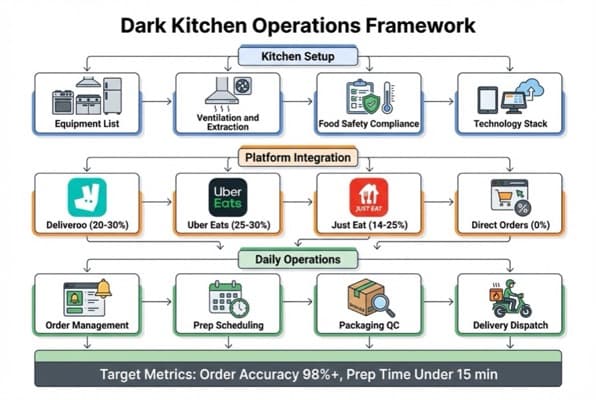
How one dark kitchen operates three virtual brands with shared resources
How Multi-Brand Works
A single kitchen can operate 2-5 virtual brands simultaneously. Each brand has its own:
- Menu and pricing
- Delivery app listings and photos
- Brand name and identity
- Food hygiene rating (in most cases)
But they share:
- Kitchen space and equipment
- Staff and management
- Suppliers and stock
- Overhead costs
For example, one kitchen might run "Bangkok Street" (Thai), "Smash & Stack" (burgers), and "Nonna's Kitchen" (pasta), all from the same 500 sq ft unit, with the same team, using overlapping ingredients. Keeping each brand's menu and offers organised in one place makes juggling several concepts far less chaotic.
Making Multi-Brand Work
Start with cuisine overlap. Brands that share base ingredients (rice, proteins, sauces) reduce waste and simplify stock management. If your Thai brand and your Japanese brand both use rice, spring onions, and soy sauce, that is efficient. Running a pizza brand alongside an Indian brand shares almost nothing.
Keep menus tight. Each virtual brand should have 8-12 items maximum. More than that creates complexity that slows down service. Successful operators often treat each brand like a focused food truck, not a full restaurant menu.
Stagger launch timing. Do not launch three brands on day one. Start with your strongest concept, build volume and ratings, then add a second brand once operations are smooth. Give each new brand 4-6 weeks before adding another.
If you are only running a single brand and want to grow revenue without expanding your kitchen, adding a virtual brand is often more cost-effective than increasing marketing spend on your existing one. Your fixed kitchen costs stay the same. The revenue potential grows significantly.
Dark kitchens are not really about the kitchen. They are about building a delivery brand that customers trust enough to reorder from, without ever seeing your face or your premises.
For a step-by-step approach to launching your operation from scratch, see our guide on how to start a ghost kitchen.
What Is the Difference Between a Dark Kitchen and a Ghost Kitchen?
When it comes to terminology, the simplest definition is a commercial kitchen that prepares food exclusively for delivery, with no customer-facing premises. A ghost kitchen is a broader term that refers to the entire business model of operating a food brand without a shopfront, including the branding, marketing, and multi-platform strategy around it.
In practice, most people in the UK use "dark kitchen" and "ghost kitchen" to mean the same thing. The important thing is not the label. It is whether your operation is set up to handle the unique challenges of delivery-only food service: no walk-in revenue, complete dependence on platforms, and a customer experience you control only up to the point the driver leaves your door.
Frequently Asked Questions
What is a dark kitchen concept?
The concept is a business model where a commercial kitchen prepares food exclusively for delivery, with no dining area or customer-facing shopfront. Orders come in through delivery platforms like Deliveroo, Uber Eats, and Just Eat, and food goes out with drivers. The model reduces overheads compared to traditional restaurants because you are paying for kitchen space only, not a full premises with seating.
How much does it cost to start one in the UK?
Startup costs range widely depending on your approach. A basic shared kitchen setup can start from a few thousand pounds, while a fully independent operation with new equipment can reach £50,000 or more. Renting a ready-equipped shared kitchen is typically the lowest-risk way to start.
Do these kitchens need a food hygiene rating?
Yes. Every such kitchen must register as a food business with the local authority and will receive a Food Hygiene Rating from an Environmental Health Officer. Delivery platforms display these ratings to customers, and a rating below 4 stars can significantly reduce your order volume. If you run multiple virtual brands, each may need its own rating.
Can you run multiple brands from one kitchen?
Yes, and this is often one of the most effective strategies for maximising profitability. A single kitchen can operate several virtual brands, each with separate menus and delivery app listings, while sharing staff, equipment, and overheads. The key is choosing brands with overlapping ingredients to reduce waste and keeping each menu focused and tight.
How do delivery platform commission rates work?
Delivery platforms charge commission on every order. Rates vary by platform and whether you handle your own deliveries, but typically range from 14% to 35%. These rates are often negotiable once you reach consistent order volume: many operators secure meaningful reductions by speaking directly to their platform account manager.
If You Only Have 30 Minutes a Week
The reality for most people considering this move is that they are already working full-time somewhere else. Not ready to launch yet but want to make progress? Here is a structured first week:
- Day 1-2: Research shared kitchen spaces in your area. Check Dephna, Karma Kitchen, and local commercial kitchen listings. Note prices, contract lengths, and what equipment is included.
- Day 3-4: Draft your first menu. Pick 8-10 dishes that travel well, use overlapping ingredients, and can be prepared in under 10 minutes. Test packaging at home with takeaway containers.
- Day 5-7: Register your food business with your local council (this is free and takes 5 minutes online). Start your food safety documentation using the FSA's Safer Food, Better Business pack. Review the delivery platform sign-up process for Deliveroo, Uber Eats, or Just Eat.
Weekly Action
This week, take one step toward your launch:
- Visit one shared kitchen space in your area and ask for a full cost breakdown
- Draft your menu: pick 8-10 items that travel well and use overlapping ingredients
- Register your food business with your local council: it is free and takes ten minutes
Key Takeaway
If you run a restaurant and want to see how Local Brand Hub can support your marketing, explore our restaurant marketing tools.
Key Takeaway
A dark kitchen strips the restaurant model down to its most efficient form: a kitchen, a menu, and a delivery platform. But efficiency without systems creates chaos.
- Layout matters more than size. A 380 sq ft unit with good workflow beats a large kitchen with poor design.
- Platform commissions demand smart pricing. Build 30-35% commission into your menu prices from day one, or use menu engineering to protect your margins.
- Food safety is not optional. Register your business, implement HACCP, and aim for a 5-star hygiene rating before you list on any platform.
- Packaging is part of your product. Budget £0.50-£0.80 per order for packaging that maintains food quality and builds trust.
- Multi-brand is where the real opportunity is. Once your first brand is stable, adding a second virtual brand from the same kitchen can significantly increase revenue with minimal extra cost.
The model is not a shortcut. It is a different business entirely. But for operators who get the details right (layout, compliance, platform strategy, and packaging), it often offers a path to profitability that traditional restaurants increasingly struggle to match.
For restaurants, salons, and local businesses
Need help with your marketing?
We help UK businesses turn social media into real results, not busywork.
Start freeGet More Marketing Tips
Practical marketing tips for UK business owners, straight to your inbox. No spam, unsubscribe anytime.
About the Author
Local Brand Hub
Empowering UK Businesses
Local Brand Hub provides comprehensive business management tools designed specifically for UK local businesses to streamline operations, automate marketing, and grow revenue.
More articlesRelated Articles
 Tutorials
How to Start a Ghost Kitchen: UK Guide
Learn how to start a ghost kitchen in the UK with this step-by-step guide covering registration, licensing, costs, equipment, and launch strategy.
 Industry Insights
Cloud Kitchen UK: Regulations, Platforms and Costs
UK cloud kitchen regulations, costs, and platform commissions compared. Deliveroo vs Uber Eats vs Just Eat, FSA registration, and provider options.
 Business Growth
Ghost Kitchen for Rent: UK Costs and Providers
Find the right ghost kitchen for rent in the UK. Compare providers like Karma Kitchen, Deliveroo Editions and Dephna, with costs from £800 to £4,000/month.