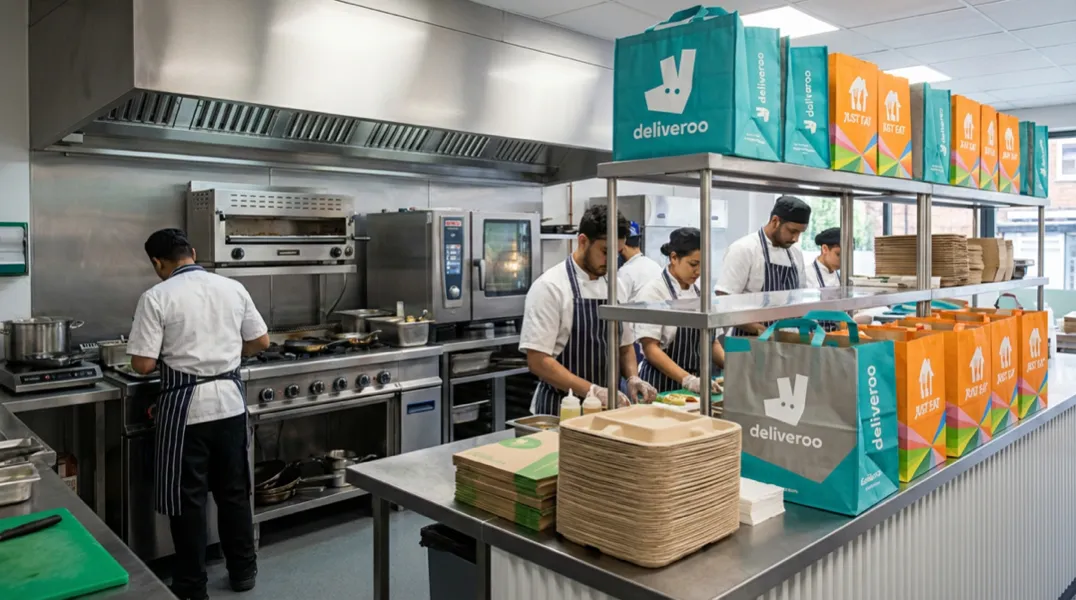
Proven ghost kitchen marketing strategies for UK operators. Build your brand, optimise delivery platforms, and acquire customers without a storefront.
You're running a tight kitchen: the menu is dialled in, prep is smooth, and the food looks brilliant. But the orders are barely trickling in at 30% of what you expected. Ghost kitchen marketing is how you change that, and it needs a different playbook from traditional restaurant marketing.
If this sounds painfully familiar, you are not alone. The UK now has over 750 ghost kitchens, according to Euromonitor (2025), and competition for every delivery order is fierce. The operators who succeed are not necessarily the ones with the best food: they are the ones who market effectively in a world without a shopfront. No passing foot traffic. No signage. Just you, the apps, and whatever brand you build online.
What You'll Learn
- Why ghost kitchen marketing requires different strategies from traditional restaurant promotion
- How to build a recognisable brand when customers never visit your kitchen
- Delivery platform optimisation tactics that increase visibility and order volume
- Social media and content strategies that work for delivery-only brands
- Customer acquisition channels beyond the apps, including direct ordering and local SEO
- A 30-minute weekly plan to keep your ghost kitchen marketing consistent
Why Ghost Kitchen Marketing Is Different
First, let's be clear about the core difference. Traditional restaurants market with location, ambiance, and walk-in appeal. A ghost kitchen has none of that. Nearly your entire brand exists on screens: in delivery apps, on social media, and through search results. That changes everything about how you attract and keep customers.
The European dark kitchen market is projected to grow from $6.21 billion in 2025 to nearly $21 billion by 2032, according to Coherent Market Insights (2025). That growth means opportunity, but also more competition for every delivery order in your postcode.
Here is the core challenge. A traditional restaurant can rely on foot traffic, window displays, and the smell of food drifting onto the street. A ghost kitchen relies entirely on digital visibility. If customers cannot find you in the apps or online, your kitchen might as well not exist.
The three pillars of ghost kitchen marketing:
- Platform presence: how you appear on Deliveroo, Uber Eats, and Just Eat
- Brand identity: what makes customers choose you over dozens of alternatives
- Direct channels: owned assets like your website, email list, and social media
Most ghost kitchen operators focus heavily on the first pillar and neglect the other two. That is a mistake. Delivery apps control the customer relationship. Building your own brand and direct channels is how you take that control back.
Case example: Karma Kitchen, one of the UK's larger ghost kitchen providers, reports that operators who invest in their own branding and direct ordering channels alongside platform listings tend to see stronger long-term growth than those relying on apps alone, according to Karma Kitchen (2025).
Info
Delivery platform commissions can take a quarter to a third of every order. Every customer you convert to a direct ordering channel is a meaningful margin improvement.
Ask yourself: would you reorder from your own kitchen based on what you see in the app right now? If the answer is "probably not," the rest of this guide is for you.
Building a Brand Without a Storefront
Now that you understand the three pillars, where do you start? With the one most operators skip: brand identity.
Without a physical presence, your brand is your packaging, your listing photos, your social media, and every interaction between order confirmation and delivery. Effective ghost kitchen marketing starts with branding, not logos, but a memorable identity that makes customers reorder.
The Brand Foundation
Before you spend a penny on promotion, define what makes your kitchen different. "Good food, fast delivery" is not a brand. Everyone says that. Your brand needs a clear point of view.
For example, a dark kitchen specialising in Korean fried chicken might build their brand around authenticity: Korean-born chef, traditional recipes, imported gochujang. That story gives customers a reason to choose them over the generic "fried chicken" listings surrounding them on every platform.
Packaging as Marketing
For ghost kitchens, your packaging is your shopfront. It is the only physical touchpoint you have with customers. Add your logo, social handles, and a call to action like "Order direct and save 15%." That turns every delivery into a marketing opportunity.
If you're only using plain brown bags you'll always lose to competitors who treat every delivery as a brand experience.
Essential packaging elements:
- Your brand name and logo (prominent, not tiny)
- Social media handles on the bag or container
- A card or sticker directing to your direct ordering website
- A thank-you message with a discount code for the next order
Visual Identity Across Platforms
Consistency matters. Your brand should look identical whether a customer finds you on Deliveroo, Instagram, or your website. That means:
- The same logo, colour scheme, and photography style everywhere
- Menu item names and descriptions that match across platforms
- A distinctive visual style for your food photography: consistent plating, backgrounds, and lighting
According to CloudKitchens (2025), professional food photography is often one of the highest-impact investments a ghost kitchen can make. Listings with high-quality photos typically outperform those with amateur images in both click-through rates and conversion.
Visual consistency tip
Related reading: Restaurant Social Media Marketing covers platform strategies that apply to delivery-only brands.
Delivery Platform Optimisation
With that brand foundation in place, next comes the channel where most of your orders will actually originate: the delivery apps.
Your delivery app listings are your primary shop window. Optimising them is not optional: it is often the single most impactful thing you can do for order volume. Think of each platform as a search engine for hungry people.
Menu Architecture
Structure your menu for the delivery experience, not the kitchen experience. What makes sense for your prep line does not necessarily make sense for a customer scrolling through 40 options on their phone.
Info
Fewer choices, more orders. Decision fatigue is real on delivery apps.
| Strategy | What to Do | Why It Works |
|---|---|---|
| Lead with bestsellers | Put your top 3-5 items in a "Popular" or "Most Ordered" category | Social proof drives conversion |
| Bundle strategically | Create meal deals combining high-margin items | Increases average order value |
| Limit choice | Keep your menu to 20-30 items maximum | Reduces decision fatigue |
| Name clearly | Use descriptive names over creative ones | Customers search by cuisine type |
For example, a cloud kitchen running three virtual brands might have 15-20 items per brand rather than one massive 60-item menu. Each brand gets a focused identity and menu that performs better in search results on the platform.
Photography and Descriptions
Ideally, every menu item should have a professional photo. Items without photos get significantly fewer orders: platforms themselves confirm this.
Your descriptions should be concise, appetising, and include terms customers actually search for. "Crispy chicken burger with house-made slaw and sriracha mayo" beats "The Clucker" every time.
Pricing Strategy
Delivery platform commissions in the UK vary widely depending on the platform and whether you handle your own delivery, according to MerchantSwitch (2025). Your pricing needs to account for these fees without making your items feel overpriced.
Commission ranges by platform:
- Just Eat: Lower rates if you self-deliver, higher with platform delivery
- Deliveroo: Typically 20-30% per order
- Uber Eats: Standard rate drops significantly if you use your own drivers
For most UK ghost kitchens, listing on at least two platforms while building a direct ordering channel often offers a strong balance of visibility and margin.
Promotions and Visibility
Every delivery platform offers promotional tools: featured listings, discounts, free delivery offers. Use them strategically, not constantly.
- Launch phase: Run aggressive promotions to build order volume and reviews
- Growth phase: Use targeted promotions during slow periods only
- Established phase: Shift budget toward direct ordering and retention
If you're thinking "promotions just eat into my margins", that is valid. But on delivery platforms, order volume directly affects your ranking. More orders mean higher visibility, which means more organic orders. Treat launch promotions as an investment in ranking position.
Social Media for Ghost Kitchens
However, delivery platforms drive orders but they do not build relationships. Social media is where ghost kitchens build the emotional connection that delivery apps cannot provide. You cannot invite customers to experience your atmosphere, but you can invite them behind the scenes of your kitchen.
Platform Selection
Not every platform deserves your time. For a delivery-only kitchen, focus on where food content performs best.
- Instagram: The primary platform for food brands. Visual-first, strong discovery features, direct ordering integrations
- TikTok: Powerful for reach, especially with younger demographics. Short-form video of food prep performs exceptionally well
- Facebook: Useful for local community groups and targeted ads within your delivery radius
For most UK ghost kitchens, Instagram often offers a strong combination of visual discovery and direct conversion features.
Content That Works
Food content tends to generate strong engagement on social media. But not all food content is equal.
Info
What works for ghost kitchens specifically: content that builds trust in an operation customers never physically visit.
Behind-the-scenes content: Show the kitchen in action. Prep, cooking, plating, packaging. A 15-second clip of a chef hand-rolling pasta or torching a creme brulee is worth more than any promotional graphic.
Customer unboxing: Encourage customers to film their delivery arrivals and share them. User-generated content is more trusted than brand content and costs you nothing to create.
Menu development: Show the process of creating new dishes. Poll your followers on flavour combinations. Make them feel part of the journey.
This sounds great in theory. In practice, when you are running a kitchen during the lunch rush with orders pinging from three platforms, filming a TikTok is the last thing on your mind. That is why batch-creating content during quieter prep periods works far better. Tuesday mornings and early afternoons are ideal.
Related reading
Restaurant Digital Marketing covers comprehensive digital strategies for UK food businesses.
Paid Social Advertising
Ghost kitchens have a natural advantage with geo-targeted social ads. You know your exact delivery radius. That means you can target ads to people within 3-5 miles of your kitchen, which is extremely efficient.
A budget of £150-300 per month on Instagram and Facebook ads, targeted to your delivery postcode area, can drive meaningful direct orders.
Info
The real advantage of ghost kitchen advertising: you are not competing with every restaurant in your city. You are competing with every restaurant within 3 miles of your kitchen. That is a much smaller fight to win.
Direct Ordering and Local SEO
Building on your social media presence, the next step is converting that awareness into direct revenue. Additionally, awareness without a conversion path just makes you popular on Instagram and poor in your bank account.
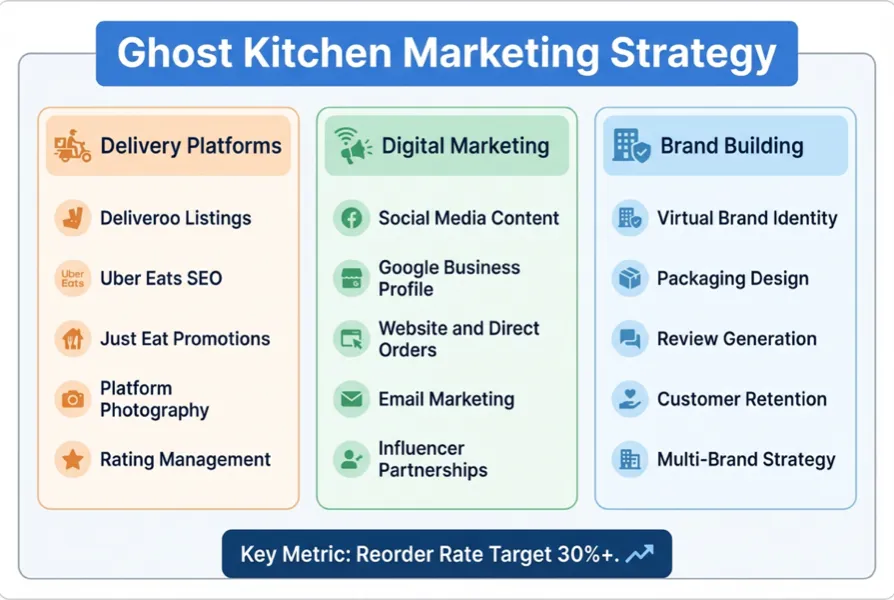
The key marketing channels for ghost kitchen customer acquisition
Here is where the real margin improvement happens. Each order through your own website or app avoids that 25-35% platform commission. Building a direct ordering channel is often critical for long-term profitability.
Setting Up Direct Ordering
The real secret is giving customers a reason to order from you directly instead of through the apps.
- Build a mobile-optimised ordering website: over 80% of food delivery orders are placed on mobile devices, according to Lumina Intelligence (2025)
- Offer a direct ordering incentive: 10-15% discount, free side, or loyalty points for ordering direct
- Include your direct ordering link on all packaging: every delivery is a marketing touchpoint
- Add ordering links to your social media profiles: Instagram bio, Facebook action buttons
Local SEO for Ghost Kitchens
Local SEO works differently for ghost kitchens. You may not have a customer-facing address, but you still need to appear in local search results.
Google Business Profile for ghost kitchens:
According to Google's guidelines (2025), delivery-only restaurants can create a Google Business Profile. Hide your physical address and use service area settings instead. This lets you appear in "near me" searches without inviting customers to a kitchen with no front of house.
- Set your business category to "Delivery Restaurant" or "Takeaway Restaurant"
- Add your full menu to your profile
- Upload professional photos of your food
- Respond to every review, positive and negative
- Include your direct ordering link
If you can't tell whether your ghost kitchen appears in local search results, that's usually a sign your Google Business Profile needs attention. Working through a local SEO checklist is the fastest way to spot exactly what is missing.
For example, a ghost kitchen in Manchester might optimise their profile for "[cuisine type] delivery Manchester [area]", such as "Thai delivery Ancoats" or "vegan delivery Northern Quarter." These hyper-local search terms have lower competition and higher conversion intent than broader phrases.
Related reading
How to Start a Ghost Kitchen covers the operational foundations before you start marketing.
Email Marketing
Email is often one of the most cost-effective ghost kitchen marketing channels. Building an email list converts platform-dependent customers into direct customers.
How to build your list:
- Include a QR code on packaging linking to a sign-up page with a first-order discount
- Collect emails through your direct ordering system
- Run social media campaigns offering exclusive menu previews to subscribers
A weekly or fortnightly email with new menu items, exclusive offers, and a direct ordering link keeps your brand top of mind when hunger strikes.
Customer Retention and Loyalty
Now that you have customers ordering, the next question is: will they come back? Acquiring a new customer through a delivery platform costs significantly more than keeping an existing one. Effective ghost kitchen marketing is not just about getting the first order: it is about making sure the second, fifth, and twentieth orders follow.
The Loyalty Loop
Ghost kitchens face a unique loyalty challenge. On delivery platforms, customers are constantly shown alternatives. There is no physical habit of walking past your restaurant. You need to create digital habits instead.
For example, a ghost kitchen in Birmingham running a poke bowl brand might include a simple loyalty card in every delivery bag: "Collect 5 stamps, get your 6th bowl free." Combined with a QR code linking to their direct ordering site, this turns a platform customer into a direct customer within weeks.
A simple loyalty programme structure:
- Order 5 times, get a free side
- Order 10 times, get a free main
- Refer a friend, both get 20% off
Keep it simple. Complicated loyalty schemes with tiers and points conversions do not work for delivery customers who just want good food quickly.
Review Management
Reviews are your reputation. Without a storefront for customers to judge, your ratings on delivery platforms and Google are often the primary trust signal.
According to BrightLocal (2025), the vast majority of consumers read online reviews for local businesses before making a purchase decision. For ghost kitchens, this is even more critical: your reviews are typically the only social proof customers have.
Review strategy:
- Respond to every review within 24 hours
- Thank positive reviewers by name and mention their specific order
- Address negative reviews professionally with a solution, not defensiveness
- Include a review request card in every delivery
- Monitor reviews across all platforms weekly
Consistency Is Everything
Successful ghost kitchen marketing is not about viral moments. It is about relentless consistency. The operators who win are posting regularly, responding to reviews daily, optimising their listings monthly, and treating every delivery as a brand touchpoint.
Info
The uncomfortable truth: ghost kitchen marketing isn't about selling food. It's about making people hungry before they are hungry, and making sure your brand is the first thing they see when they are.
Your competitors do not have bigger budgets. They have smaller gaps between marketing activities.
If you're only marketing when orders are slow you'll always lose to competitors who treat marketing as part of daily operations.
Related reading
Ghost Kitchen for Rent covers finding the right space for your delivery-only operation.
Key Takeaway
If you run a restaurant and want to see how Local Brand Hub can support your marketing, explore our restaurant marketing tools.
Key Takeaway
Ghost kitchen marketing requires a fundamentally different approach from traditional restaurant promotion. Here is what to act on:
- Build your brand deliberately: packaging, photography, and visual consistency across every platform are your shopfront
- Optimise delivery listings ruthlessly: professional photos on every item, strategic menu architecture, and smart pricing that accounts for commission fees
- Invest in social media: behind-the-scenes content builds the trust that a physical location would normally provide
- Build direct ordering channels: every customer moved off platforms and onto your own website saves 25-35% in commission
- Prioritise local SEO: set up your Google Business Profile with service areas, respond to reviews, and target hyper-local search terms
- Focus on retention: loyalty programmes, email marketing, and consistent quality turn one-time orderers into regulars
- Treat every delivery as marketing: branded packaging with social handles and direct ordering links turns customers into repeat buyers
Weekly Action
If you only have 30 minutes a week to improve your ghost kitchen marketing:
- Day 1-2: Audit your delivery platform listings: check that every menu item has a photo, descriptions are appetising and keyword-rich, and your brand information is consistent across platforms
- Day 3-4: Respond to all reviews from the past week across every platform. Send a follow-up email or social post promoting your highest-rated dish
- Day 5-7: Create and schedule three social media posts: one behind-the-scenes kitchen clip, one customer review highlight, and one new menu item or promotion
This minimum viable ghost kitchen marketing approach keeps things consistent without requiring hours you do not have. A ghost kitchen that shows up every week will always outperform one that runs a big campaign once and goes quiet.
Frequently Asked Questions
How is ghost kitchen marketing different from traditional restaurant marketing?
Ghost kitchen marketing is a discipline that focuses entirely on digital visibility and brand building without a physical storefront. Traditional restaurants rely on location, signage, walk-in traffic, and atmosphere. Ghost kitchens must create all brand awareness through delivery platform optimisation, social media, local SEO, and packaging, making digital marketing skills essential rather than optional.
Do I need a website for my ghost kitchen?
Yes. A direct ordering website lets you bypass delivery platform commissions, build an email list, and own the customer relationship. The majority of food delivery orders now happen on mobile, so your site must be mobile-optimised with a seamless ordering experience.
How much should I budget for ghost kitchen marketing?
Start with £300-500 per month covering professional food photography (one-off investment of £200-400), social media advertising (£150-300 per month geo-targeted to your delivery area), and packaging upgrades with your branding and direct ordering links. As direct orders grow, reinvest the commission savings into expanding your marketing.
Can ghost kitchens appear on Google Maps?
Yes. According to Google's guidelines (2025), delivery-only restaurants can create a Google Business Profile. Hide your physical address, set service areas covering your delivery radius, and categorise your listing as a delivery or takeaway restaurant. Add your full menu, photos, and respond to all reviews to improve your local search visibility.
Which social media platform typically works well for ghost kitchens?
For most UK ghost kitchens, Instagram often offers a strong combination of visual food content, local discovery features, and direct ordering integration. TikTok is powerful for reaching new audiences, especially younger demographics, through short-form cooking and food preparation videos. Start with one platform and do it consistently before expanding to a second.
For restaurants, salons, and local businesses
Need help with your marketing?
We help UK businesses turn social media into real results, not busywork.
Start freeGet More Marketing Tips
Practical marketing tips for UK business owners, straight to your inbox. No spam, unsubscribe anytime.
About the Author
Local Brand Hub
Empowering UK Businesses
Local Brand Hub provides comprehensive business management tools designed specifically for UK local businesses to streamline operations, automate marketing, and grow revenue.
More articlesRelated Articles
 Marketing Tips
Aesthetics Marketing: DIY Playbook for UK Clinics
Practical aesthetics marketing strategies you can run yourself. Social media, before-and-after content, local SEO, email, and referrals for UK clinics.
 Marketing Tips
20 Aesthetics Marketing Ideas to Fill Your Diary
20 actionable aesthetics marketing ideas for UK clinics: social media, trust-building content, local marketing, retention, and seasonal strategies.
 Marketing Tips
Marketing a Beauty Salon: Week-by-Week Action Plan
A week-by-week plan for marketing your beauty salon. Google, social media, email, and referrals with templates you can use today.