
Learn how to start a ghost kitchen in the UK with this step-by-step guide covering registration, licensing, costs, equipment, and launch strategy.
You have been running the numbers on a ghost kitchen for weeks. The margins look promising. The overhead is lower. Your food already sells well on apps. But every guide skips the UK-specific details. What happens when you register with your local council? How much does insurance cost? What licences do you actually need?
Info
Related: Ghost Kitchen Marketing, our complete guide to promoting a delivery-only kitchen
A ghost kitchen, also called a dark kitchen or cloud kitchen, is a delivery-only food business with no public dining room. You cook. Customers order through apps. No waiters, no tables, no expensive shopfront. The global ghost kitchen market is projected to reach $196 billion by 2032 (Coherent Market Insights, 2025).
Here is how to start a ghost kitchen in the UK. Step by step, from food business registration through to your first delivery orders.
What You'll Learn
- The nine-step process showing how to start a ghost kitchen in the UK from scratch
- What licences and registrations you need (and what they cost)
- A realistic startup cost breakdown for UK ghost kitchens
- How to choose between renting, sharing, or converting your own kitchen space
- Which delivery platforms to join and what commission rates to expect
- How to market your ghost kitchen before and after launch
Step 1: Choose Your Concept and Menu
The first step is choosing what you will actually cook. Every successful delivery-only kitchen begins with a clear, focused concept. You are not opening a restaurant with a sprawling menu. You are building a delivery brand. Delivery rewards simplicity.
Pick one cuisine or food style. A restaurant business plan helps, but the core question is simple: what can you cook well, package for travel, and price competitively?
What makes a strong ghost kitchen concept:
- Delivery-friendly food: items that travel well and still taste good after transit. Burgers, bowls, curries, and wraps outperform delicate plated dishes.
- Focused menu: around a dozen items maximum. Fewer ingredients to manage, less waste, faster prep times.
- Clear niche: "Korean fried chicken" is a concept. "A bit of everything" is not.
- Local gap: check Deliveroo and Uber Eats in your area. If there are already a dozen burger brands, consider something different.
For example, a chef with years in Thai restaurants might start a ghost kitchen focused on Thai street food bowls. Five base options, three protein choices, done. Simple to execute. Easy to brand. Distinctive enough to stand out on a crowded delivery app.
Pro Tip
If you're thinking "but I want to offer everything so I don't miss any customers", that's usually a sign you haven't found your concept yet. The ghost kitchens that struggle most are the ones trying to be everything to everyone.
Step 2: Write a Ghost Kitchen Business Plan
Now that you have your concept, anyone learning how to start a ghost kitchen needs to answer one question next: do the numbers actually work? You do not need a lengthy document. You need honest numbers on a spreadsheet and a clear plan for reaching them.
Your ghost kitchen business plan should cover:
- Startup costs: equipment, deposits, and first-month stock (see the cost table below)
- Monthly running costs: rent, ingredients, packaging, platform commissions, insurance
- Revenue targets: orders per day at what average value gets you to break-even
- Food cost percentage: keep ingredient costs between a quarter and a third of revenue, according to Kitchen Space Rentals (2025)
- Break-even timeline: many UK ghost kitchens break even within a few months of consistent daily orders
For example, a ghost kitchen selling loaded fries at £12 average order value with food costs of £3.50 and platform commission of £3 leaves just £5.50 per order. That covers rent, packaging, labour, and profit. Writing those numbers down quickly shows whether the ghost kitchen concept works.
If you're reading this thinking "I'll figure out the numbers as I go", don't. Ghost kitchen operators who fail fastest are the ones who start cooking before they start counting. A basic business plan forces you to face reality before your savings account does.
Viability Check
If you're not sure whether your concept is viable, calculate your target average order value, estimate food cost per order, subtract delivery platform commission, and see what's left. If there is not enough margin to cover rent and your time, rethink the menu before you sign a lease.
Step 3: Register Your Food Business
With that plan drafted, here's where ghost kitchen setup in the UK differs from guides written for other markets. Are ghost kitchens legal in the UK? Yes, completely. But they must meet the same regulatory requirements as any traditional restaurant or takeaway.
For instance, a chef planning to start a ghost kitchen from a shared space in Manchester would register with Manchester City Council online, listing the kitchen address and planned menu type. The whole process takes about ten minutes.
Your first legal step: register your food business with your local council at least 28 days before you start trading. Registration is free and cannot be refused: it is a notification, not an application, according to GOV.UK (2025).
Registration essentials:
- Register online through your local council's food business registration page
- Register no earlier than 28 days before your planned opening date
- Your kitchen will be inspected by environmental health officers, who issue a Food Hygiene Rating
- Operating without registration can result in significant fines and criminal prosecution, according to the Food Standards Agency (2025)
This applies whether you are operating from a commercial unit or from home. For a deeper look at the full regulatory landscape, see our guide to cloud kitchen regulations in the UK.
Step 4: Get Your Licences and Insurance
You have registered your ghost kitchen. However, registration alone does not mean you are ready to trade. You also need specific licences and insurance before serving your first customer.
Required licences and certifications:
- Food Hygiene Certificate (Level 2): online course, typically under £30
- Premises Licence: required if serving late at night or selling alcohol
- Gas Safety Certificate: required for commercial gas equipment
- Fire Risk Assessment: mandatory under UK fire safety regulations, self-assessed and free
- Allergen Compliance (Natasha's Law): full ingredient labelling required on all pre-packaged food for direct sale
Required insurance:
- Public liability insurance: typically a few hundred pounds annually for a small food business
- Employer liability insurance: legally required if you have any staff, even part-time
- Product liability insurance: covers food-related illness claims
- Contents/equipment insurance: protects your ghost kitchen equipment
Natasha's Law matters when you start a ghost kitchen. Any food packaged before sale must display a full ingredients list with major allergens clearly highlighted (Food Standards Agency, 2025). For instance, a ghost kitchen selling chicken wraps would label every wrap with its full ingredient list, highlighting wheat, milk, and sesame. Since almost everything a ghost kitchen produces is pre-packaged, this applies to virtually every menu item.
Info
Related: Cloud Kitchen UK Regulations, our full guide to UK compliance for delivery-only kitchens
If you're only ticking the boxes without actually understanding allergen labelling you'll always lose to competitors who take food safety seriously, and risk prosecution in the process.
Step 5: Find Your Kitchen Space
Licences sorted. Here is the biggest practical decision when you start a ghost kitchen: where to cook. Your location affects costs, delivery radius, and daily operations. For a detailed breakdown of options, see our guide to finding a ghost kitchen for rent.
Three main options:
- Shared commercial kitchen: lower commitment. Ideal for testing a ghost kitchen concept. Limited hours and shared equipment, but minimal upfront cost.
- Dedicated rental unit: higher commitment, but full control over your ghost kitchen operations and hours. Best for an established concept ready to scale.
- Home kitchen conversion: zero rent (setup costs apply), but strict regulations, limited capacity, and potential need for council approval.
Location matters:
- London has the largest delivery customer base but the highest rents.
- Birmingham offers major city infrastructure at significantly lower costs, according to Kitchen Space Rentals (2025).
- Emerging areas like Leeds and Salford are seeing rapid growth in dark kitchen expansion.
If you only have 30 minutes a week to spend on property research, do this: check Deliveroo's partner pages to see where they are actively recruiting kitchens in your area. That tells you where demand outstrips supply.
Can you start a ghost kitchen from home?
Yes, but with significant caveats. You must still register with your local council, pass food hygiene inspections, and comply with all the same regulations as a commercial ghost kitchen. Your home kitchen needs to be used exclusively for business during operating hours, and you may need planning permission for change of use, according to Oya Kitchens (2025). Starting a ghost kitchen from home works best for low-volume operations with simple menus.
Step 6: Set Up Equipment and Operations
Now that you have your space, understanding how to start a ghost kitchen means getting the operational details right from day one. Your equipment needs depend entirely on your concept: a burger ghost kitchen needs different gear than a sushi operation.
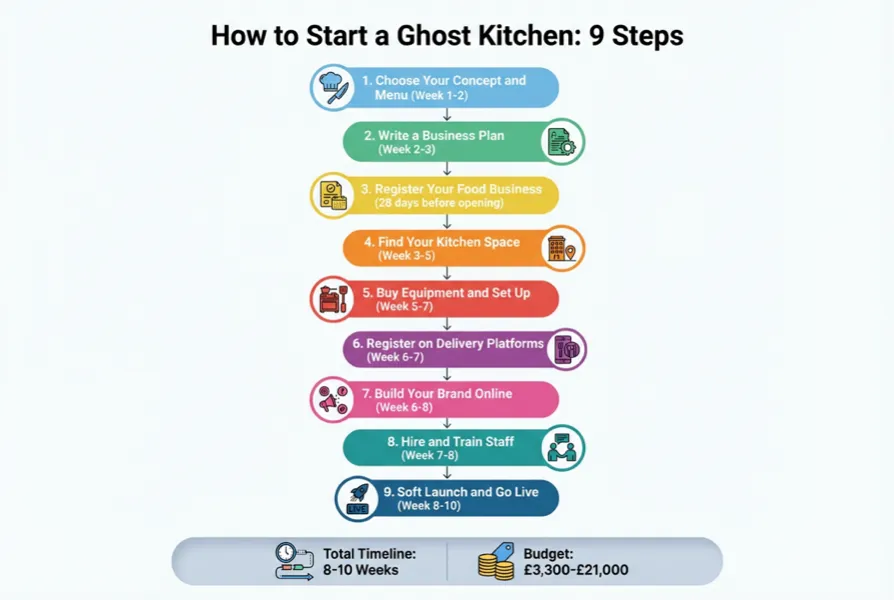
The nine stages of launching a ghost kitchen in the UK
For example, a wraps-and-bowls ghost kitchen might need little more than a commercial grill, a rice cooker, a prep fridge, and packaging supplies. A fried chicken operation might need a commercial deep fryer, extraction upgrade, and oil disposal setup: significantly higher equipment costs.
Essential equipment for any ghost kitchen:
- Commercial cooker/hob and oven
- Refrigeration (fridge and freezer, commercial grade)
- Food prep surfaces (stainless steel)
- Extraction and ventilation system
- Packaging station with heat sealers
- Tablet or screen for managing delivery orders
- Handwash basin (separate from food prep sinks)
Operational systems you need from day one:
- Order management: a system that aggregates orders from multiple delivery platforms into one screen
- Inventory tracking: even a simple spreadsheet prevents waste and stockouts
- Food safety documentation: temperature logs, cleaning schedules, allergen records (environmental health will ask for these)
Avoid the Multi-Tablet Chaos
If you're down two staff and trying to manage orders from three different tablets during the Saturday rush, your operation will break. Invest in a multi-platform order aggregator before you launch; it saves hours of chaos.
Step 7: Join Delivery Platforms
Your ghost kitchen is set up. But knowing how to start a ghost kitchen means understanding that cooking is only half the equation. Delivery platforms are your shopfront. Without them, customers cannot find your ghost kitchen.
Here is what each major UK platform typically charges:
| Platform | Commission | Key Detail |
|---|---|---|
| Just Eat | Lowest tier | Customer pays admin fee separately |
| Deliveroo | Mid-to-high tier | May increase if you list on competing platforms |
| Uber Eats | Highest tier (drops significantly with own drivers) | Large customer base |
Commission rates are negotiable and vary by arrangement. Source: MerchantSwitch (2025)
Platform strategy for your ghost kitchen:
- Start with two platforms: typically the lowest-commission option plus whichever has the largest reach in your area. Adding a third later is easier than launching on all three simultaneously.
- Optimise your listings: professional food photography, clear menu descriptions, and accurate prep times directly affect your visibility.
- Build your own ordering channel: even a simple website or Instagram ordering lets you take orders commission-free. Even a small percentage of direct orders significantly improves margins.
For instance, a ghost kitchen launching smash burgers in Birmingham might start on Just Eat and Uber Eats, then add Deliveroo once order volume justifies the additional commission.
Do you need planning permission for a ghost kitchen? Not specifically for the delivery model itself, but you may need it for the kitchen premises depending on its current use classification. Check with your local council planning department before signing any lease.
Step 8: Build Your Brand and Online Presence
Platforms are sorted. Next, you need to make sure people actually choose your listing. A ghost kitchen without a brand is just an anonymous listing buried beneath hundreds of others on a delivery app. You need a name, a look, and a reason for customers to choose you.
Brand essentials for your ghost kitchen:
- Name and logo: something memorable that communicates your food concept instantly
- Photography: invest in professional food photography for your delivery listings. This is often the single biggest factor in whether someone taps your listing or scrolls past.
- Social media profiles: Instagram and TikTok work well for food brands. Show behind-the-scenes kitchen content, menu development, and customer reviews.
- Google Business Profile: set one up even without a public-facing premises. It helps with local search visibility.
For broader marketing strategies, our restaurant digital marketing guide covers the fundamentals, and our restaurant advertising guide covers paid promotion. To keep those delivery-app listings and social profiles active without eating into prep time, a social post generator can draft a week of posts in one sitting.
Pre-launch marketing checklist:
- Set up Instagram and start posting a few weeks before launch
- Offer a launch promotion (free delivery or a discount on first orders)
- Reach out to local food bloggers and micro-influencers for reviews
- Join local community Facebook groups and announce your launch
Your competitors don't have bigger budgets. They have smaller gaps between posting.
Step 9: Launch and Optimise
Everything is in place. Finally, the last step to start a ghost kitchen is actually going live, but do not launch everything at once. Start with a soft launch: limited menu, limited hours, limited delivery radius.
Soft launch strategy (first two weeks):
- Open on one platform only
- Offer a reduced menu (your strongest items)
- Track every order for prep time, packaging quality, and delivery condition
- Read every customer review and respond personally
- Adjust recipes, packaging, or portions based on feedback
Full launch (week three onward):
- Expand to your full menu
- Add a second delivery platform
- Begin social media marketing and any paid promotions
- Set up a regular posting schedule
For example, a new poke bowl ghost kitchen might soft launch with just three bowl combinations on Just Eat for the first fortnight. After refining portion sizes and packaging based on customer feedback, they expand to the full menu and add Deliveroo.
The reality for nearly every ghost kitchen operator: your first two weeks will be messy. Orders arrive faster than expected at peak times. They arrive slower than hoped during off-peak. Treat the first month as a learning phase: you need data from day one to spot problems before they become habits.
How Much Does It Cost to Start a Ghost Kitchen?
Knowing how much it costs to start a ghost kitchen is essential before you commit. Here is a realistic breakdown of ghost kitchen startup costs in the UK:
| Cost Category | Typical Range |
|---|---|
| Kitchen rental deposit | £1,000 - £7,000 |
| Equipment and fit-out | £500 - £5,000 |
| Licences, insurance, and certifications | £500 - £1,800 |
| Initial stock and packaging | £500 - £2,000 |
| Branding, photography, and technology | £300 - £2,200 |
| Working capital | £500 - £3,000 |
| Total | £3,300 - £21,000 |
Source: Compiled from Kitchen Space Rentals (2025) and PDQ Funding (2025). Costs vary significantly by location and concept.
Compare that to opening a traditional restaurant. When you understand how to start a ghost kitchen on a budget, the entry point is remarkably accessible. Test your concept with real customers. Scale if it works.
Info
Related: Ghost Kitchen Business Model Explained, understand the four types before choosing your ghost kitchen setup
Can You Make Money With a Ghost Kitchen?
This is the question everyone asks. Profit margins in a ghost kitchen typically run higher than in traditional restaurants, often significantly so after break-even, according to CloudKitchens (2025). Lower overheads give you more room. But delivery platform commissions eat into that advantage.
Many UK ghost kitchens reach break-even within a few months of launching when they achieve consistent daily order volume. The key factors are keeping food costs under a third of revenue, managing packaging waste, and building repeat customers through quality and speed.
Is a ghost kitchen worth it? For many entering the food industry, it is typically the lowest-risk way to test a concept. If you're reading this thinking "I don't have time for all nine steps", you have more time than someone opening a traditional restaurant. That is the point of the ghost kitchen model.
Social media marketing isn't about selling food. It's about making people hungry before they're hungry. The same applies to your ghost kitchen brand: your delivery listing needs to make someone's stomach growl before they tap "order."
Is It Worth Starting a Ghost Kitchen? A Quick Self-Assessment
Before you commit to learning how to start a ghost kitchen and investing real money, answer these honestly:
- Can you consistently produce meals to a high standard under time pressure?
- Do you have enough capital to invest without putting yourself in financial difficulty?
- Are you comfortable with delivery platforms controlling your customer relationship?
- Can you handle food prep, order management, and cleaning largely on your own at first?
- Is there a gap in your local delivery market that your concept fills?
If you answered yes to at least four, learning how to start a ghost kitchen is a sensible next step. For instance, a home cook who has been selling meal prep boxes to friends might find that a ghost kitchen is the natural progression: proven demand, existing recipes, and a ready-made customer base.
If you can't tell whether your concept brings enough demand or just sounds good in your head, that's usually a sign you need to test it first, perhaps through home-based catering or a market stall.
Ask yourself honestly: would I order from my own ghost kitchen twice a week?
If You Only Have 30 Minutes a Week, Do This
Week 1 (Day 1-2): Research your local delivery market. Open Deliveroo, Uber Eats, and Just Eat. Note which cuisines are oversaturated and where the gaps are.
Week 1 (Day 3-4): Draft a one-page business plan. Anyone figuring out how to start a ghost kitchen needs basic numbers first: estimate your startup costs using the table above.
Week 1 (Day 5-7): Register your food business with your local council. This is free and takes ten minutes online.
Week 2: Complete your Level 2 Food Hygiene Certificate online. Start viewing kitchen spaces.
Week 3: Finalise your kitchen space, order essential equipment, and set up your delivery platform accounts.
Week 4: Soft launch your ghost kitchen. That is how to start a ghost kitchen in a month, start cooking.
Ghost Kitchen Startup Checklist
When it comes to tracking progress, here is a practical checklist covering every step in how to start a ghost kitchen in the UK:
- Choose your food concept and design a focused delivery menu
- Write a one-page business plan with startup costs and break-even targets
- Register your food business with your local council (28 days before trading)
- Complete Level 2 Food Hygiene Certificate
- Arrange insurance (public liability, product liability, employer liability if hiring)
- Secure your kitchen space (shared, dedicated, or home)
- Purchase essential equipment and set up food safety documentation
- Sign up for at least two delivery platforms
- Create your brand identity and invest in food photography
- Soft launch on one platform and gather feedback
- Full launch and begin marketing your ghost kitchen
Frequently Asked Questions
Are ghost kitchens legal in the UK?
Yes. Ghost kitchens are fully legal in the UK. They must comply with the same food safety regulations as any other food business, including registering with the local council at least 28 days before trading and meeting Food Standards Agency hygiene requirements.
Do you need planning permission for a ghost kitchen?
Not specifically for the delivery-only model, but you may need planning permission for the kitchen premises depending on its current use classification. A unit already classified for food preparation typically does not need additional permission. Always check with your local planning authority before signing a lease.
Can I sell food cooked at home in the UK?
Yes, provided you register your home as a food business with your local council, pass food hygiene inspections, and comply with all food safety regulations including Natasha's Law allergen labelling. Your home kitchen must meet commercial hygiene standards during operating hours.
How much does it cost to start a ghost kitchen from home?
Starting a ghost kitchen from home significantly reduces costs because you avoid rental deposits. Budget for food hygiene certification, initial stock, packaging, insurance, and delivery platform setup. You may also need to invest in equipment upgrades to meet commercial kitchen standards.
What is the 3x4 kitchen rule?
The 3x4 kitchen rule is a framework that refers to a minimum kitchen workspace of three metres by four metres, often cited as the smallest practical area for commercial food preparation. This is not a legal requirement, but many environmental health officers consider it a practical minimum for safe, efficient ghost kitchen operations.
Key Takeaway
If you run a restaurant and want to see how Local Brand Hub can support your marketing, explore our restaurant marketing tools.
Key Takeaway
Now that you know how to start a ghost kitchen in the UK, here is what to remember:
- Registration is free and mandatory: register with your local council at least 28 days before you start trading
- Focus your concept: a tight delivery-friendly menu beats a sprawling one every time
- Commission rates vary: compare platforms carefully and build your own direct ordering channel
- Break-even is achievable: many ghost kitchens reach profitability within a few months of consistent orders
- Start small, then scale: soft launch on one platform before expanding
The food industry has never had a lower barrier to entry. Learning how to start a ghost kitchen is the first step. Actually launching one is the next. You can start a ghost kitchen this month, test your concept with real paying customers, and decide whether to scale or pivot, all without the commitment of a traditional restaurant.
Weekly Action
This week, take one step toward your ghost kitchen:
- Open Deliveroo and Uber Eats in your area and identify the gap your concept could fill
- Register your food business with your local council: it takes ten minutes
- Read our complete guide to ghost kitchens for a deeper understanding of the model
Tools like LocalBrandHub can help you build and maintain your online presence once your ghost kitchen is live: handling your social media, local SEO, and digital marketing so you can focus on cooking.
For restaurants, salons, and local businesses
Need help with your marketing?
We help UK businesses turn social media into real results, not busywork.
Start freeGet More Marketing Tips
Practical marketing tips for UK business owners, straight to your inbox. No spam, unsubscribe anytime.
About the Author
Local Brand Hub
Empowering UK Businesses
Local Brand Hub provides comprehensive business management tools designed specifically for UK local businesses to streamline operations, automate marketing, and grow revenue.
More articlesRelated Articles
 Industry Insights
What Is a Ghost Kitchen? The UK Business Guide
Discover what a ghost kitchen is, compare four types, weigh costs against traditional restaurants and decide if this model fits your UK business.
 Tutorials
Dark Kitchen: Set Up and Run One in the UK
Learn how to set up and run a dark kitchen in the UK. Covers equipment, delivery platforms, food safety, staffing, and managing virtual brands.
 Business Growth
Ghost Kitchen for Rent: UK Costs and Providers
Find the right ghost kitchen for rent in the UK. Compare providers like Karma Kitchen, Deliveroo Editions and Dephna, with costs from £800 to £4,000/month.