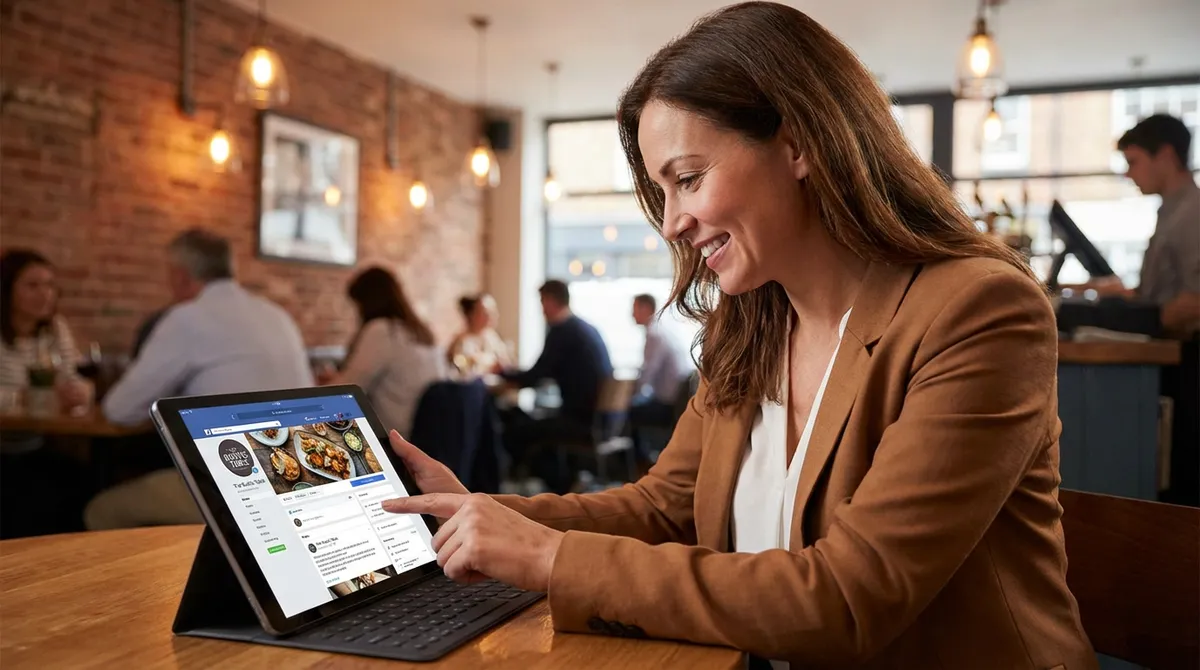
Learn restaurant Facebook marketing that drives bookings. Proven content strategies, the 30-30-30 posting rule, and whether paid ads are worth it.
Your TikTok's getting views. Your Instagram looks polished. But when someone searches for your restaurant, the first thing they check is your Facebook page, and it hasn't been updated in three weeks. 72% of customers use Facebook to decide where to eat. Restaurant Facebook marketing isn't exciting anymore, but it's where decisions happen.
Related: Restaurant Social Media Marketing (hub page)
For a broader social media framework, see our guide to restaurant social media strategy. For platform-specific tactics, see Instagram marketing for restaurants and TikTok marketing for restaurants.
Restaurant Facebook marketing means using Facebook to promote your restaurant, talk to customers, and drive bookings. Unlike TikTok or Instagram that reward viral moments, Facebook rewards showing up regularly. It's ideal for building relationships with regulars.
The numbers make the case: Facebook has 38-39 million active users in the UK each month (DataReportal). 72% of customers use Facebook to decide where to eat, based on comments and photos from others (GITNUX). Your Facebook presence isn't optional: it's how customers check you out before visiting.
What You'll Learn
- Why Facebook still matters for restaurants (with UK statistics)
- How to set up your page for bookings, not just likes
- The content mix that keeps followers engaged
- Understanding the 30-30-30 and 24-1 rules
- Whether Facebook ads actually work for restaurants
- Common mistakes that waste your time
Why Facebook Still Matters for UK Restaurants
First, let's look at the data. Before adding another platform, consider where your customers actually are. Facebook remains the most-used social platform in the UK, reaching all age groups. While TikTok captures the 18-24 crowd, Facebook dominates the 25-54 age range, the people who spend the most at restaurants. For restaurant Facebook marketing, this demographic alignment is key.
The demographics favour restaurants:
- 38-39 million UK monthly users, more than any other platform
- 25-34 year olds remain the largest Facebook demographic in the UK
- 72% of diners use Facebook to decide where to eat
- 81% of restaurateurs use Facebook for promotion (GITNUX)
Facebook vs Instagram vs TikTok
Each platform serves different purposes in your marketing mix:
| Factor | TikTok | ||
|---|---|---|---|
| Best for | Local community, reviews, events | Visual branding, younger diners | Discovery, viral potential |
| Engagement style | Comments, shares, reviews | Likes, saves, DMs | Views, follows |
| Content lifespan | Days to weeks | 24-48 hours | Hours to days |
| Booking integration | Native reserve button | Link in bio only | Link in bio only |
Choose based on where YOUR customers are, but don't neglect restaurant Facebook marketing just because it's not trendy.
When Facebook might NOT be your priority: If your target customers are primarily under 25, or if you're a delivery-only kitchen with no dine-in experience to showcase, focus your energy on TikTok and Instagram first. Facebook works best for restaurants building local community.
For most established UK restaurants with a physical location, Facebook should remain a priority channel: it's where customers check reviews, find opening hours, and discover events. Even if engagement feels lower than Instagram, the reach and booking intent often make up for it.
Setting Up Your Restaurant Facebook Page Right
With that context in mind, let's get practical. What does a proper Facebook marketing setup look like for restaurants? A poorly set up page loses customers before they see your content. Facebook business pages have features built for restaurants, use them.
Essential Page Elements
Complete every field that matters to diners:
- Category: Set as "Restaurant" with appropriate subcategory
- Address: Accurate and linked to Maps
- Hours: Updated for holidays and special occasions
- Phone number: Clickable for mobile users
- Menu: Upload directly or link to your website
- Action buttons: "Reserve," "Order Food," or "Call Now"
Profile and Cover Photos
Your profile photo appears in every comment and share, make it recognisable:
- Profile: Your logo, sized to be visible at small sizes
- Cover: Your signature dish, interior, or seasonal special (1200x630px recommended)
Don't do this: Using a blurry phone photo of your exterior. Your cover photo is prime real estate, use it.
The Content Mix: What to Post on Facebook
With that foundation set, let's talk content. What do you post? Most restaurants get restaurant Facebook marketing wrong. They treat Facebook like an ad board. But promotional posts perform 40% worse than useful or fun content: people scroll past obvious sales pitches.
The 70-20-10 Rule for Restaurant Content
Here's a framework that keeps your feed balanced:
| Type | Percentage | Examples |
|---|---|---|
| Value content | 70% | Behind-the-scenes, recipes, staff stories, tips |
| Curated content | 20% | Sharing local events, customer photos, food news |
| Promotional | 10% | Special offers, booking reminders, new menu launches |
Example: A gastropub using this framework might post:
- Value: "How we make our Sunday roast Yorkshire puddings" (behind-the-scenes)
- Curated: Sharing a customer's photo with "This is what Sundays are for"
- Promotional: "Mother's Day bookings now open: our set menu is £35pp"
Content Ideas That Work
What actually gets engagement on restaurant Facebook pages:
- Behind-the-scenes kitchen content: Prep work, busy service, ingredient sourcing
- Staff spotlights: Introduce your team with short bios
- Menu stories: Why you chose specific dishes, supplier relationships
- Customer moments: User-generated content (with permission)
- Local community: Events, partnerships, charity involvement
- Seasonal updates: Holiday menus, opening hours changes
Facebook marketing for restaurants gets lower engagement than Instagram or TikTok. But its strength is reach, not likes. A post seen by 1,000 local followers, even with few reactions, builds familiarity. They'll think of you when they're hungry.
Are you tracking reach or just engagement? For Facebook, reach often matters more for restaurant discovery.
Understanding Facebook Marketing Rules of Thumb
With your content plan taking shape, let's cover some useful frameworks for restaurant Facebook marketing. Marketers love "rules" for social media. Two common ones for restaurants are the 30-30-30 and 24-1 rules. Here's what they mean.
The 30-30-30 Rule for Restaurants
This rule divides your marketing focus into four areas:
- 30% building brand awareness (content, visibility)
- 30% engaging community (comments, messages, local involvement)
- 30% converting to sales (ads, promotions, booking pushes)
- 10% experimentation (new content types, platforms)
Your mileage will vary: a new restaurant might spend more on awareness, while an established venue focuses on conversion.
Why this matters
Most restaurants post randomly without a plan. Having a framework, even a rough one, stops you wasting time on content that doesn't serve your goals.
The 24-1 Rule
A simpler framework for engagement:
- 24 hours: Maximum response time for comments and messages
- 1 post: Minimum daily posting frequency
Customers expect replies within 24 hours; many expect faster. If someone asks "Are you open on Boxing Day?" and waits three days for an answer, they've booked elsewhere.
Think you don't have time to post daily? You're not alone. The fix: batch your content. Spend one hour filming and scheduling a week's worth of posts. A social media content calendar makes batching and scheduling far less fiddly. Facebook has a built-in scheduler. It's free.
Facebook Ads for Restaurants: Worth It?
Moving on from organic to paid restaurant Facebook marketing. Do Facebook ads work for restaurants? Short answer: yes, when used well. But you need to know the costs and set realistic goals.
Realistic Costs
Let's start with the numbers. Facebook ads use an auction system, so costs vary by area and targeting:
| Metric | Typical Range (UK) |
|---|---|
| Cost per click | £0.50 - £2.00 |
| Cost per 1,000 impressions | £5 - £15 |
| Cost per booking (estimated) | £3 - £10 |
These are benchmarks, not guarantees. Your results depend on creative quality, targeting, and offer strength.
When to Use Ads vs Organic
Here's when each approach makes sense:
| Use Ads For | Use Organic For |
|---|---|
| New restaurant launch | Building regular customer relationships |
| Specific events (Valentine's, NYE) | Day-to-day engagement |
| Reaching new local audiences | Staying visible to existing followers |
| Promoting limited-time offers | Sharing your story and values |
Best Ad Types for Restaurants
Here's which formats work best:
- Carousel ads: Multiple dishes, "swipe to explore menu"
- Video ads: 15-30 second food preparation clips
- Offer ads: Trackable discounts that measure conversion
- Event responses: Driving attendance to special nights
Local targeting matters. A restaurant in Bristol doesn't need to reach London: target your ads within a realistic travel radius of your location.
Pro Tip
Start with a £50 budget for a single "open table" or "special event" ad. Track how many clicks you get and whether bookings follow. This gives you data before spending more.
Measuring What Actually Matters
Here's where many restaurants go wrong with Facebook marketing: they track the wrong things. You're posting. Maybe running some ads. But how do you tell if restaurant Facebook marketing is working? Focus on metrics tied to your business goals.
Metrics That Matter
Focus on these numbers:
| Metric | Why It Matters |
|---|---|
| Reach | How many unique people see your content |
| Engagement rate | Quality of content (comments, shares, reactions) |
| Click-throughs to website | Interest converting to action |
| Reserve/Order button clicks | Direct booking intent |
| Message response time | Customer service quality |
Vanity Metrics to Deprioritise
- Page likes: Nice for ego, don't pay bills
- Viral posts: One-off spikes don't build regulars
- Follower count: Quality matters more than quantity
Which metrics do you check regularly? If they're not connected to bookings, you're measuring the wrong things.
Example: A bistro tracking their Facebook might check: "We posted about our new winter menu on Tuesday, got 45 reactions and 12 shares. Website visits spiked Wednesday. Booking requests were up 20% that week." That's the connection you're looking for.
A restaurant with 500 local followers beats one with 5,000 who never visit. Can't tell if Facebook brings bookings or just likes? That's a sign the strategy needs work. Check your Insights: do website clicks match busy periods?
Common Restaurant Facebook Marketing Mistakes
Finally, let's cover what NOT to do. These Facebook marketing mistakes waste your time.
Posting Only Promotions
"20% off this Friday!" "Book now for Saturday!" "Special offer ends today!"
If every post asks for something, followers tune out. Remember the 70-20-10 rule: promotional content should be just 10% of your output.
Ignoring Comments and Messages
Every unanswered comment is a public signal that you don't care. Worse, Facebook's algorithm notices low engagement and shows your content to fewer people.
Response time matters. Set up notifications and check messages at least twice daily, morning and evening.
Inconsistent Posting
Posting five times one week then disappearing for a month confuses the algorithm and your followers. Consistency beats intensity in restaurant Facebook marketing. Three posts per week, every week, outperforms daily posting that stops after two weeks.
Example: A curry house posts daily during launch week. Then nothing for six weeks. When they post again, reach drops significantly. The algorithm, and their audience, moved on.
Not Using Location Features
Facebook offers location-specific tools: check-ins, local recommendations, and area targeting. If you're not using these, you're harder to find when people search "restaurants near me."
Putting It All Together
Here's what this looks like in practice. Restaurant Facebook marketing isn't about chasing likes or going viral. It's about being present, consistent, and genuinely useful to your local community. The platform rewards restaurants that show up regularly with content worth engaging with.
If you pick just one thing: Set up your action buttons and start responding to every message within 24 hours. These basics build more trust than any clever content strategy.
Weekly Action Checklist
- Post 3-5 times (following 70-20-10 mix)
- Respond to all comments and messages
- Share one piece of user-generated content
- Check Insights for top-performing content
- Update hours if anything changes
If You Only Have 15 Minutes This Week
This week, show you're active:
- Day 1-2: Post one behind-the-scenes photo from service with a simple caption
- Day 3-4: Respond to any comments or messages from the past week
- Day 5-7: Check your Insights to see when your followers are most active
That's your minimum viable Facebook strategy: showing you're open, active, and worth visiting. For ready-to-use caption templates, see our restaurant social media posts guide.
If you run a restaurant and want to see how Local Brand Hub can support your marketing, explore our restaurant marketing tools.
Key Takeaways for Restaurant Facebook Marketing
- 38-39 million UK users, still the largest social platform
- 72% of diners use Facebook to decide where to eat
- 70-20-10 rule keeps content balanced (not just promotions)
- 24-hour response time is the maximum customers expect
- Local focus beats follower count: 500 engaged locals trump 5,000 random followers
Ask yourself: if someone found your Facebook page today, would they know when you're open, what you serve, and why they should visit? If not, that's where effective restaurant Facebook marketing begins.
Social media moves fast. We keep this restaurant Facebook marketing guide updated regularly.
Related reading: Restaurant Social Media Strategy | Instagram Marketing for Restaurants | TikTok Marketing for Restaurants
For UK restaurants
Ready to master your restaurant's Facebook presence?
Local Brand Hub helps UK restaurants create engaging content, schedule posts, and turn Facebook followers into paying customers.
Start freeGet More Marketing Tips
Practical marketing tips for UK business owners, straight to your inbox. No spam, unsubscribe anytime.
About the Author
Local Brand Hub
Empowering UK Businesses
Local Brand Hub provides comprehensive business management tools designed specifically for UK local businesses to streamline operations, automate marketing, and grow revenue.
More articlesRelated Articles
 Tutorials
The 5 3 2 Rule for Social Media: Content Mix That Works
The 5 3 2 rule for social media: 50% curated, 30% original, 20% promotional content mix for engagement. A guide for UK restaurants in 2026.
 Tutorials
Restaurant Social Media Agency: When to Hire One (2026)
When hiring a restaurant social media agency makes sense. Services, UK pricing £500-£4,000/month, and how to choose wisely.
 Tutorials
Instagram Marketing for Restaurants: The 13 Minute Problem
Instagram reaches most UK online adults but takes 13 minutes a day. What to post, what the 5-3-2 and 5-3-1 rules are worth, and how to prove it works.