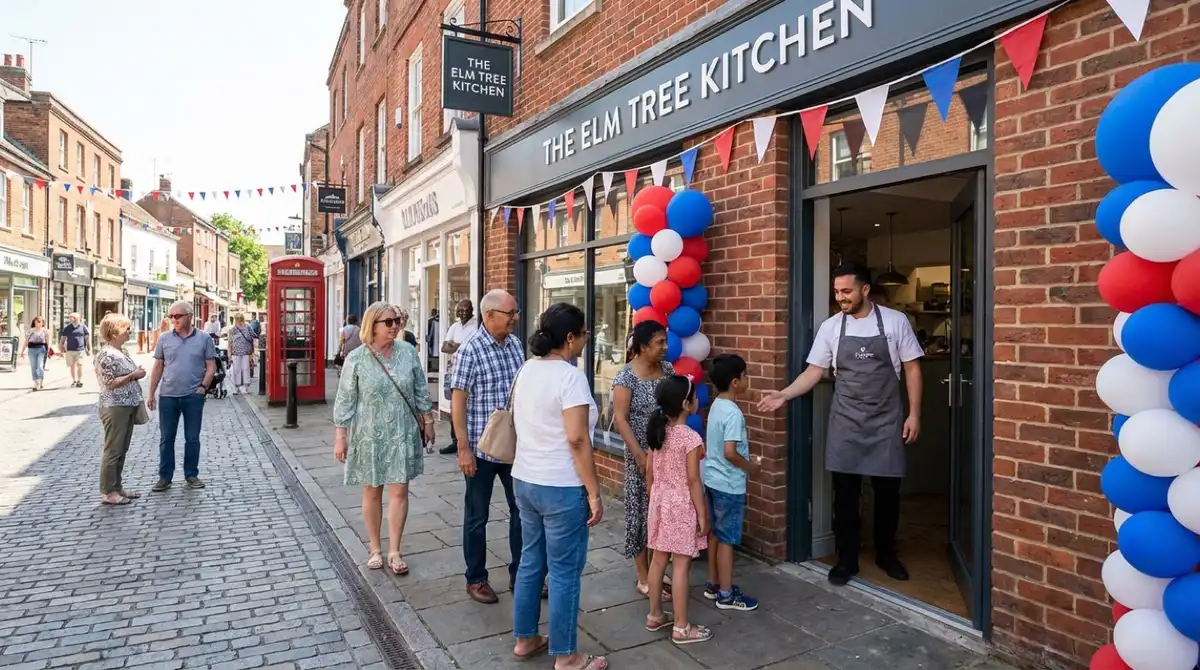
Watch the visual overview· 92 seconds
Learn how to promote a grand opening for your restaurant. PR outreach, live social media coverage, opening day offers and a step-by-step launch event plan.
Launch day is tomorrow. You've spent months on fit-out, menu development, and hiring — the signage is up and you've told everyone you know. But around 60% of UK restaurants close within their first year, and many trace the problem back to a launch that nobody noticed.
Knowing how to promote a grand opening separates a packed first night from an empty dining room with nervous staff. This guide covers the final two weeks of promotion, the event itself, and the live coverage that turns one opening into weeks of momentum. If you're building a wider launch plan, start with our restaurant grand opening marketing hub.
What You'll Learn
- How to promote a grand opening in the final two weeks before your restaurant launch
- A running order for launch day — from morning prep through VIP hour to public opening
- Live social media coverage tactics that generate reach beyond the room
- PR and media strategies including press releases, media kits, and food blogger invitations
- Opening day offers that attract crowds without destroying your margins
- A timeline diagram to keep every detail on track
Pre-Event Promotion: The Final Two Weeks
First, let's tackle the lead-up. The last 14 days before your grand opening are when casual interest converts into confirmed attendance. Your restaurant might be ready, but if nobody knows about the event, you'll be serving your best dishes to empty tables. Mastering how to promote a grand opening in those final days makes the difference between a packed house and a quiet first week.
Creating a unique branded hashtag and encouraging attendees to share photos expands your reach far beyond those who physically attend. But hashtags only work if people know the event exists.
Week Two Out (Days 14-7)
Press releases go first. Send your press release to local media outlets, food editors, and community listings at the two-week mark. This gives newspaper and magazine editors enough lead time for print editions or online event calendars.
Your press release should include the date, time, address, what makes your restaurant different, and a clear call-to-action. Effective press releases function as both informational documents and promotional tools with integrated branding.
For example, a new seafood restaurant in Bristol might send their press release to Bristol Live, the Bristol Post food desk, local food bloggers like Bristol Bites, and the Bristol Good Food Awards team. Four different channels from a single document.
Info
A press release costs nothing but your time. Yet most independent restaurants skip this step entirely, missing out on free coverage that paid advertising can't replicate.
Social media countdown begins. Post daily countdown content mixing behind-the-scenes footage with teasers. Show your chefs discussing signature dishes, share a time-lapse of the dining room transformation, or reveal one menu item per day.
Posting videos of your chefs highlighting what makes your food distinct creates anticipation and gives potential customers a reason to attend.
Create your Facebook Event. This gives you an RSVP mechanism, a shareable link, and a place to post updates. Add your location to your Facebook Business profile so attendees can geotag posts on the day.
Week One Out (Days 7-1)
So your press release is sent and your social countdown is running. The final week is about converting online interest into physical attendance.
Neighbourhood flyering. Distribute flyers within a half-mile radius of your restaurant — focus on residential letterboxes, community noticeboards in supermarkets and libraries, and nearby offices. Include a simple incentive: "Show this flyer on opening day for a complimentary welcome drink."
Window signage. A bold "Grand Opening" banner or window vinyl with the date, time, and a teaser about your opening offer. Foot traffic past your premises is free advertising — make it work.
Email blast. If you've collected contacts during your build-out (suppliers, neighbours, people who've stopped to ask what's opening), send them a personal invitation. Even a list of 50 addresses can generate 15-20 attendees and their guests.
Personal invitations convert better
Personal email invitations convert better than public social media posts. A message that says "I'd love you to be there" outperforms a generic "Everyone's invited."
Final social push. Boost one Instagram or Facebook post with a modest budget of £20-50 targeting your postcode area within a 3-mile radius. This puts your grand opening event in front of people who live nearby but haven't discovered your profiles yet.
If you're thinking "I don't have a social media following yet" — that's exactly the point. Pre-opening promotion builds the audience you'll need from day one. Our guide to restaurant social media marketing covers how to build that presence from scratch.
Pro Tip
See also: Opening soon restaurant — how to build pre-opening buzz from the moment your site goes up.
The Grand Opening Event Plan
You've built the buzz. Next comes the day itself — and knowing how to promote a grand opening means having every hour planned before you open the doors.
A grand opening isn't just "opening for the first time." It's a structured event that creates energy, photo opportunities, and stories people tell. If you've already run a restaurant soft opening, your team has been through real service. It's time to turn up the volume.
Part of knowing how to promote a grand opening is planning every hour. Here is a running order from arrival to last guest.
Running Order
| Time | Activity | Who's Responsible |
|---|---|---|
| 8:00-10:00 | Morning prep — final clean, decoration, table settings | Full team |
| 10:00-11:00 | Photographer arrives, staged photos, food prep shots | Manager + photographer |
| 11:00-12:00 | Staff briefing — event flow, roles, VIP guest names | Manager |
| 12:00-13:00 | VIP preview — press, food bloggers, councillor, suppliers | Front-of-house lead |
| 13:00-14:00 | Ribbon cutting and transition to public opening | Owner + VIP guest |
| 14:00-20:00 | Public grand opening — full service with opening offers | Full team |
| 20:00-22:00 | Evening celebration — music, special cocktails | Full team |
Staffing for the Event
Schedule 25 to 30 per cent more staff than a normal service. Your team will be handling food service, answering questions, giving tours, facilitating media interviews, and managing guests who are exploring rather than simply dining.
For example, if you normally run with two front-of-house staff and three in the kitchen, add a dedicated greeter, a runner for drinks and canapes during the VIP hour, and one person solely responsible for managing the photographer and keeping the event on schedule.
Photographer and Videographer
An often overlooked part of grand opening promotion is the content you capture on the day itself. Hire a professional photographer for the full day. Budget between £300 and £600 for 6-8 hours of coverage. Those images become your Google Business Profile photos, social media content for the next three months, and press materials.
If budget allows, add a videographer for 2-3 hours covering the VIP hour and ribbon cutting. A 60-second highlight reel performs well on Instagram Reels and TikTok.
If you're thinking "can't we just use a phone?" — you can, but professional photos on your Google listing and website signal credibility to every customer who searches for you. First impressions happen online before anyone walks through your door.
Create a shot list
Brief your photographer on the key moments — ribbon cutting, first customers walking in, the full dining room, and food being plated. A shot list prevents missed opportunities you can't recreate.
Entertainment Options
Entertainment sets the atmosphere and gives guests a reason to stay longer. Keep it appropriate to your concept:
- Live acoustic music: Works for most restaurant types, typically £150-300 for a 2-3 hour set
- DJ: Better for evening celebrations or casual dining concepts, £200-400
- Live cooking demonstration: Your head chef prepares a signature dish in front of guests — zero cost, high engagement
- Balloon artist or caricaturist: Good for family-friendly restaurants, £100-200
For most UK restaurants, a live acoustic musician during the VIP hour followed by background playlists for public service often offers the strongest balance of atmosphere and cost.
Ribbon Cutting Logistics
The ribbon cutting is your single most photographable moment. Get it right.
Who cuts the ribbon? In the UK, invite your local councillor, the chair of your local chamber of commerce, or a respected community figure. Contact your council at least three weeks in advance — most councillors are happy to attend and will promote the event through their own channels.
Setup: Red ribbon across the doorway, large scissors (available from event supply companies for around £15-25), and your photographer positioned front-on. Gather VIP guests, staff, and early public attendees behind the person cutting the ribbon for a crowd shot.
That single photo becomes your "About Us" page hero image, your Google Business Profile cover, and the image every local news outlet runs with their coverage.
Live Social Media Coverage
Now that the event itself is planned, here's where your ability to promote a grand opening truly accelerates — live, in real time. The event is a content goldmine, but only if you capture it. One person on your team needs to be dedicated to social media for the entire day. This isn't something your busy manager can do between seating guests.
If your social media coverage on opening day consists of one blurry photo posted at 10pm, that's usually a sign you didn't plan the content capture in advance.
Instagram Stories and Reels Plan
Post 10-15 Instagram Stories throughout the day. Aim for one every 30-45 minutes during peak hours.
| Time | Story Content | Format |
|---|---|---|
| 9:00 | "Setting up for the big day" — kitchen prep | Video (15 sec) |
| 11:00 | Staff briefing — team huddle | Photo + text overlay |
| 12:00 | "Doors about to open for VIP preview" | Video |
| 12:30 | VIP guests arriving, blogger reactions | Video (multiple clips) |
| 13:00 | Ribbon cutting moment | Video + share to feed |
| 14:00-18:00 | Food shots, guest reactions (every 45 min) | Mix |
| 19:00 | Evening atmosphere — music, full restaurant | Video |
| 21:00 | "What a night" — thank you from the owner | Video to camera |
For example, a new tapas bar might film their chef assembling a signature sharing board during the VIP hour, post it to Stories with a "First guests are here" sticker, then repost a blogger's reaction video 30 minutes later. That sequence tells a story in real time.
Info
Your Instagram Stories from opening day become the first impression for anyone who discovers your profile in the weeks that follow. Make them worth watching.
Shoot one dedicated Reel. Film 5-8 short clips throughout the day — morning prep, ribbon cutting, food being plated, happy guests, the full restaurant — and edit them into a 30-60 second Reel with trending audio. Post it the following morning when it reaches maximum engagement.
Ask yourself: would I follow my own restaurant's account based on this content? If the answer is no, your social coverage needs more personality.
Avoid posting one photo because that rarely builds lasting momentum. You need the full arc: setup, excitement, celebration, and follow-up.
TikTok and Facebook Strategy
If your target audience skews younger, go live on TikTok during the VIP hour or ribbon cutting. A 15-20 minute live stream captures authentic energy that polished content can't replicate.
Post real-time updates to your Facebook Event page throughout the day. People who clicked "Interested" but didn't commit will see activity in their notifications and a busy event with comments often converts fence-sitters into last-minute attendees.
Hashtag Strategy and Guest UGC
Create one branded hashtag and use it on everything: #[YourRestaurantName]GrandOpening. Print it on table cards, mention it in your welcome speech, and include it on signage.
User-generated content from your grand opening is more trusted than anything you post yourself. Three ways to encourage it:
- Photo opportunity wall: A branded backdrop or neon sign where guests naturally want to take photos
- Table cards: "Enjoying your visit? Share a photo and tag us @YourRestaurant"
- Incentive: "Post a photo and show your server — free dessert on your next visit"
For a deeper dive on making social media work for your restaurant beyond opening day, see our guide to restaurant advertising.
PR and Media Strategy
Beyond your own social channels, the biggest reach opportunity on opening day isn't your followers — it's local media, food bloggers, and community groups who can put your restaurant in front of thousands of people you'd never reach alone.
Grand openings are genuinely newsworthy for local media — but only if you make their job easy. Journalists and bloggers receive dozens of pitches weekly. Yours needs to include everything they need to write a story without chasing you for details.
Press Release Template
Your press release should follow this structure — it forms the foundation of your earned media strategy:
- Headline: "[Restaurant Name] Opens in [Location] — [Unique Angle]"
- Opening paragraph: Who, what, when, where, and why it matters locally
- Body: What makes the restaurant different, your background, the concept
- Quote: A direct quote from the owner or head chef
- Event details: Date, time, address, special activities or offers
- Contact information: Name, phone, email for media enquiries
- Boilerplate: Two sentences about the restaurant for editors to copy
For example, a vegan restaurant in Manchester might lead with: "Manchester's First Zero-Waste Vegan Restaurant Opens in Northern Quarter — Grand Opening Saturday 15th March with Local Councillor Jane Smith."
Send the press release as the body of an email, not an attachment. Editors don't open attachments from unknown senders.
Media Invite List
Build your grand opening promotion list from these categories:
- Local newspaper food editors (print and online)
- Local radio stations — approach their community or events team, not news
- Regional food magazines (Olive, Great British Food, regional lifestyle titles)
- Food bloggers within 20 miles — search Instagram for #[YourCity]Food
- Local Instagram food accounts — many cities have dedicated food photography accounts
- Community Facebook group admins — ask them to share your event
Press Kits
Prepare a digital press kit and have printed copies available on the day:
| Component | Format | Purpose |
|---|---|---|
| Press release | PDF + plain text | Ready-to-publish story |
| High-res photos | JPG, min 2000px wide | Print and online use |
| Menu (PDF) | Designed version | Visual reference for reviewers |
| Owner bio + headshot | 150 words + JPG | Background for features |
| Fact sheet | One page | Key facts — seats, cuisine, hours |
| Social media handles | Text | Easy tagging |
Upload everything to a shared Google Drive or Dropbox folder and include the link in every media email.
Food Blogger Invitations
Food bloggers are often more influential than traditional media for restaurant discovery. Building media and influencer relationships during the planning phase generates complementary publicity that attracts long-term customers.
Do this:
- Invite bloggers to the VIP preview hour — they want exclusive access
- Offer a complimentary tasting menu so they can photograph multiple dishes
- Give them space and time to photograph without rushing
- Follow up the next day with a thank you and the digital press kit
Don't do this:
- Don't demand they post — genuine recommendations carry more weight
- Don't invite 20 bloggers to the same hour — they compete for the same audience
- Don't forget micro-influencers — an account with 3,000 engaged local followers often drives more covers than one with 50,000 national followers
If you're only sending your press release to the local paper you'll always lose to competitors who build relationships with bloggers, radio stations, and community groups simultaneously.
Pro Tip
See also: Restaurant events — how to plan events that keep customers coming back after opening night.
Opening Day Offers That Work
With your PR strategy and social media plan in place, there is one more element of how to promote a grand opening that makes the difference: what you offer the people who actually show up. The right opening day offer gets people through the door. The wrong one attracts bargain hunters who never return. The goal is generosity that feels special without training customers to expect discounts.
Offers That Drive Footfall Without Killing Margins
Estimated costs based on typical UK independent restaurant pricing.
| Offer Type | Estimated Cost | Why It Works | Risk |
|---|---|---|---|
| Free welcome drink | £1.50-3.00/guest | High perceived value, encourages food orders | Low |
| Free dessert with any main | £2.00-4.00/guest | Encourages full ordering, extends visit | Low |
| 10% off total bill (opening week) | Variable | Simple, time-limited | Medium |
| First 50 customers get branded tote bag | £3.00-5.00/bag | Creates urgency, take-home reminder | Low |
| Loyalty card — buy 5, get 1 free | £0 (deferred) | Drives repeat visits, data collection | Very Low |
| 50% off food bill | Variable | Attracts crowds but sets wrong expectation | High |
What Actually Works vs What Costs Too Much
The most effective grand opening day offers share three qualities: they feel generous, they're easy for staff to manage, and they encourage the customer to come back.
A free welcome drink works because it costs under £2 per person but makes every guest feel welcomed. Pair it with a loyalty card and you've turned a one-time visitor into a tracked customer.
"First 50 customers" offers create urgency. People arrive early, queue outside, and that queue is visible social proof for every passerby.
Blanket percentage discounts above 15 per cent are risky. They attract people who came for the deal, not the food. Offering coupons or vouchers to encourage repeat visits converts opening day visitors into returning customers more effectively than deep discounts on the first visit.
Warning
If your offer would attract someone who'll never come back at full price, it's the wrong offer.
For example, a new pizzeria might offer a free garlic bread with any pizza ordered (cost: roughly £1.20) plus a loyalty stamp card. The garlic bread costs almost nothing to produce but makes every customer feel they got something extra. The stamp card means a significant portion of those customers come back within a month.
If you're thinking "do I really need to give anything away?" — consider this. The average cost of acquiring a new restaurant customer through paid advertising is significantly higher than the cost of a free dessert. Opening day offers are your cheapest customer acquisition tool.
"Bring a Friend" Mechanics
A "bring a friend" offer during opening week doubles your reach at minimal cost. Structure it as: "Dine with us this week and receive a voucher for a free starter for you and a friend on your next visit." This guarantees a second visit and introduces a new customer who might never have found you otherwise.
The biggest mistake is treating opening day offers as an expense rather than an investment. Every free welcome drink that converts a stranger into a regular pays for itself within two visits.
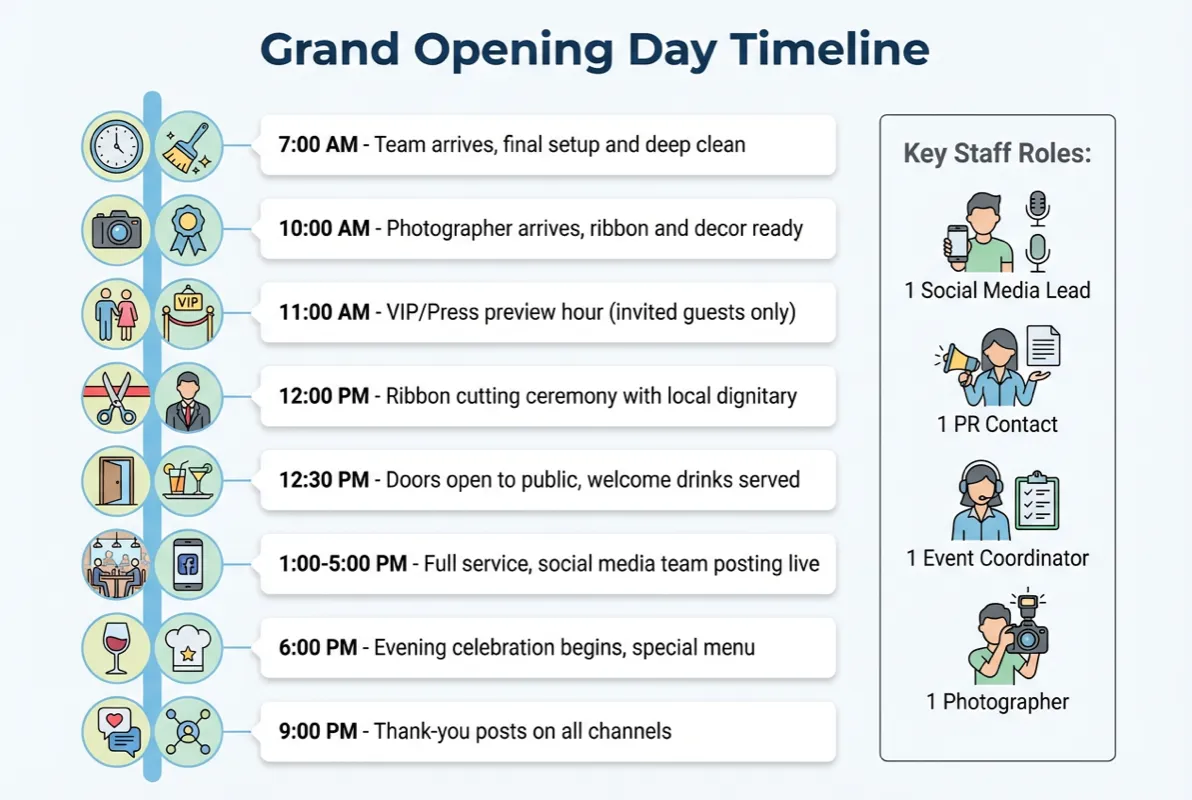
Grand opening day timeline from morning prep to evening celebration
If You Only Have 30 Minutes a Week
Maybe you've reached this article with your grand opening just days away. If you're reading this thinking "I haven't done any of this and we open on Saturday" — here's the minimum viable promotion plan for how to promote a grand opening on a tight timeline.
Last-minute grand opening promotion plan
- Day 1-2: Write a short Facebook Event and Instagram post announcing your grand opening. Boost the Instagram post with £20 targeting your postcode. Create your branded hashtag
- Day 3-4: Email or message every contact on your phone who lives locally — personal invitations convert better than public posts. Call your local councillor's office about cutting the ribbon
- Day 5-7: Print 50 simple flyers with the date, time, address, and "Free welcome drink on opening day." Drop them through letterboxes on your street and brief one team member to own social media on the day
For example, a tapas bar owner in Cardiff followed exactly this plan three days before opening. The boosted Instagram post reached 2,400 local people for £20, personal WhatsApp messages brought in 35 confirmed guests, and neighbourhood flyers drove another 15 walk-ins on the night.
The reality for most independent restaurants is that grand opening promotion happens alongside a hundred other urgent tasks. That's fine. The three actions above — social post, personal invitations, neighbourhood flyers — cost under £30 and cover the essentials.
Pro Tip
See also: Restaurant opening checklist — make sure you haven't missed any operational steps.
Your competitors don't have bigger budgets. They have better preparation. And preparation starts with a plan, even a simple one.
Frequently Asked Questions
How far in advance should you start promoting a grand opening?
Start serious promotion two weeks before the event. Press releases and media invitations should go out at the 14-day mark to allow lead time for print publications. Social media countdown content, neighbourhood flyering, and email invitations fill the final seven days. If you haven't done a restaurant soft opening yet, schedule that one to two weeks before your grand opening to work out operational issues before the public event.
How much does it cost to promote a restaurant grand opening in the UK?
Initial marketing costs for a UK restaurant opening typically range from £2,000 to £6,000, covering website development, social media setup, and printed materials. For the grand opening event itself, budget £300-600 for a photographer, £150-400 for entertainment, £50-100 for decorations and signage, and £20-50 for a single boosted social media post. Many of the most effective tactics — press releases, flyering, social content — cost nothing beyond your time.
What should you include in a restaurant grand opening press kit?
When planning how to promote a grand opening through media coverage, a complete press kit includes your press release, high-resolution photographs (minimum 2000px wide), a designed menu PDF, a 150-word owner biography with headshot, a one-page fact sheet covering capacity, cuisine type, and opening hours, and your social media handles. Upload everything to a shared folder and include the link in every media email so journalists can access what they need without asking.
Who should cut the ribbon at a restaurant grand opening?
In the UK, invite your local councillor, the chair of your local chamber of commerce, or a well-known community figure. Contact them at least three weeks before the event. Most councillors welcome the invitation and will promote the event through their own channels. Position your photographer directly in front for the shot — this image will serve as your "About Us" page hero, Google Business Profile cover, and the photo local media use in their coverage.
What are the best opening day offers for a new restaurant?
The most effective offers feel generous without training customers to expect discounts. A free welcome drink (costing £1.50-3.00 per guest) paired with a loyalty card launch gives high perceived value at low cost. "First 50 customers" mechanics create urgency and visible queues. Avoid blanket discounts above 15 per cent — they attract deal-seekers who rarely return. For strategies that build on grand opening day momentum, see our guide to how to promote a newly opened restaurant.
If you run a restaurant and want to see how Local Brand Hub can support your marketing, explore our restaurant marketing tools.
Key Takeaway
Key Takeaway
Here is a summary of how to promote a grand opening effectively:
- Pre-event promotion starts two weeks out — press releases, social countdown, neighbourhood flyering, and email blasts convert awareness into attendance
- The grand opening event needs a structured running order from morning prep through VIP preview to public opening and evening celebration
- Live social media coverage requires a dedicated person posting 10-15 Stories throughout the day, plus one polished Reel posted the morning after
- PR strategy means making journalists' jobs easy — press releases in email bodies, digital press kits, and exclusive VIP access for food bloggers
- Opening day offers should feel generous but protect margins — free welcome drinks and loyalty cards outperform blanket discounts
- Ribbon cutting is your single most photographable moment — invite your local councillor and position your photographer front-on
Knowing how to promote a grand opening isn't about spending thousands on advertising. It's about making the most of the one day when everyone wants to know your story — and ensuring the story reaches further than the people in the room.
Weekly Action
This week, take one step toward your grand opening promotion:
- Draft your press release using the template above and identify five local media contacts to send it to
- Create your branded hashtag and set up a Facebook Event with all the details
- Brief one team member who will own social media coverage on the day — show them the posting schedule
For restaurants, salons, and local businesses
Need help with your marketing?
We help UK businesses turn social media into real results, not busywork.
Get in TouchAbout the Author
Local Brand Hub
Empowering UK Businesses
Local Brand Hub provides comprehensive business management tools designed specifically for UK local businesses to streamline operations, automate marketing, and grow revenue.
More articlesRelated Articles
 Marketing Tips
Medical Aesthetics Marketing: UK Compliance Guide
Medical aesthetics marketing for UK doctor and nurse-led clinics. GMC/NMC rules, before-and-after photo limits, CQC signals and patient trust strategies.
 Marketing Tips
Aesthetics Marketing Agency: A UK Clinic Buyer's Guide
How to find the right aesthetics marketing agency for your UK clinic — what to look for, red flags, costs, and when DIY is smarter.
 Marketing Tips
Aesthetics Marketing: DIY Playbook for UK Clinics
Practical aesthetics marketing strategies you can run yourself. Social media, before-and-after content, local SEO, email, and referrals for UK clinics.