
A practical internet marketing guide for UK restaurant owners. Covers local SEO, social media, Google Business Profile, and website essentials.
You have just finished a 12-hour shift. Your feet hurt. The last table has paid, and you are wondering: why does the restaurant down the road always seem busier? Their food is not better. The difference? They have figured out restaurant internet marketing: showing up where customers look.
What exactly is restaurant internet marketing? It is a strategy that uses online channels (including websites, social media, local search, and email) to attract diners to your restaurant. This framework helps independent UK restaurants build a loyal local following, compete with chains, and fill tables during quiet periods without a massive budget.
Why does this matter so much? According to a 2025 Deloitte report, 78% of UK diners research restaurants online before visiting. If you are not visible in those moments, you are often invisible, no matter how good your food is.
This restaurant internet marketing guide walks you through the core online marketing channels that work for UK restaurants, gives you a framework you can actually follow, and includes a minimum-effort plan for when time is tight.
Info
Related: See our restaurant digital marketing guide for a broader perspective on how all these pieces fit together.
What You'll Learn
First, here is what this guide covers. By the end, you will understand:
- How local SEO for restaurants puts your restaurant in front of hungry searchers
- Which social media platforms typically matter for UK restaurants
- Why your website still matters (and what to fix first)
- A simple framework for prioritising your restaurant internet marketing efforts
- The minimum viable plan if you only have 30 minutes a week
For example, a family-run Italian in Leeds increased their weekday bookings by 40% simply by claiming their Google Business Profile and responding to reviews consistently for three months. For instance, a seafood restaurant in Brighton saw their "near me" searches double after adding 20 photos to their profile over a month.
Why Internet Marketing Matters for UK Restaurants
Let's dig deeper into why online marketing matters so much for restaurants in 2026. The way people find restaurants has fundamentally changed. They check Google Maps, scroll through Instagram, and read reviews before deciding where to eat.
If your restaurant is not visible in those critical online moments, you are often invisible to potential customers, no matter how good your food is. That is why restaurant internet marketing matters.
For example, consider two curry houses on the same street. One has mastered restaurant internet marketing with a complete Google Business Profile and 150 reviews. The other has no online presence. When someone searches "best curry near me," only one appears. The other might as well not exist.
The Reality for Independent Restaurants
If you're thinking "I don't have time for this online marketing stuff," you're not alone. Most independent restaurant owners are already stretched thin between suppliers, staffing, and service.
The good news is that effective restaurant internet marketing does not require hours every day. It requires showing up consistently in the right places. And the channels that matter are more limited than you might think. Understanding restaurant marketing strategies at a high level helps you see how digital marketing fits together.
Quick Self-Check
Would you book a table at your own restaurant based solely on what appears online? If you hesitate, that's usually a sign something needs attention. Would you follow your own social media account if you were a potential customer?
The Three Pillars of Restaurant Internet Marketing
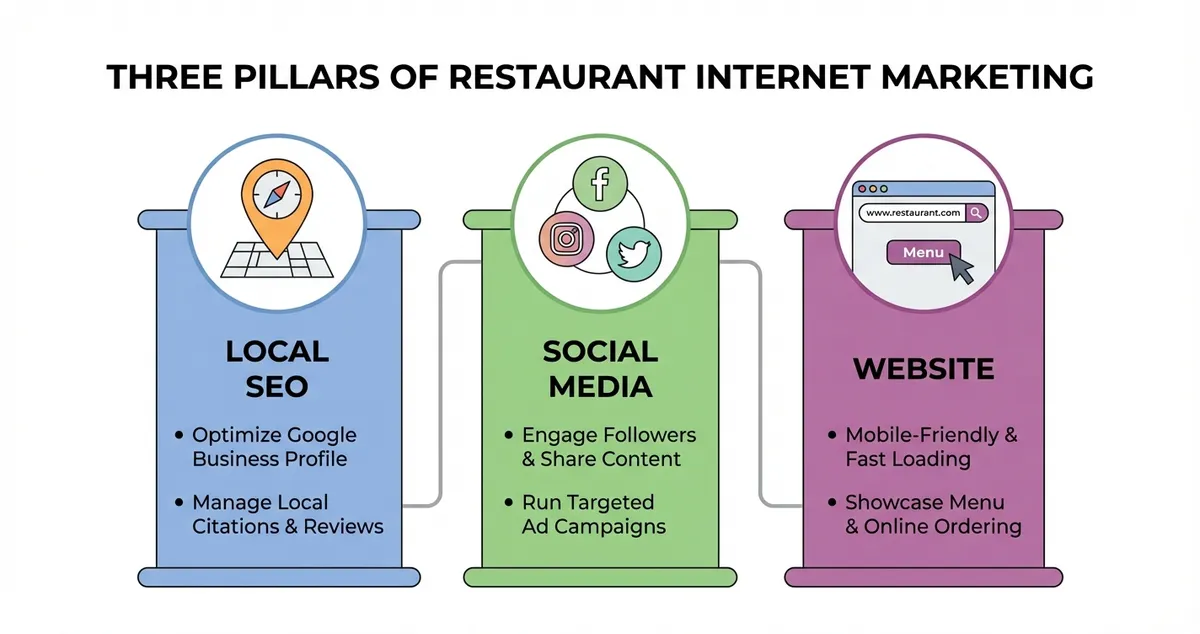
Your online presence rests on three interconnected pillars
The three pillars framework is a model that organises restaurant internet marketing into three interconnected areas. It is a framework that simplifies your approach by focusing on the essentials. Think of your online presence as resting on these pillars:
- Local SEO: Getting found when people search "restaurants near me"
- Social Media: Building recognition and appetite before the visit
- Your Website: Converting interest into bookings
Each pillar supports the others. Strong local SEO brings traffic. Social media builds familiarity. Your website seals the deal.
If you're only focusing on one pillar while ignoring the others you'll always lose to competitors who treat all three as part of the same system, ideally an all-in-one marketing platform that connects them. Neglect one, and the others work harder for less return.
Local SEO: Getting Found in "Near Me" Searches
Building on the three pillars framework, local SEO is typically where most restaurants should start. It is your foundation.
When someone searches "Italian restaurant near me" or "best Sunday roast [your town]," Google decides which restaurants to show. Local SEO is how you influence that decision.
Google Business Profile: Your Most Important Free Tool
Your Google Business Profile (GBP) is often the first thing customers see. Complete profiles are typically twice as likely to be considered reputable by customers, which directly affects whether someone chooses your restaurant over a competitor.
A Moz study found that GBP signals account for roughly 32% of local pack rankings, making it often one of the most influential factors for local search visibility. Businesses with complete profiles are significantly more likely to attract visits, according to Google's official business guidelines.
Essential GBP Optimisations
- Complete every field: Business name, address, phone, website, hours, and attributes
- Choose the right primary category: "Restaurant" is too broad; "Italian Restaurant" or "Gastropub" is better
- Add photos weekly: Businesses with photos typically receive more direction requests. For example, a Thai restaurant adding just two new dish photos weekly saw their profile views increase by 35% over two months.
- Respond to reviews: Every single one, positive or negative
For example, a gastropub in Bristol might update their GBP photos every Friday afternoon, showing that week's specials and the pub in full swing. That takes ten minutes and signals to Google that the business is active.
Getting More Reviews (Without Being Annoying)
Reviews are essential for restaurant internet marketing. But asking every customer to leave one feels awkward. Here are approaches that typically work:
- Train staff to mention it naturally at the end of a great meal: "If you enjoyed tonight, we would love a Google review"
- Add a QR code to receipts or table cards that links directly to your review page
- Send a follow-up email after online orders with a one-click review link
The goal is not hundreds of reviews overnight. Aim for steady growth: two to four new reviews per month keeps your profile fresh without looking manufactured. If you're getting fewer than one review a month, that's usually a sign your review request process needs attention.
Info
Related: See our restaurant reviews and SEO guide for how to handle negative reviews and build your reputation.
Social Media: Building Appetite Before the Visit
With local SEO bringing people to your door, the next question is how to stay top of mind between searches. That is where social media fits into your restaurant internet marketing strategy.
Social media for restaurants is not about selling food. It is about making people hungry before they are hungry. The question is not "should I be everywhere?" It is "where are my customers?"
Choosing the Right Platforms
| Platform | Strength | UK Users | Frequency |
|---|---|---|---|
| Visual, under-45 | ~32M | 3-5/week | |
| Local, over-35 | ~44M | 2-3/week | |
| TikTok | Viral, Gen Z | ~23M | 2-4/week |
| Google Posts | SEO boost | N/A | 1-2/week |
Note: UK user figures from Statista social media statistics, 2025. Your actual audience may vary based on location and cuisine type.
For many UK restaurants, Instagram often offers a strong combination of visual appeal and local discovery features. If your audience skews older or you rely heavily on events and promotions, Facebook typically deserves attention too. TikTok can work brilliantly for some, but requires more creative investment.
The 70/20/10 Content Rule
Once you have chosen your platforms, the next challenge is what to actually post. The 70/20/10 rule is a content framework that balances value and promotion across your posts. It is a framework that prevents the common mistake of over-promoting.
If you're not sure what to post, this gives you a simple formula. For a deeper dive into platform-specific tactics, see our guide to restaurant social media marketing.
- 70% value content: Behind-the-scenes, cooking tips, team spotlights, local stories
- 20% shared content: Customer photos (with permission), local business shoutouts, community events
- 10% promotional: Offers, new dishes, booking pushes
For example, a restaurant posting five times a week might share three behind-the-scenes moments, one customer photo, and one weekly special. That is the 70/20/10 rule in action.
For instance, a bistro in Manchester might post a video of their chef preparing the signature dish on Monday, a story highlighting the local farm they source from on Wednesday, and a booking reminder for the weekend on Friday.
Show Your Team
According to Meta for Business, posts that show the people behind the brand typically generate higher engagement than product-only content. Your team is your differentiator. For example, a pub in York tripled their engagement by featuring a weekly "Meet the Staff" story.
Your Website: Converting Interest Into Bookings
Having established your local SEO foundation and social media presence, we turn to the third pillar. With local SEO and social media working together, you have one more piece to complete your online marketing foundation.
All that effort drives people somewhere: your website. This is where interest becomes action.
Your website does not need to be fancy. It needs to answer three questions fast: What do you serve? Where are you? How do I book?
Website Essentials Checklist
- Mobile-friendly design (over 60% of restaurant searches are mobile)
- Menu visible without downloading a PDF
- Clear booking button above the fold
- Address, phone, and hours on every page
- Fast loading time (under 3 seconds)
- Basic schema markup for local business
If your current website fails any of these, that is where to start. A beautiful site that loads slowly or hides the menu will often lose bookings to the simpler competitor next door. For restaurant website optimisation tips, see our guide to email marketing for restaurants for capturing visitor details.
Quick Win: Add Online Booking
Building on the website essentials above, online booking deserves special attention. If you do not have online reservations, you are making customers work harder than they need to. Platforms like ResDiary, OpenTable, or even a simple embedded form reduce friction.
If you can not name how many website visitors booked a table last month, that's usually a sign your tracking needs attention.
For example, one study by OpenTable found that restaurants with online booking received roughly 25% more reservations than those relying on phone calls alone. For instance, a small cafe in Edinburgh added a simple booking form and saw their reservation rate increase by 30% in the first month.
Prioritising Your Efforts: The Impact vs Effort Matrix
With the three pillars in place, the question becomes where to focus your limited time. That is the theory behind restaurant internet marketing. Here is where it gets practical.
You cannot do everything at once. When deciding where to focus, consider potential activities against impact and effort:
Priority Actions by Impact and Effort
Do First (High Impact, Low Effort):
- Optimise Google Business Profile
- Respond to reviews
- Update website contact information
Do Next (High Impact, Medium Effort):
- Post consistently on Instagram (3-5 times weekly)
- Add online booking to your website
- Set up Google Posts for weekly specials
Schedule Time (High Impact, High Effort):
- Rebuild or fix website issues
- Create a content calendar
Only After Basics (Variable Impact, High Effort):
- Run paid ads
- Launch TikTok presence
If you can only do one thing for your restaurant internet marketing this week, make it your Google Business Profile. It is free, takes an hour to optimise, and directly affects local search visibility.
Weekly Action
Here is a simple weekly plan to keep your restaurant internet marketing on track:
- Monday: Reply to any new Google reviews (5 minutes)
- Tuesday: Post one photo to Instagram (10 minutes)
- Wednesday: Check website loads on mobile (5 minutes)
- Thursday: Create a Google Post about a special (10 minutes)
- Friday: Schedule weekend social posts (15 minutes)
- Sunday: Review profile insights and note what worked (10 minutes)
This weekly rhythm takes under an hour total and keeps all three pillars active.
Minimum Viable Effort: The 30-Minute Weekly Plan
Building on the prioritisation matrix, let us address the elephant in the room. If you're reading this after a double shift thinking "I do not have time for any of this," here is your floor. This is enough to stay visible online without burning out.
This Week: Audit Your Presence
- Day 1-2: Check your Google Business Profile: update hours if needed, reply to any new reviews (10 minutes)
- Day 3-4: Take one photo of your best dish or your team and post it to Instagram with a simple caption (10 minutes)
- Day 5-7: Check your website on your phone: does the menu load quickly? Is the booking button visible? (10 minutes)
That is it. Three actions, thirty minutes total. You are already doing more online marketing than many of your competitors.
For example, a pizza restaurant in Cardiff followed this exact 30-minute plan for eight weeks. Their GBP views increased by 45% and they started getting two to three new reviews monthly instead of none.
If that feels manageable, build from there. Add a second post. Write a Google Post about your weekend special. The point is consistency, not volume.
Common Mistakes to Avoid
You have a framework for restaurant internet marketing. But what trips people up? These mistakes cost restaurants bookings every week.
Mistake 1: Treating Marketing as an Afterthought
If you're only posting when the restaurant is quiet you'll always lose to competitors who treat it as part of operations, not an afterthought. Block time for it like you would a supplier call.
For example, scheduling 15 minutes every Monday morning to batch-schedule posts for the week takes marketing off your daily to-do list entirely.
Mistake 2: Buying Fake Reviews
This is a mistake that rarely works out well. Fake reviews typically get spotted by Google's algorithms, by competitors, and by customers. One batch of obviously fake reviews can tank your credibility permanently. Focus on genuine reviews from real customers instead.
Other Pitfalls to Watch
The reality for most independent restaurants is that marketing feels like one more thing on an already overwhelming list. But avoiding these mistakes takes minutes, not hours.
- Ignoring negative reviews: Silence often looks worse than a thoughtful response. For instance, a simple "We're sorry to hear this. Please call us so we can make it right" shows you care.
- Inconsistent information: Different hours on Google vs your website confuses customers and search engines
- Chasing every platform: Better to be excellent on two platforms than mediocre on five
- Forgetting to track results: If you can't tell whether social media brings bookings or just likes, that's usually a sign the strategy needs tightening
Weekly Check-In
Set a 15-minute reminder once a week to check your Google Business Profile insights. You will quickly learn which posts and photos drive the most action.
What Success Looks Like
Having covered the mistakes to avoid, let us turn to measuring progress. So how do you know if your restaurant internet marketing efforts are working?
Successful restaurant internet marketing is not about going viral. It is about showing up consistently so that when someone nearby searches for what you offer, you appear. When they scroll social media, they recognise you. When they visit your website, booking is easy.
Realistic Benchmarks
Within three months of consistent effort, you should typically see:
- More direction requests in Google Business Profile
- Steady growth in followers (not explosive, but consistent)
- Customers mentioning they found you online
- Fewer quiet Wednesday nights as regulars bring friends
For example, a Vietnamese restaurant in Nottingham tracked their GBP insights for three months. In month one, they had 200 direction requests. By month three, with consistent posting and review responses, that number reached 380, a 90% increase.
The restaurants that often succeed at restaurant internet marketing are not necessarily the ones with the biggest budgets. They tend to be the ones with the smallest gaps between posting.
Key Takeaways
If you run a restaurant and want to see how Local Brand Hub can support your marketing, explore our restaurant marketing tools.
Key Takeaways
To summarise everything we have covered in this restaurant internet marketing guide:
- Local SEO is your foundation: Your Google Business Profile is often one of the highest-impact, lowest-effort starting points for restaurant internet marketing
- Choose platforms strategically: Instagram typically works for most UK restaurants; add others based on your audience
- Your website must convert: Mobile-friendly, fast, with clear booking options
- Consistency beats intensity: Thirty minutes weekly typically beats three hours monthly
- Track what matters: Direction requests, bookings, and mentions tell you more than follower counts
Restaurant internet marketing does not replace good food and service. It simply ensures people can find you and decide to visit.
For example, the restaurants we have highlighted throughout this guide all share one thing: they started small, stayed consistent, and saw results within three months. Start with one pillar, build consistency, and expand from there.
Your next step: Open Google and search for your restaurant name. What shows up? Is your Google Business Profile complete, accurate, and current? If not, that is your first action. Spend 30 minutes this afternoon getting it right.
Frequently Asked Questions
Finally, here are answers to the questions restaurant owners ask most often about internet marketing.
What is the best internet marketing channel for restaurants?
The best internet marketing approach for restaurants is a combination strategy that pairs Google Business Profile with Instagram. This approach is a framework that offers a strong foundation for many UK restaurants.
Google captures high-intent searches from people actively looking for somewhere to eat. Instagram builds brand awareness and appetite. Start with these two before expanding to other channels.
How much should a restaurant spend on internet marketing?
Many effective online marketing tactics, like Google Business Profile, social media, and review management, are free. If you have budget, here are typical ranges for UK restaurants:
- Starter budget: £0-100/month (free tools + occasional photo boosting)
- Growth budget: £200-500/month (targeted local ads, professional photos)
- Established budget: £500-1,000/month (full social management, SEO services)
Start with the basics working before spending on paid promotion.
How long does it take to see results from restaurant internet marketing?
Expect to see early indicators (more profile views, engagement) within 4-6 weeks of consistent activity. Tangible results like increased bookings typically appear within 2-3 months. Online marketing for your restaurant is a long-term investment, not a quick fix.
What is the 70/20/10 rule for restaurant social media?
The 70/20/10 rule is a content framework that divides your posts into 70% value content (behind-the-scenes, tips, team spotlights), 20% shared content (customer photos, community posts), and 10% promotional content (offers, booking pushes). It is a framework that helps prevent the common mistake of over-promoting to followers. This balance typically keeps followers engaged without feeling sold to constantly.
Info
Explore our detailed guides:
- Restaurant Digital Marketing - Complete marketing overview
- Restaurant Social Media Marketing - Platform strategies
- Restaurant Online Marketing - Broader online presence
For UK restaurants
Need Help With Your Internet Marketing?
Local Brand Hub helps UK restaurants master internet marketing without the complexity, from Google Business Profile to social media management.
Start freeGet More Marketing Tips
Practical marketing tips for UK business owners, straight to your inbox. No spam, unsubscribe anytime.
About the Author
Local Brand Hub
Empowering UK Businesses
Local Brand Hub provides comprehensive business management tools designed specifically for UK local businesses to streamline operations, automate marketing, and grow revenue.
More articlesRelated Articles
 Marketing Tips
Digital Marketing for Restaurants: A Practical UK Guide
Learn how digital marketing helps UK restaurants attract more customers. Covers the 4 P's, 70/20/10 rule, and practical strategies you can start this week.
 Marketing Tips
Restaurant Digital Presence: Building Your Online Foundation
Build a strong restaurant digital presence that attracts local customers. Essential platforms, 15-minute audit, and realistic time investment for owners.
 Marketing Tips
Restaurant Online Visibility: Get Found by Local Diners
Improve your restaurant online visibility with practical steps. Get found by hungry customers via Google profiles, reviews, and local SEO.