
Build a private dining marketing strategy that fills your room year-round with seasonal campaigns, corporate pipelines, and rebooking systems.
You're staring at an empty private dining room on a quiet Wednesday night, knowing it has been dark since last Friday's birthday booking. Sound familiar? Your private dining restaurant marketing strategy amounts to "hope someone enquires." December fills itself, Valentine's gets a couple of bookings, and the rest of the year the room generates nothing.
Info
Related: Restaurant Group Dining Marketing, your complete group dining marketing hub
What You'll Learn
- Why a private dining marketing strategy matters more than individual tactics
- How to build a seasonal campaign calendar matching UK booking patterns
- The corporate pipeline system that turns one-off bookings into quarterly clients
- A retention framework that lifts repeat booking rates
- Which KPIs actually matter for private dining profitability
- A minimum viable plan you can start this week with 30 minutes
Why Tactics Without Strategy Fail
First, let's be clear about what goes wrong. You have read the advice: post on Instagram, list on venue platforms, send an email to local businesses.
These are all sensible private dining marketing ideas and they work in isolation.
The problem is that isolated tactics create isolated results.
A private dining restaurant marketing strategy is a framework that links seasonal campaigns, corporate outreach, and retention into a year-round revenue engine. Not a series of one-off promos.
Audit before you plan
Before building your plan, audit the past 12 months. How many bookings came per month? Which months had none? The gaps reveal your biggest opportunities.
Here is the difference:
- A tactic says "post about your Christmas menu in November"
- A strategy says "in July, email the previous year's corporate Christmas clients offering early-bird priority booking, then launch a September campaign to new prospects, then follow up every unconverted lead in October"
One fills a night. The other fills the season. That is the core of any effective strategy. For example, a gastropub could run the same Instagram post every December and book its room twice. Or it could run a 12-month calendar and fill it 50 times.
What Happens Without a Strategy
A city-centre brasserie running random promotions might book its private room eight times in December then manage two bookings per month for the rest of the year. The same brasserie with a 12-month marketing plan could sustain six to eight bookings per month year-round by targeting different client types for different seasons.
If you're thinking "I already know I need a plan, I just don't have time to make one," that is exactly why this guide exists. The framework below gives you the plan. You fill in your dates.
Private dining brings in close to a third of total revenue for venues that manage their events well (Tripleseat, 2025). If you're only promoting your room when you remember to you'll always lose to competitors who treat private dining as a core revenue stream with its own marketing calendar.
Info
See also: Restaurant Marketing Plan, build your overall marketing strategy around these principles
The Seasonal Campaign Calendar
Now that the case for strategy is clear, let's map your plan onto the calendar. The biggest mistake is treating private dining as one market. It is four markets cycling through the year. Each has different clients, different lead times, and different price points.
Q1: January to March, Reactivation and Celebrations
January feels like a dead month. It is not.
- January: Reach out to every corporate client who booked last quarter. Offer a "planning session" where they hold dates for the year. This one action can lock in several bookings before February.
- February: Valentine's Day is your top celebration booking. Price it well: champagne and set menu at a premium. Corporate away-days also peak in early spring.
- March: Mother's Day drives family bookings. A Sunday set menu with a printed menu card costs almost nothing and gets shared online.
For example, a gastropub with a private room might run a "New Year Planning" email on 6th January to previous corporate clients, launch Valentine's packages mid-January, and switch to Mother's Day messaging from 1st March. Three campaigns, three audiences, one room, your plan already taking shape.
Q2: April to June, Celebrations and Corporate Entertaining
Next, spring brings big celebrations: birthdays, engagement parties, christenings, graduations. It is also when firms entertain clients before the summer break.
- April: Easter family dining: launch four weeks ahead with a set menu option
- May: Bank holiday weekends drive group celebrations; corporate clients use late spring for client entertainment before financial year-end
- June: Father's Day and summer corporate events: companies planning summer away-days book six to eight weeks ahead, putting your outreach window in late April
Q3: July to September, The Critical Christmas Window
This quarter is where your strategy separates from tactics.
- July: Contact the previous year's Christmas corporate clients. Offer priority booking and early-bird pricing. Guidance from 41 Portland Place (2025) confirms that prime December dates are often fully booked by September.
- August: Quieter for bookings but key for planning. Build your Christmas packages, photograph the room with festive styling, create PDFs for corporate enquiries.
- September: Launch your Christmas campaign to new prospects. Contact local firms, EAs, and PAs who did not book last year. List updated packages on venue sites.
If you're thinking "July is too early for Christmas marketing," it is not. Any plan worth following starts Christmas outreach in summer. Corporate planners work four to six months ahead. By the time you think it is right to mention Christmas, they have booked elsewhere.
Q4: October to December, Execution and Next-Year Setup
Finally, the payoff quarter.
- October: Chase unconverted Christmas leads. Offer midweek December dates at a slight discount to fill gaps. Launch Bonfire Night and autumn-themed events.
- November: Final Christmas push. Promote last-minute availability. Run a social media countdown showing the room dressed for different events.
- December: Execute booked events flawlessly. Collect feedback. Before each event ends, mention January availability.
If you're only running a Christmas push without the July-September groundwork you'll always lose to competitors who start filling their December calendar in summer.
Info
See also: Restaurant Events Guide, broader event planning strategies that complement your private dining calendar
Building Your Corporate Pipeline
Now that you have a seasonal calendar, where do the corporate bookings come from? Corporate clients are the backbone of any plan that brings in steady income. One corporate client who books each quarter is worth more than a dozen one-off birthday parties.
Identify Your Target Companies
Not every business needs private dining. Focus on three categories within a mile radius:
- Professional services (law, accounting, consulting): Client lunches, partner dinners, team events
- Tech and creative agencies: Team socials, client nights, away-days
- Financial services: Client hosting, investor dinners, quarterly team events
If you only pick one category, start with professional services. Law firms and accounting practices host client events most often, making them the bedrock of your corporate pipeline.
Build EA and PA Relationships
The EA or PA is the person who books. Not the boss, not the team leader, the EA. They look at venues, compare options, and pick the winner.
The EA relationship is a framework that treats the person who books as the real client, not just the gatekeeper. Their happiness with the process shapes whether the company rebooks.
For instance, a European restaurant near a business district might identify 20 law firms within a 10-minute walk. Rather than emailing the managing partners (who will never read it), they send a tailored pack to each firm's EA: a one-page PDF with the room, three set menu tiers, AV capabilities, and a direct mobile number.
No generic contact form. No vague "get in touch" button. A name and a phone number.
Your EA Outreach Pack Checklist
- Room photos (set up for a corporate lunch, not a birthday)
- Capacity and layout options
- Three set menu tiers with per-head pricing
- AV and presentation capabilities
- A direct contact number (not a generic email)
- A complimentary site visit invitation
The Site Visit Approach
Invite EAs for a complimentary lunch. Show them the room set up as it would be for their event. Let them experience the food and service firsthand.
That's usually a sign your conversion rate will climb: when someone has sat in the space and eaten the food, they feel sure about booking it.
The ROI of one site visit
A site visit costs you one lunch cover. A converted corporate client who books quarterly at £1,000+ per event generates £4,000+ per year. That is the best return on investment in your entire marketing plan.
LinkedIn for Corporate Outreach
LinkedIn is underused in hospitality. A solid restaurant page that posts room photos, event feedback, and seasonal openings reaches the right crowd.
What works on LinkedIn:
- "We hosted 47 corporate events last quarter: here's what our clients said" (social proof)
- "December Thursdays are fully booked; January availability open" (urgency)
- "Our private dining room seats 30 with full presentation setup" (capability)
What does not work: posting food photos with no business context. Save that for Instagram and your social media strategy.
Don't spam connection requests because it flags your page. Target five to ten relevant EAs per week with personalised messages instead.
Info
Related: Group Booking Restaurant Strategy, how to manage larger group bookings alongside your private dining programme
Retention and Rebooking System
With your seasonal calendar running and corporate pipeline active, let's tackle the part most venues skip: keeping clients coming back. This is where your private dining restaurant marketing strategy pays the highest return for the least effort. Getting a new client costs time and money. Keeping one costs a follow-up email.
Venues using data-driven follow-up systems see higher repeat bookings than those who wait for clients to come back on their own (Tripleseat, 2026).
The Post-Event Follow-Up Sequence
The window right after an event is a strong opportunity for securing future business. Most restaurants do nothing. That is the gap.
- Email 1, Thank you (within 48 hours): Thank the organiser by name. Mention one thing from the night: a toast, a dish that got praise, a talk that went well.
- Email 2, Feedback request (5-7 days later): Short survey, three to four questions max. What worked? What could be better? Would they book again?
- Email 3, Rebooking prompt (2-3 weeks later): "Would you like to hold a date for your next team event?" Include next quarter's openings.
If you're thinking "that sounds like a lot of admin for each booking," it is three email templates you write once and personalise with two lines each time.
Case Example: The Quarterly Rebooking Effect
A 45-cover city-centre restaurant tracked its corporate private dining bookings over 12 months:
- Without follow-up system: 34 corporate bookings, only a small fraction rebooked within six months
- With three-email follow-up sequence: 41 corporate bookings, rebooking rate more than doubled
- Revenue impact: The rebooking increase generated roughly £18,000 in additional revenue from clients who would otherwise not have returned
The follow-up system cost nothing beyond the time to write three emails, proving that strong parts of a private dining marketing plan are often free.
Anniversary and Milestone Reminders
Corporate clients follow clear patterns. Annual Christmas parties, quarterly team dinners, yearly away-days. Build a simple tracking system:
| Client | Event Type | Last Booking | Next Reminder |
|---|---|---|---|
| Smith & Co Solicitors | Christmas dinner | Dec 2025 | Jul 2026 |
| Apex Digital Agency | Quarterly lunch | Mar 2026 | May 2026 |
Reach out six to nine months ahead for yearly events and six to eight weeks ahead for quarterly ones.
Don't wait for clients because by then they have already looked at three other venues. Proactive outreach is the difference between a retention strategy and wishful thinking.
Loyalty Rewards for Repeat Bookers
You do not need a complex loyalty programme. Simple gestures outperform points systems:
- Third booking: Complimentary canapes on arrival
- Fifth booking: Upgrade to premium wine package at standard price
- Annual clients: Priority booking for December (before public availability)
- Referral bonus: If an EA recommends you to a colleague at another firm, a bottle of champagne sent to their office
For example, a local Italian with a private room might see that an accounting firm books quarterly team lunches. Before the fourth booking, the venue offers a free prosecco reception. The EA recalls that when a colleague next door asks for a venue tip.
If you're only sending a standard booking confirmation and nothing after the event you'll always lose to competitors who build genuine relationships with their repeat clients.
Info
Related: Private Dining Rooms Marketing, promoting the physical space that anchors your private dining programme
Info
See also: Restaurant Special Offers, how to structure incentives that drive repeat bookings without eroding margins
Measuring What Matters
Building on your seasonal campaigns, corporate pipeline, and retention system, you need to know if the plan is working. Most venues track total revenue. Few track the metrics that show whether the plan is on track.
The Five Essential KPIs
1. Room Utilisation Rate
Formula: (Booked evenings / Available evenings) x 100. Aim for 60 to 75 percent. Below half means your marketing needs work. Above 80 means you should raise prices.
For instance, a restaurant with a private room available six evenings per week (312 evenings per year) booking 200 events achieves roughly two-thirds utilisation. If bookings drop below 156, the seasonal calendar needs attention.
2. Average Spend Per Event
Track total revenue per booking, not per head. This captures upsells, drinks packages, and room hire.
3. Repeat Booking Rate
Formula: (Clients who booked more than once / Total unique clients) x 100. Aim for 30 to 40 percent. Venues with strong retention see most of their revenue from return clients (Lightspeed, 2025).
4. Lead-to-Booking Conversion Rate
Formula: (Confirmed bookings / Total enquiries) x 100. A typical range sits at 25 to 35 percent. If yours falls well below that, check your response time and how you pitch.
5. Revenue Per Square Metre
Compare your private dining revenue per square metre against your main floor. RevPAM (Revenue Per Available Square Metre) is a KPI from the hotel events world (HSMAI Academy, 2025) that works just as well for restaurants.
Budget Guidance for Your Private Dining Restaurant Marketing Strategy
Your budget should match the revenue each channel can bring:
| Channel | Typical Monthly Cost | Expected Return |
|---|---|---|
| Venue platform listings | £0-£150 | Several enquiries per month |
| LinkedIn content (organic) | £0 (time only) | Corporate leads |
| EA outreach packs | £50-£100 | Site visit requests |
| Email follow-up system | £0-£30 | Higher repeat rate |
As a rule of thumb, these figures reflect typical costs for independent UK restaurants; your results will vary based on location and target market.
Total ongoing cost: roughly £50-£280 per month for most independent restaurants. Compare that against a single corporate booking worth £1,000-£3,000.
Ask yourself: do you know your room utilisation rate right this moment, without checking? If the answer is no, that is the first number to start tracking: automated weekly reports surface numbers like this without the manual spreadsheet work.
Your 12-Month Strategy Timeline
Here is the full plan on one page, showing how each quarter feeds the next.
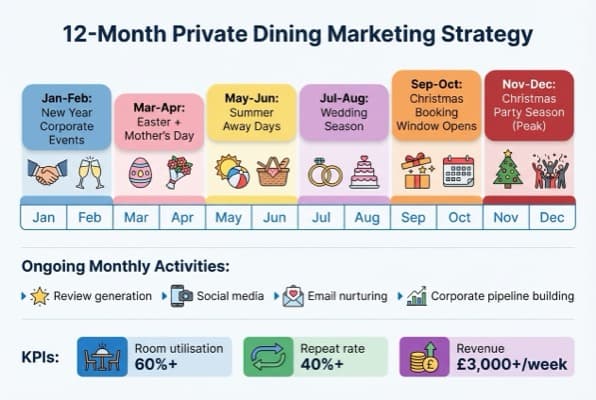
A complete 12-month private dining restaurant marketing strategy timeline
How to read this table
Each quarter builds on the one before it. Q3 prep drives Q4 results. Q4 feedback fuels Q1 outreach.
| Quarter | Focus | Key Actions | Targets |
|---|---|---|---|
| Q1 Jan-Mar | Reactivation | Contact past clients, Valentine's, Mother's Day | Repeat corporate, couples, families |
| Q2 Apr-Jun | Celebrations | Graduations, bank holidays, client entertaining | Celebration organisers, corporate |
| Q3 Jul-Sep | Christmas prep | July: recontact Xmas clients. Sept: new prospects | EAs/PAs, event planners |
| Q4 Oct-Dec | Execute + seed | Chase leads, run events, collect feedback | All segments |
For example, a restaurant running this framework might find that Q2 (previously their weakest quarter) becomes their second strongest. Graduation parties and pre-summer corporate entertaining fill gaps that went unmarketed.
The compound effect
The power of this calendar is not any single campaign. It is the compound effect of never having a dead month.
The Year-Round Flywheel
A complete strategy has no off-season. Every month feeds the next:
- December bookings generate July outreach targets
- Mother's Day clients become birthday party leads
- Corporate Christmas clients become quarterly lunch regulars
Private dining marketing is not about selling food. It is about selling a room that happens to serve food, and the experience, privacy, and convenience that come with it.
Frequently Asked Questions
What is a private dining restaurant marketing strategy?
It is a framework that links seasonal campaigns, corporate outreach, and retention into a year-round plan for filling your private room. Unlike one-off tactics (posting on social media, listing on venue sites), a strategy ties these activities into a 12-month calendar so each action feeds the next.
When should I start marketing for Christmas corporate bookings?
Start in July. Contact previous year's corporate Christmas clients first, offering priority booking and early-bird pricing. Launch your public Christmas campaign in September. By October, premium dates, particularly Thursday and Friday evenings in mid-December, are often fully booked at popular venues (41 Portland Place, 2025). For example, a 20-cover private dining room might have only eight prime December Friday evenings available: if five are booked by returning clients in July, you only need three new bookings to fill the month.
How do I attract more corporate private dining clients?
Focus on the person who actually books: the executive assistant or PA. Send tailored packs (room photos, set menu tiers, AV details, direct contact number) to EAs at law firms, agencies, and finance companies near your venue. Offer free site visit lunches. Build ties on LinkedIn with business content rather than food photos alone. This corporate pipeline is central to any private dining marketing plan.
What is a good room utilisation rate for private dining?
Aim for 60 to 75 percent of available evenings. Below half means your marketing plan needs work. Above 80 means you could raise prices. Track this monthly and check quarterly trends.
How much of my revenue should come from private dining?
Venues that manage their events well see private dining bring in close to a third of total revenue (Tripleseat, 2025). If your room falls well below that, that's usually a sign you need a system, not more one-off tactics. For a venue turning over £500,000 a year, a third means £150,000 from one room.
If you run a restaurant and want to see how Local Brand Hub can support your marketing, explore our restaurant marketing tools.
Key Takeaway
Key Takeaway
Here's what matters most from this guide:
- Strategy beats tactics: A 12-month plan consistently outperforms random promotions, even if the individual tactics are identical
- Seasonal timing matters: Corporate Christmas outreach starts in July, not November: missing this window means missing the highest-value bookings
- Corporate clients are your foundation: One quarterly corporate client is worth more than a dozen one-off celebrations: build EA relationships, not just email lists
- Retention is cheaper than acquisition: A three-email post-event sequence and anniversary reminders significantly lift repeat bookings
- Five KPIs tell the story: Room utilisation, average event spend, repeat rate, conversion rate, and revenue per square metre
This week: List every private dining booking from the past 12 months, identify your top five repeat clients, and plot the next three months on a calendar. That gives you a client list, a reactivation template, and a quarterly plan, the foundation of any private dining restaurant marketing strategy.
For restaurants, salons, and local businesses
Need help with your marketing?
We help UK businesses turn social media into real results, not busywork.
Start freeGet More Marketing Tips
Practical marketing tips for UK business owners, straight to your inbox. No spam, unsubscribe anytime.
About the Author
Local Brand Hub
Empowering UK Businesses
Local Brand Hub provides comprehensive business management tools designed specifically for UK local businesses to streamline operations, automate marketing, and grow revenue.
More articlesRelated Articles
 Marketing Tips
Private Dining Restaurant Marketing Ideas: 9 That Work
Nine private dining marketing ideas for UK restaurants: what to put on your room page, where to list it, and how to answer an enquiry before rivals do.
 Marketing Tips
Restaurant Group Dining Marketing: UK Guide
Proven group dining marketing strategies for UK restaurants. Boost private dining revenue with pricing, corporate outreach, and seasonal campaigns.
 Industry Insights
Private Dining: Set Up, Price, and Market Your Room
Turn your underused back room into steady revenue. A UK guide to private dining setup, pricing models, and marketing for restaurant owners.