Plan profitable restaurant events with this UK checklist. Covers budgets, pricing tiers, promotion timelines, and staffing requirements.
Restaurant event planning is the process of organising special functions at your venue, from private dining and corporate bookings to themed nights and seasonal celebrations, with a structured approach that covers budgeting, logistics, staffing, and promotion to ensure profitability and guest satisfaction.
Your phone rings at 3pm on a quiet Wednesday. A local business wants to book 35 people for a team dinner - set menu, dietary options, private area required. You scramble for a pen. What deposit do you charge? How do you confirm dietary requirements? What's your cancellation policy?
By the time you've figured it out, they've moved on to the venue down the road with the slick PDF and instant quote. According to UKHospitality, events and private dining typically generate 15-25% of revenue for UK restaurants. That's significant income slipping away every time an enquiry goes unanswered.
The difference between restaurants that win events and those that lose them often isn't resources - it's having a repeatable planning process that captures enquiries, converts them confidently, and delivers without stress.
Info
Related: See our restaurant marketing guide for broader marketing strategies beyond events.
What You'll Learn
- The 5 P's and 7 stages of event planning (and how they apply to restaurants)
- A complete restaurant event planning checklist you can use today
- How to budget events so they're actually profitable
- Promotion strategies that fill tables without spending a fortune
- A minimum viable plan if you only have 30 minutes a week
Info
Related: For event inspiration, see our guide to restaurant event ideas with 15 proven concepts that fill tables. Also see our complete hub guide to restaurant events for an overview of event types that work for UK venues.
What Are the 5 P's of Event Planning?
So you understand why events matter. Now let's talk frameworks that make planning systematic rather than stressful.
The 5 P's of event planning is a framework that helps organisers structure their approach: Purpose, People, Place, Plan, and Promotion. For restaurant owners, this framework provides a useful mental checklist before taking on any event.
Purpose defines why you're hosting the event. Is it to fill a quiet Tuesday? Build loyalty with VIP customers? Generate press coverage for a new menu? Your purpose shapes every other decision.
People means understanding your audience. A corporate Christmas party has different needs from a 50th birthday celebration. Knowing who's coming helps you plan menus, staffing, and ambiance.
Place in a restaurant context seems obvious - it's your venue. But consider which areas work for events, what capacity you can handle without disrupting regular service, and whether your space suits the event type.
Plan covers the logistics: timeline, menu, staffing rota, suppliers, and contingencies. Don't wing it with events because that approach rarely works when 35 guests arrive expecting a seamless experience.
Promotion determines whether tables actually fill. Even private events need promotion to the booking contact, while public events like themed nights need broader marketing.
The Most Overlooked P
Based on our experience working with UK restaurant owners, the most overlooked P is Purpose. Restaurants that define clear goals for each event (whether revenue targets, customer retention, or brand awareness) consistently outperform those who "just see how it goes."
Info
Related: See our restaurant social media marketing guide - essential for promoting public events.
For example, a gastropub in Birmingham planning a monthly wine tasting might apply the framework like this: Purpose (attract midweek customers and boost wine sales), People (wine-curious diners aged 35-55), Place (private function room with 25 capacity), Plan (sommelier-led format, tasting menu partnership), Promotion (email list, social media, table cards).
What Are the 7 Stages of Event Planning?
That's the framework. Here's where it becomes practical - the seven stages that take you from enquiry to execution.
The 7 stages of event planning provide a step-by-step roadmap from concept to completion: define goals, organise your team, set a budget, select date and venue, plan event details, market and promote, then execute and manage.

Follow these seven stages from enquiry to execution
For restaurant events, here's how each stage works:
Stage 1: Define Your Goals
What does success look like? Be specific. "A successful corporate dinner" is vague. "30 covers at £45 per head with 20% deposit secured 14 days in advance" gives you targets to work toward.
Stage 2: Organise Your Team
Who handles enquiries? Who plans menus? Who manages on-the-night coordination? Even in a small team, clear ownership prevents things falling through the cracks.
Stage 3: Set Your Budget
Event costs include food, additional staffing, marketing materials, entertainment (if applicable), and setup/breakdown time. Never quote without calculating your full costs first because underpriced events will drain your margins. Build a simple costing template that accounts for these so you can quote accurately.
Stage 4: Select Date and Availability
Avoid double-booking events since it's the fastest way to damage your reputation and stress your kitchen. Check your calendar against staff availability, supplier lead times, and any clashes with local events. A corporate lunch on the same day as a major sporting event might struggle with parking and focus.
Stage 5: Plan All Details
This is where your checklist comes in. Menu sign-off, dietary requirements, table layouts, AV equipment, arrival drinks, payment terms - capture everything.
Stage 6: Market and Promote
For private bookings, promotion means clear confirmation communications. For public events, you need a marketing plan covering social media, email, and possibly local PR.
Stage 7: Execute and Manage
On the day, brief your team, run through timings, and have someone senior available to handle any issues. Don't leave the front-of-house team to figure things out alone because that's when small problems become guest complaints. Post-event, follow up with feedback and thank-you communications.
If you're reading this thinking "I don't have time for seven stages" - you're not alone. The reality for most independent restaurants is that events feel like extra work when you're already down two staff and running a Saturday rush. But these stages don't need to be elaborate. A simple checklist can typically cover most of them in minutes rather than hours.
The Restaurant Event Planning Checklist
You've got the theory. Now here's the practical tool you can actually use - a checklist you can adapt for your venue and use for every event enquiry.
Having documented processes helps ensure consistency and reduces liability. This checklist incorporates those principles for hospitality settings.
6-8 Weeks Before (For Larger Events)
- Confirm event date, time, and estimated guest count
- Agree provisional menu options and pricing
- Send booking contract with terms and deposit requirements
- Collect deposit (typically 25-50% for events over 20 guests)
- Block date in your booking system
- Brief head chef on menu requirements
4 Weeks Before
- Finalise menu and confirm any dietary requirements
- Create staff rota for the event
- Order any special ingredients or supplies
- Confirm entertainment or external suppliers (if applicable)
- Send confirmation to client with full details
- Begin promoting (for public events)
2 Weeks Before
- Collect final payment or confirm payment method
- Confirm final guest numbers
- Create detailed running order for the event
- Brief front-of-house team on service plan
- Confirm table layout and any room setup needs
- Prepare signage or table cards
1 Week Before
- Final staff briefing
- Confirm all supplier deliveries
- Prepare welcome communications (for corporate clients)
- Test any AV equipment
- Review contingency plans
Day Before
- Check all stock is in
- Prep whatever can be prepped ahead
- Set up room if possible
- Final walkthrough of running order
Event Day
- Morning brief with all team members
- Check room setup against plan
- Confirm arrival drink service ready
- Monitor timing throughout
- Address any issues quickly and calmly
- Thank guests and confirm feedback mechanism
Post-Event
- Send thank-you communication within 48 hours
- Request feedback or review
- Process final invoice if applicable
- Debrief team on what worked and what didn't
- Update event notes for future reference
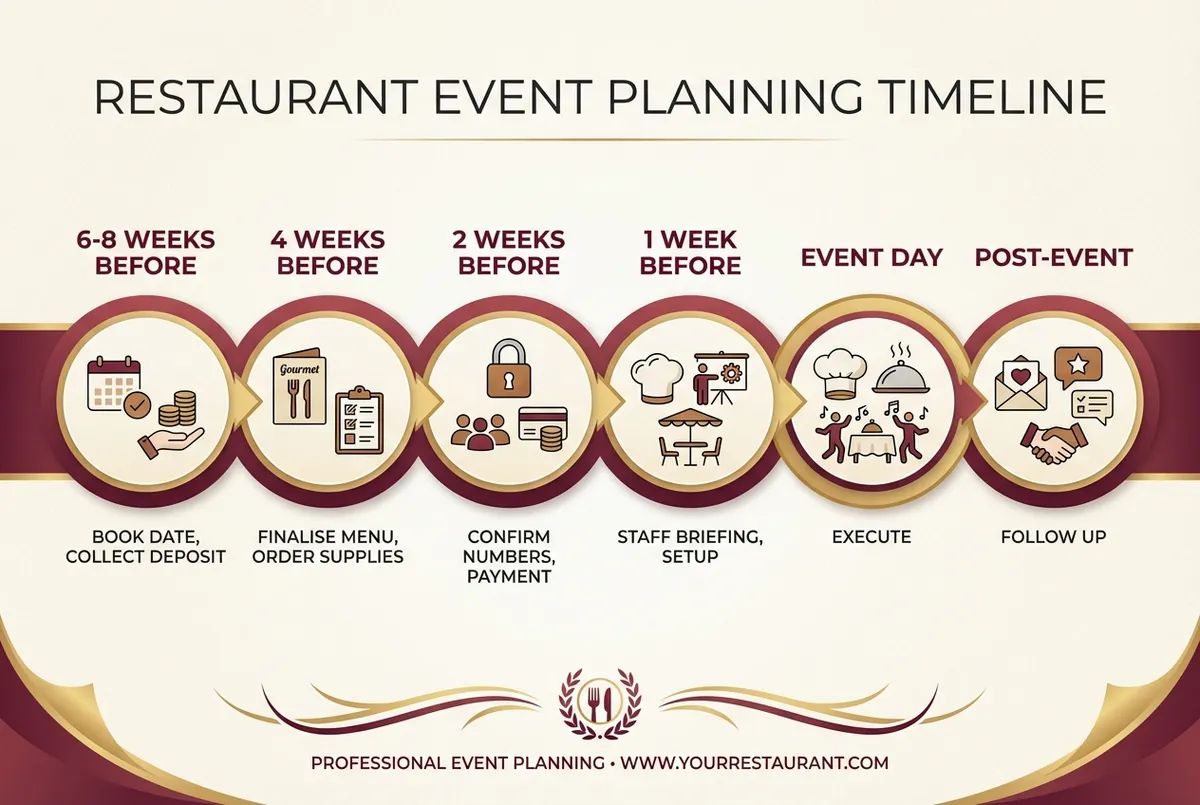
Timeline your tasks from 6 weeks out to post-event follow-up
This restaurant event planning checklist works for events of most sizes. For smaller functions like a table of 10 for a birthday, you might compress the timeline. For large corporate events or weddings, you might extend it.
Why Checklists Matter
The checklist isn't just admin - it's risk management. Every missed detail is a potential complaint. Every confirmed detail is peace of mind.
How to Budget Restaurant Events for Profit
The checklist keeps you organised. But none of it matters if you're losing money on every event. Let's talk numbers.
Events should make money, not just cover costs. Yet many restaurants undercharge because they haven't properly calculated what events actually cost to deliver.
For instance, a bistro in Leeds might price a private dinner at £35 per head thinking that covers food costs comfortably. But when you add the two extra staff hours, the setup time, and the fact that you turned away walk-ins for that table, the real margin shrinks dramatically.
Here's a simple budgeting framework:
Calculate your direct costs:
- Food cost (typically 25-35% of menu price)
- Additional staffing hours required
- Any special supplies or equipment hire
- Entertainment or external supplier fees
Add your indirect costs:
- Opportunity cost of lost regular covers (if closing for a private event)
- Setup and breakdown time
- Administrative time handling the booking
Set your margin:
- Aim for 15-25% profit margin after all costs
- Remember that events often drive higher beverage spend, which has better margins
For a private dining event serving 20 guests a £45 set menu:
- Food revenue: £900
- Wine/drinks estimate: £400 (assuming £20 per head)
- Total revenue: £1,300
- Food cost at 30%: £270
- Additional staff (2 extra for 4 hours at £12/hour): £96
- Total direct costs: £366
- Gross profit: £934
That's a healthy margin. The biggest mistake is underpricing because you don't factor in all costs. Even worse: discounting to win bookings and ending up with events that barely break even.
If you're thinking "I can't tell whether events bring in profit or just revenue" - that's usually a sign the costing needs tightening.
Minimum Spend vs Set Menu
For private dining, you have two pricing approaches:
| Approach | How It Works | Best For | Margin Predictability |
|---|---|---|---|
| Set Menu | Fixed price points (£35/£45/£55 per head) | Most private events | High - you know exactly what you'll make |
| Minimum Spend | Spending threshold (e.g., £800 for exclusive use) with a la carte ordering | Flexible groups, cocktail parties | Lower - depends on what guests order |
If you only pick one approach, go with set menus. They simplify operations, clarify expectations, and make profit margins predictable. Minimum spend works better for cocktail parties or flexible groups, but set menus should be your default.
Info
Related: For detailed marketing budgets, see our guide on restaurant marketing on a budget.
Promoting Restaurant Events That Actually Fill Tables
You've priced the event profitably. Now you need to actually fill those tables.
Event promotion splits into two categories: private bookings (where you're marketing to the person who made the enquiry) and public events (where you need to attract guests directly).
For Private Bookings
- Send a professional confirmation email with all details and a contact number for questions
- Provide a PDF or branded document with menu options they can share with guests
- Follow up one week before to confirm final numbers
- Make it easy for them to look good to their guests
For Public Events
Promotion should start 3-4 weeks before the event date. According to hospitality research, social media plays a significant role in restaurant discovery, making platforms like Instagram and Facebook essential for event promotion, which is far easier when you line up posts in advance with our social media calendar.
This Week: Start Promoting Your Next Event
- Day 1-2: Create event listing with clear details (date, time, price, what's included)
- Day 3-4: Post announcement on Instagram and Facebook with compelling imagery
- Day 5-7: Email your customer list with booking link and early-bird incentive
That's your minimum viable promotion plan if you only have 30 minutes a week.
For larger events, add:
- Local press release to food bloggers and journalists
- Table cards in your restaurant promoting the date
- Partner with local businesses who might share with their audience
- Paid social media promotion (even £20-30 can extend your reach significantly)
Info
Related: For broader marketing strategies, see our guide to restaurant marketing which covers social media, email, and local promotion.
What Are the 5 C's of Event Planning?
Now that you understand promotion, there's one more framework worth knowing - especially useful for the execution phase.
The 5 C's of event planning is another framework used by event professionals: Concept, Coordination, Control, Culmination, and Closeout. While similar to the 5 P's, this framework focuses more on execution stages.
Concept is your creative vision - the theme, format, and guest experience you want to create.
Coordination brings all elements together - vendors, timeline, logistics, and team assignments.
Control means maintaining oversight during the event - managing flow, solving problems, and keeping everything on track.
Culmination is the delivery - when your planning comes to life and guests experience what you've created.
Closeout covers post-event activities - payments, feedback, documentation, and lessons learned.
For a restaurant planning a monthly supper club, this might look like: Concept (intimate 20-seat chef's table with storytelling), Coordination (sommelier partnership, special ingredient sourcing), Control (senior manager dedicated to the evening), Culmination (seamless service with personal touches), Closeout (feedback survey, social sharing prompts, next event teaser).
Common Restaurant Event Planning Mistakes
Frameworks and checklists help - but they don't stop you making the mistakes that cost restaurants money. Here's what to avoid.
If you're only running events when it's quiet in the restaurant you'll always lose to competitors who treat them as part of operations not an afterthought.
Pricing and Payment Mistakes
- Underpricing to win bookings. A £30 per head event that loses money is worse than no event at all. For example, a restaurant in Sheffield offered a Christmas party package at £25 per head to beat local competition - but once they factored in the extra staff hours and drinks included, they made less than a quiet Tuesday.
- No deposit policy. Don't accept large bookings without securing a deposit first or you'll end up with last-minute cancellations and empty tables. Require 25-50% deposit on bookings over 15 guests, refundable up to 14 days before.
Operational Mistakes
- Vague dietary handling. "A few vegetarians" isn't good enough - that never works when someone with a severe allergy arrives. Get specific requirements in writing, ideally a week before.
- Overpromising and underdelivering. Don't agree to requests you can't confidently execute. It's better to recommend an alternative than to disappoint.
Relationship Mistakes
- Poor follow-up. Don't just let the event end and never contact them again - that's how you lose repeat business. Send a thank-you, ask for feedback, invite them back. (See our guide on restaurant customer retention for follow-up strategies.)
- Treating events as interruptions. If you view every event enquiry as extra hassle rather than revenue opportunity, your team will mirror that attitude - and guests will notice.
Would you book a celebration at a venue where the staff seemed annoyed to have you?
Building Your Restaurant Event Planning System
For most independent restaurants, you don't need expensive software. You need:
- An enquiry form - capture event type, date, guest count, budget, and dietary needs upfront
- A pricing document - clear set menu options and minimum spends for different group sizes
- A checklist - like the one above, adapted to your venue
- A contract template - covering terms, deposits, cancellation, and final payment
- A follow-up sequence - confirmation, week-before reminder, thank-you, feedback request
Start simple. Refine as you learn what works for your venue. Good restaurant event planning is about consistency, not complexity.
Info
Related: For managing corporate events specifically, our dedicated guide covers pricing, invoicing, and building business relationships.
Weekly Action
This Week: Build Your Foundation
- Day 1-2: Create your event enquiry form (type, date, guest count, budget, dietary needs)
- Day 3-4: Draft your set menu pricing for 2-3 tiers (e.g., £35, £45, £55 per head)
- Day 5-7: Adapt the checklist above to your venue and save it somewhere accessible
That's your minimum viable restaurant event planning system. It beats scrambling every time the phone rings.
Key Takeaways
If you run a restaurant and want to see how Local Brand Hub can support your marketing, explore our restaurant marketing tools.
Key Takeaways
Restaurant event planning transforms ad-hoc enquiries into profitable, repeatable bookings. The key points to remember:
- Use the 5 P's framework (Purpose, People, Place, Plan, Promotion) to structure your approach
- Follow the 7 stages from goal-setting through to post-event follow-up
- Build a checklist adapted to your venue and use it for every event
- Price events to include all costs - not just food - and aim for 15-25% profit margin
- Promote systematically, starting 3-4 weeks before public events
- Avoid common mistakes around pricing, deposits, and follow-up
The difference between restaurants that win events and those that don't often comes down to having systems in place before the enquiry arrives.
Info
Explore our detailed guides:
- Restaurant Events - Complete UK planning guide
- Restaurant Private Dining - Set menus, pricing, and booking systems
- Restaurant Corporate Events - Business booking strategies
- Restaurant Event Ideas - Creative concepts for every venue type
For UK restaurants
Ready to Streamline Your Event Planning?
Local Brand Hub helps independent restaurants manage events, marketing, and customer communications in one simple system.
Start freeGet More Marketing Tips
Practical marketing tips for UK business owners, straight to your inbox. No spam, unsubscribe anytime.
About the Author
Local Brand Hub
Empowering UK Businesses
Local Brand Hub provides comprehensive business management tools designed specifically for UK local businesses to streamline operations, automate marketing, and grow revenue.
More articlesRelated Articles
 Operations
Restaurant Events: Complete UK Planning Guide
Plan restaurant events that fill tables and build loyalty. From private dining to themed nights, with budgets, timelines, and promotion tactics.
 Operations
Restaurant Corporate Events: The UK Venue Guide 2026
Guide to hosting profitable restaurant corporate events in the UK. Pricing, packages, marketing, and planning tips for venue success.
 Operations
Restaurant Live Music: A Practical Guide for UK Owners
Add live music to your UK restaurant with this practical guide. Covers PRS licensing, musician fees from £200, and booking strategies that work.